We read your photo as:

Differentiate the following functions using the first principle: iii) y = 4x2 + 2x + 1 iv) y = sin x

Mathematics

ScanSolve AI Answer

Answers

3 parts
iii

f′(x)=8x+2f'(x) = 8x + 2

iv

f′(x)=cos⁡xf'(x) = \cos x

v

f′(x)=−sin⁡xf'(x) = -\sin x

Step-by-step solution

16 steps

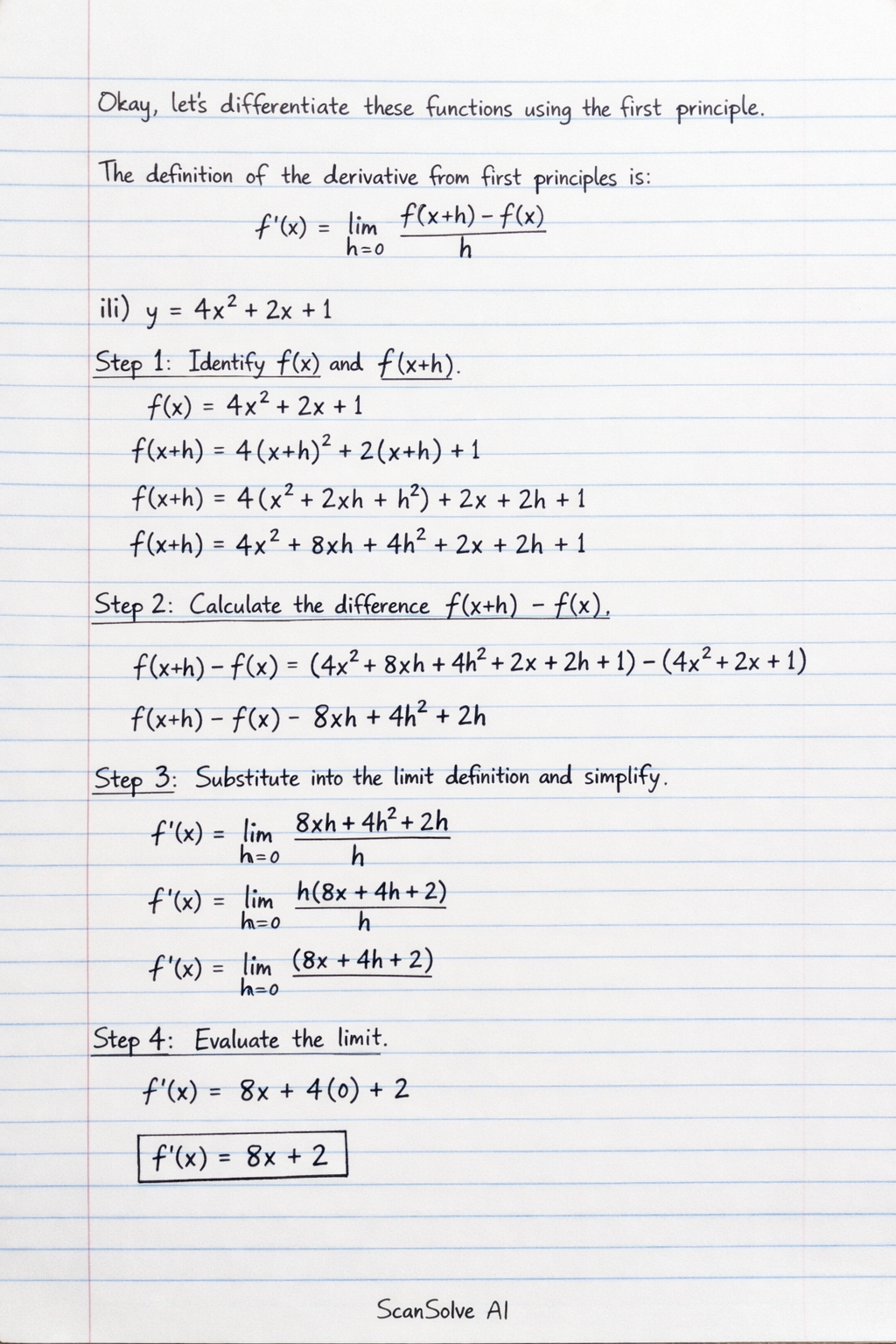
Okay, let's differentiate these functions using the first principle.

The definition of the derivative from first principles is:

f′(x)=lim⁡h→0f(x+h)−f(x)hf'(x) = \lim_{h \to 0} \frac{f(x+h) - f(x)}{h}

Part iii· 4 steps

y=4x2+2x+1y = 4x^2 + 2x + 1

  1. Identify f(x)f(x) and f(x+h)f(x+h).

    f(x)=4x2+2x+1f(x) = 4x^2 + 2x + 1 f(x+h)=4(x+h)2+2(x+h)+1f(x+h) = 4(x+h)^2 + 2(x+h) + 1 f(x+h)=4(x2+2xh+h2)+2x+2h+1f(x+h) = 4(x^2 + 2xh + h^2) + 2x + 2h + 1 f(x+h)=4x2+8xh+4h2+2x+2h+1f(x+h) = 4x^2 + 8xh + 4h^2 + 2x + 2h + 1
  2. Calculate the difference f(x+h)−f(x)f(x+h) - f(x).

    f(x+h)−f(x)=(4x2+8xh+4h2+2x+2h+1)−(4x2+2x+1)f(x+h) - f(x) = (4x^2 + 8xh + 4h^2 + 2x + 2h + 1) - (4x^2 + 2x + 1) f(x+h)−f(x)=8xh+4h2+2hf(x+h) - f(x) = 8xh + 4h^2 + 2h
  3. Substitute into the limit definition and simplify.

    f′(x)=lim⁡h→08xh+4h2+2hhf'(x) = \lim_{h \to 0} \frac{8xh + 4h^2 + 2h}{h} f′(x)=lim⁡h→0h(8x+4h+2)hf'(x) = \lim_{h \to 0} \frac{h(8x + 4h + 2)}{h} f′(x)=lim⁡h→0(8x+4h+2)f'(x) = \lim_{h \to 0} (8x + 4h + 2)
  4. Evaluate the limit.

    f′(x)=8x+4(0)+2f'(x) = 8x + 4(0) + 2 f′(x)=8x+2\boxed{f'(x) = 8x + 2}

Part iv

f′(x)=cos⁡xf'(x) = \cos x

y=sin⁡xy = \sin x

  1. Identify f(x)f(x) and f(x+h)f(x+h).

    f(x)=sin⁡xf(x) = \sin x f(x+h)=sin⁡(x+h)f(x+h) = \sin(x+h)
  2. Calculate the difference f(x+h)−f(x)f(x+h) - f(x).

    f(x+h)−f(x)=sin⁡(x+h)−sin⁡xf(x+h) - f(x) = \sin(x+h) - \sin x

    Using the sum-to-product identity sin⁡A−sin⁡B=2cos⁡(A+B2)sin⁡(A−B2)\sin A - \sin B = 2 \cos\left(\frac{A+B}{2}\right) \sin\left(\frac{A-B}{2}\right):

    f(x+h)−f(x)=2cos⁡(x+h+x2)sin⁡(x+h−x2)f(x+h) - f(x) = 2 \cos\left(\frac{x+h+x}{2}\right) \sin\left(\frac{x+h-x}{2}\right) f(x+h)−f(x)=2cos⁡(x+h2)sin⁡(h2)f(x+h) - f(x) = 2 \cos\left(x + \frac{h}{2}\right) \sin\left(\frac{h}{2}\right)
  3. Substitute into the limit definition and simplify.

    f′(x)=lim⁡h→02cos⁡(x+h2)sin⁡(h2)hf'(x) = \lim_{h \to 0} \frac{2 \cos\left(x + \frac{h}{2}\right) \sin\left(\frac{h}{2}\right)}{h} f′(x)=lim⁡h→0[cos⁡(x+h2)⋅sin⁡(h2)h2]f'(x) = \lim_{h \to 0} \left[ \cos\left(x + \frac{h}{2}\right) \cdot \frac{\sin\left(\frac{h}{2}\right)}{\frac{h}{2}} \right]
  4. Evaluate the limit using lim⁡θ→0sin⁡θθ=1\lim_{\theta \to 0} \frac{\sin \theta}{\theta} = 1.

    f′(x)=cos⁡(x+0)⋅1f'(x) = \cos(x+0) \cdot 1 f′(x)=cos⁡x\boxed{f'(x) = \cos x}

Part v

f′(x)=−sin⁡xf'(x) = -\sin x

y=cos⁡xy = \cos x

  1. Identify f(x)f(x) and f(x+h)f(x+h).

    f(x)=cos⁡xf(x) = \cos x f(x+h)=cos⁡(x+h)f(x+h) = \cos(x+h)
  2. Calculate the difference f(x+h)−f(x)f(x+h) - f(x).

    f(x+h)−f(x)=cos⁡(x+h)−cos⁡xf(x+h) - f(x) = \cos(x+h) - \cos x

    Using the sum-to-product identity cos⁡A−cos⁡B=−2sin⁡(A+B2)sin⁡(A−B2)\cos A - \cos B = -2 \sin\left(\frac{A+B}{2}\right) \sin\left(\frac{A-B}{2}\right):

    f(x+h)−f(x)=−2sin⁡(x+h+x2)sin⁡(x+h−x2)f(x+h) - f(x) = -2 \sin\left(\frac{x+h+x}{2}\right) \sin\left(\frac{x+h-x}{2}\right) f(x+h)−f(x)=−2sin⁡(x+h2)sin⁡(h2)f(x+h) - f(x) = -2 \sin\left(x + \frac{h}{2}\right) \sin\left(\frac{h}{2}\right)
  3. Substitute into the limit definition and simplify.

    f′(x)=lim⁡h→0−2sin⁡(x+h2)sin⁡(h2)hf'(x) = \lim_{h \to 0} \frac{-2 \sin\left(x + \frac{h}{2}\right) \sin\left(\frac{h}{2}\right)}{h} f′(x)=lim⁡h→0[−sin⁡(x+h2)⋅sin⁡(h2)h2]f'(x) = \lim_{h \to 0} \left[ -\sin\left(x + \frac{h}{2}\right) \cdot \frac{\sin\left(\frac{h}{2}\right)}{\frac{h}{2}} \right]
  4. Evaluate the limit using lim⁡θ→0sin⁡θθ=1\lim_{\theta \to 0} \frac{\sin \theta}{\theta} = 1.

    f′(x)=−sin⁡(x+0)⋅1f'(x) = -\sin(x+0) \cdot 1 f′(x)=−sin⁡x\boxed{f'(x) = -\sin x}

Part vi· 4 steps

y=tan⁡xy = \tan x

  1. Identify f(x)f(x) and f(x+h)f(x+h).

    f(x)=tan⁡x=sin⁡xcos⁡xf(x) = \tan x = \frac{\sin x}{\cos x} f(x+h)=tan⁡(x+h)=sin⁡(x+h)cos⁡(x+h)f(x+h) = \tan(x+h) = \frac{\sin(x+h)}{\cos(x+h)}
  2. Calculate the difference f(x+h)−f(x)f(x+h) - f(x).

    f(x+h)−f(x)=sin⁡(x+h)cos⁡(x+h)−sin⁡xcos⁡xf(x+h) - f(x) = \frac{\sin(x+h)}{\cos(x+h)} - \frac{\sin x}{\cos x} f(x+h)−f(x)=sin⁡(x+h)cos⁡x−cos⁡(x+h)sin⁡xcos⁡(x+h)cos⁡xf(x+h) - f(x) = \frac{\sin(x+h)\cos x - \cos(x+h)\sin x}{\cos(x+h)\cos x}

    Using the angle subtraction formula sin⁡(A−B)=sin⁡Acos⁡B−cos⁡Asin⁡B\sin(A-B) = \sin A \cos B - \cos A \sin B:

    f(x+h)−f(x)=sin⁡((x+h)−x)cos⁡(x+h)cos⁡x=sin⁡hcos⁡(x+h)cos⁡xf(x+h) - f(x) = \frac{\sin((x+h)-x)}{\cos(x+h)\cos x} = \frac{\sin h}{\cos(x+h)\cos x}
  3. Substitute into the limit definition and simplify.

    f′(x)=lim⁡h→0sin⁡hcos⁡(x+h)cos⁡xhf'(x) = \lim_{h \to 0} \frac{\frac{\sin h}{\cos(x+h)\cos x}}{h} f′(x)=lim⁡h→0[sin⁡hh⋅1cos⁡(x+h)cos⁡x]f'(x) = \lim_{h \to 0} \left[ \frac{\sin h}{h} \cdot \frac{1}{\cos(x+h)\cos x} \right]
  4. Evaluate the limit using lim⁡θ→0sin⁡θθ=1\lim_{\theta \to 0} \frac{\sin \theta}{\theta} = 1.

    f′(x)=1⋅1cos⁡(x+0)cos⁡xf'(x) = 1 \cdot \frac{1}{\cos(x+0)\cos x} f′(x)=1cos⁡xcos⁡x=1cos⁡2xf'(x) = \frac{1}{\cos x \cos x} = \frac{1}{\cos^2 x}
Was this helpful?

Try one yourself

A new problem that tests the same skill.

Still stuck on this one?

Ask a follow-up, and the answer starts from this question.

Got a different question?Ask your own question
Handwritten step-by-step solution preview

Handwritten Step-by-Step Solution

Get this as a handwritten image on WhatsApp — like a tutor wrote it for you.

Try on WhatsApp