
We read your photo as:
Differentiate y = 2 x ( x) using the product rule and chain rule. Simplify your answer.
Mathematics
ScanSolve AI Answer
Use the left and right arrow keys to trace the curve, up and down to jump between key points, and plus and minus to zoom.
| Point | x | y |
|---|---|---|
| Minimum | 0 | 0 |
Step-by-step solution
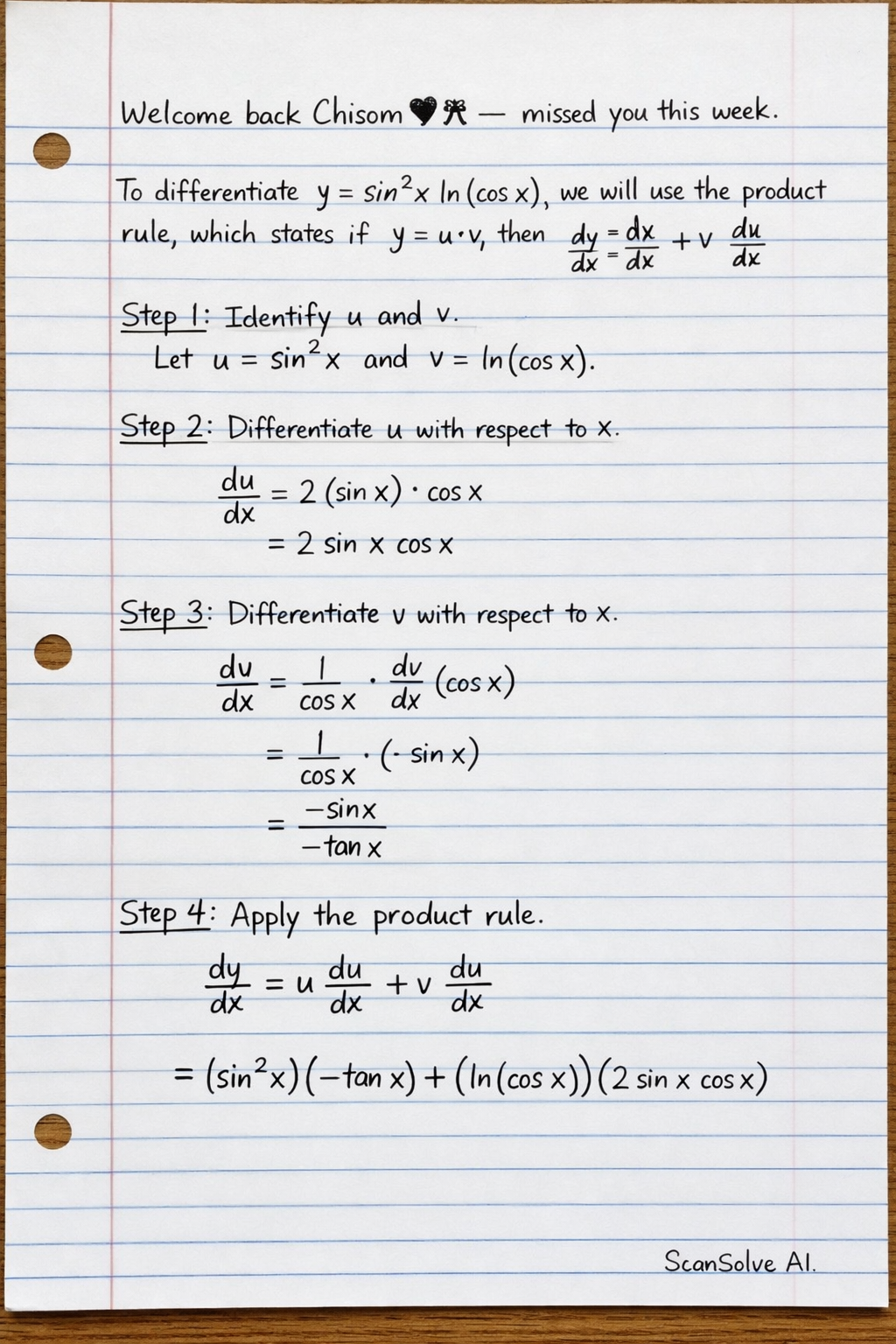
5 stepsTo differentiate , we will use the product rule, which states that if , then .
Identify and .
Let and .
Differentiate with respect to .
Using the chain rule for :
Differentiate with respect to .
Using the chain rule for :
Apply the product rule.
Substitute , , , and into the product rule formula:
Simplify the expression.
We can factor out :
The final answer is .
Was this helpful?
Still stuck on this one?
Ask a follow-up, and the answer starts from this question.
Got a different question?Ask your own question
More Mathematics Questions
QDifferentiate y = (x2+3x−1)(2x−5) using the product rule.QDifferentiate the following functions using the product rule and chain rule: y = x2 x, y = e^x 3x, y…QFind the derivative of y = (x2+3x−1)(2x−5) using the product rule.QDifferentiate y = (1)/(1+2 x) with respect to x.QGiven y = (x2+3x−1)(2x−5), we can use the product rule for differentiation.
Handwritten Step-by-Step Solution
Get this as a handwritten image on WhatsApp — like a tutor wrote it for you.
Try on WhatsApp