
We read your photo as:
Determine the dimensions of the first rectangle.
ScanSolve AI Answer
Answer
Step-by-step solution
3 stepsDetermine the dimensions of the first rectangle.
The top-left corner of the first rectangle is .
The top-right corner of the first rectangle is .
The width of the rectangle is the difference in x-coordinates:The point is given, which is the bottom-right corner of the first rectangle.
The height of the rectangle is the difference in y-coordinates:Determine the coordinates of point A.
Point A is the bottom-right corner of the first rectangle. From the given information, this point is .
Determine the coordinates of point B.
The problem states that the two rectangles are identical. This means the second rectangle also has a width of 7 units and a height of 6 units.
Point A is the top-left corner of the second rectangle.
To find the coordinates of point B, which is the bottom-right corner of the second rectangle:
The x-coordinate of B will be the x-coordinate of A plus the width:The y-coordinate of B will be the y-coordinate of A minus the height (since the rectangle extends downwards from A):
So, the coordinates of point B are .
The coordinates are:
A is
B isFor the second part of the question:
n stands for a whole number.
n is greater than 30, which means .
n is less than 100, which means .
Combining these conditions, we have .
Since n is a whole number (non-negative integer), the possible values for n are integers strictly between 30 and 100.
The numbers that n stands for are .
Try one yourself
A new problem that tests the same skill.
Still stuck on this one?
Ask a follow-up, and the answer starts from this question.
More Mathematics Questions
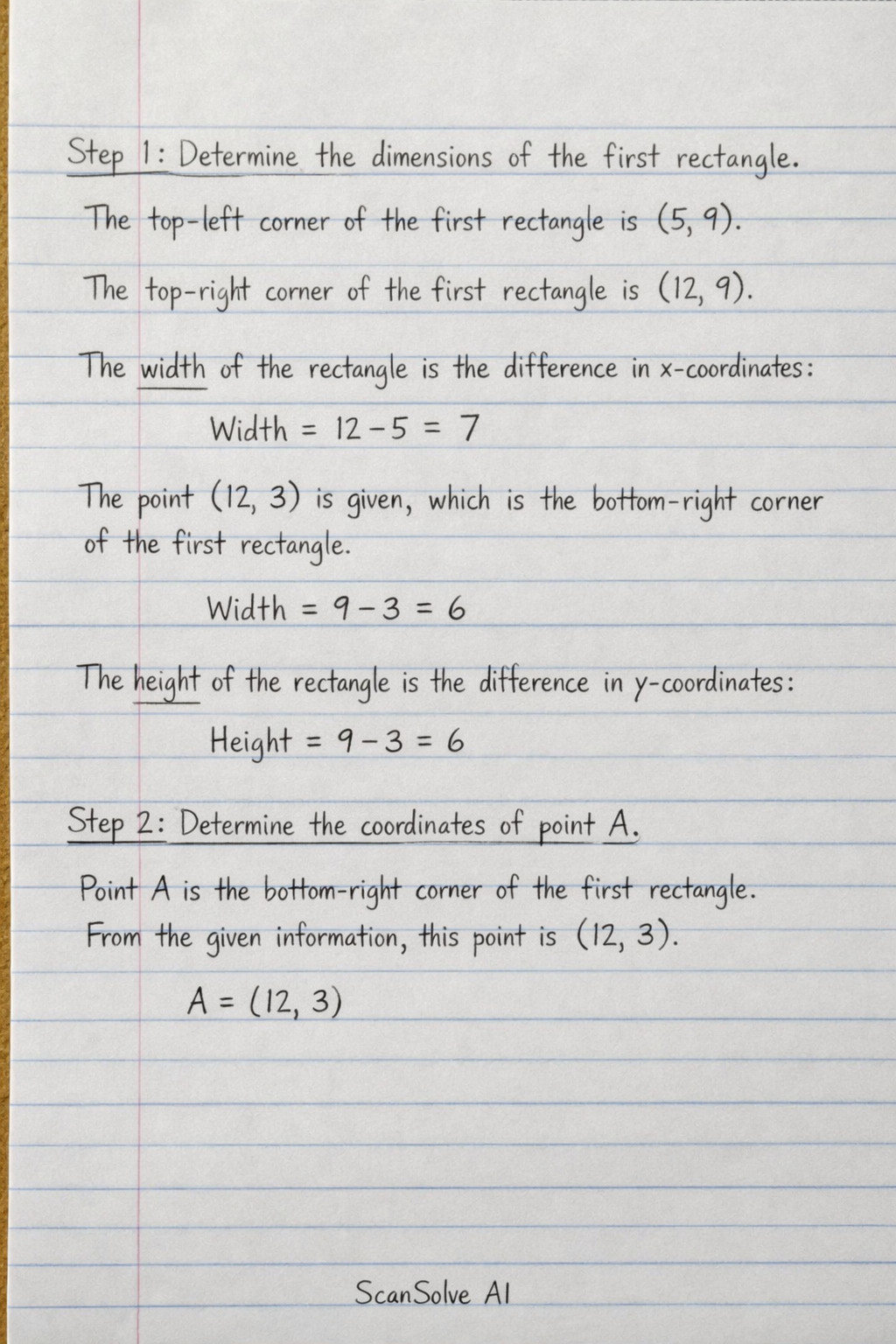
Handwritten Step-by-Step Solution
Get this as a handwritten image on WhatsApp — like a tutor wrote it for you.
Try on WhatsApp