
We read your photo as:
Find the directional derivative of f(x,y) = 2x2 + y2 at P0(-1, 1) in the direction of u = 3i − 4j.
Mathematics
ScanSolve AI Answer
Answer
-4
Step-by-step solution
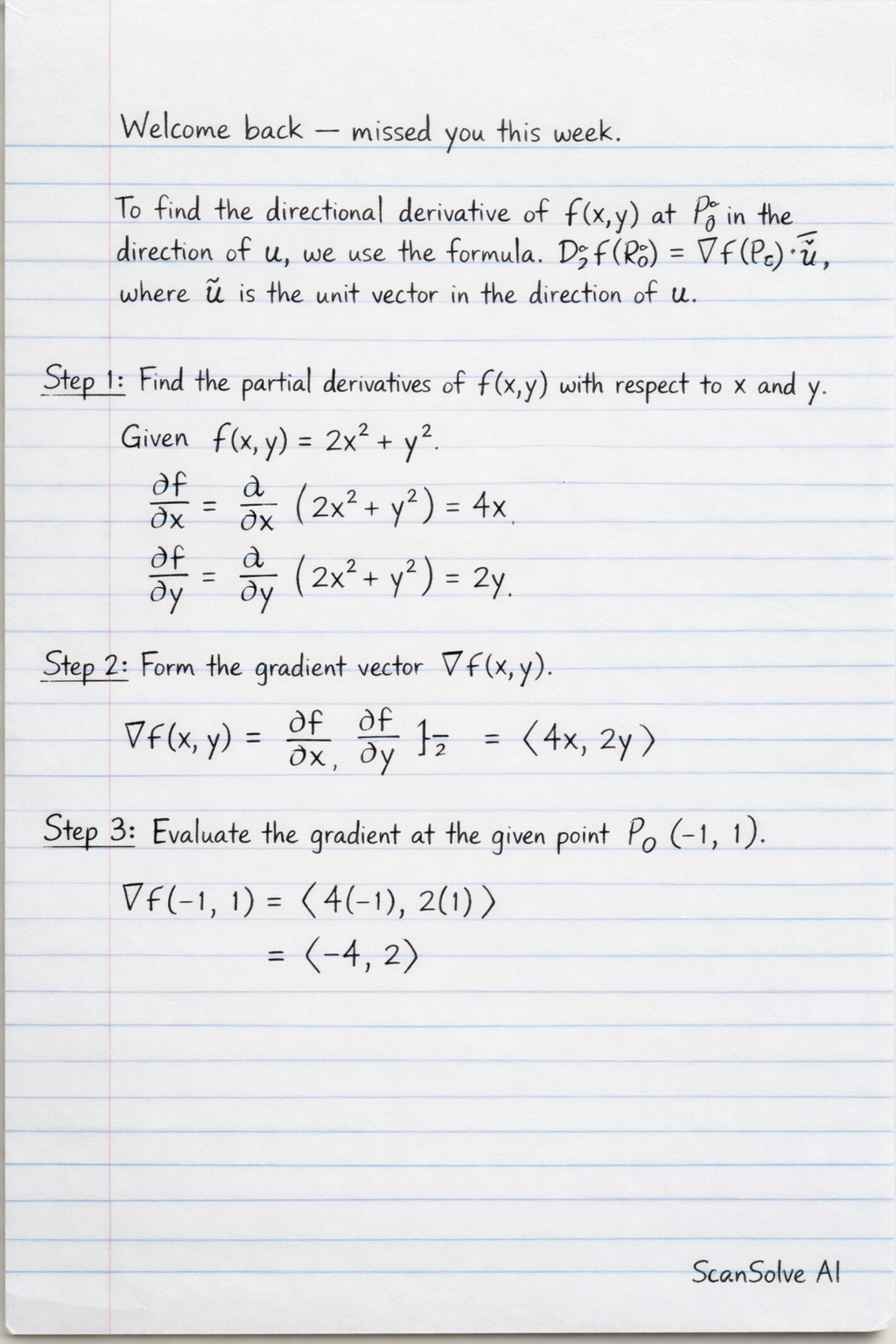
5 stepsTo find the directional derivative of at in the direction of , we use the formula , where is the unit vector in the direction of .
Find the partial derivatives of with respect to and .
Given .
Form the gradient vector .
Evaluate the gradient at the given point .
Find the unit vector in the direction of .
First, find the magnitude of :
Now, find the unit vector:
Calculate the directional derivative by taking the dot product of and .
The directional derivative is .
Was this helpful?
Try one yourself
A new problem that tests the same skill.
Still stuck on this one?
Ask a follow-up, and the answer starts from this question.
Got a different question?Ask your own question
More Mathematics Questions
QQn.1: Find the directional derivative of (x, y, z) = 4xz³ - 3x²y² at a point P (2, −1, 2) in the…QFind the directional derivative of h(x,y,z) = cos(xy) + e^(yz) + ln(zx) at P0(1, 0, 1/2) in the…QFind the partial derivative of f(x,y) with respect to y.QFind the derivative of y = 2x2 - x + 3 from first principles.QFind the derivative of x with respect to y for the equation x = (3/4)cot(2y - pi/2).
Browse by topic:Calculus
Handwritten Step-by-Step Solution
Get this as a handwritten image on WhatsApp — like a tutor wrote it for you.
Try on WhatsApp