
We read your photo as:
Divide every term in the numerator and the denominator by the highest power of K, which is K².
Mathematics
ScanSolve AI Answer
Answer
Step-by-step solution
4 stepsDivide every term in the numerator and the denominator by the highest power of , which is .
Simplify the terms.
Apply the limit.
As , terms of the form (where ) approach 0.
Calculate the final value.
Was this helpful?
Try one yourself
A new problem that tests the same skill.
Still stuck on this one?
Ask a follow-up, and the answer starts from this question.
Got a different question?Ask your own question
More Mathematics Questions
QDivide each term in the numerator by the denominator.QDivide the numerator by the denominator.QRewrite the integrand by dividing each term in the numerator by the denominator.QMultiply the numerator and the denominator by the conjugate of the denominator.QFactor out the common term from the numerator.
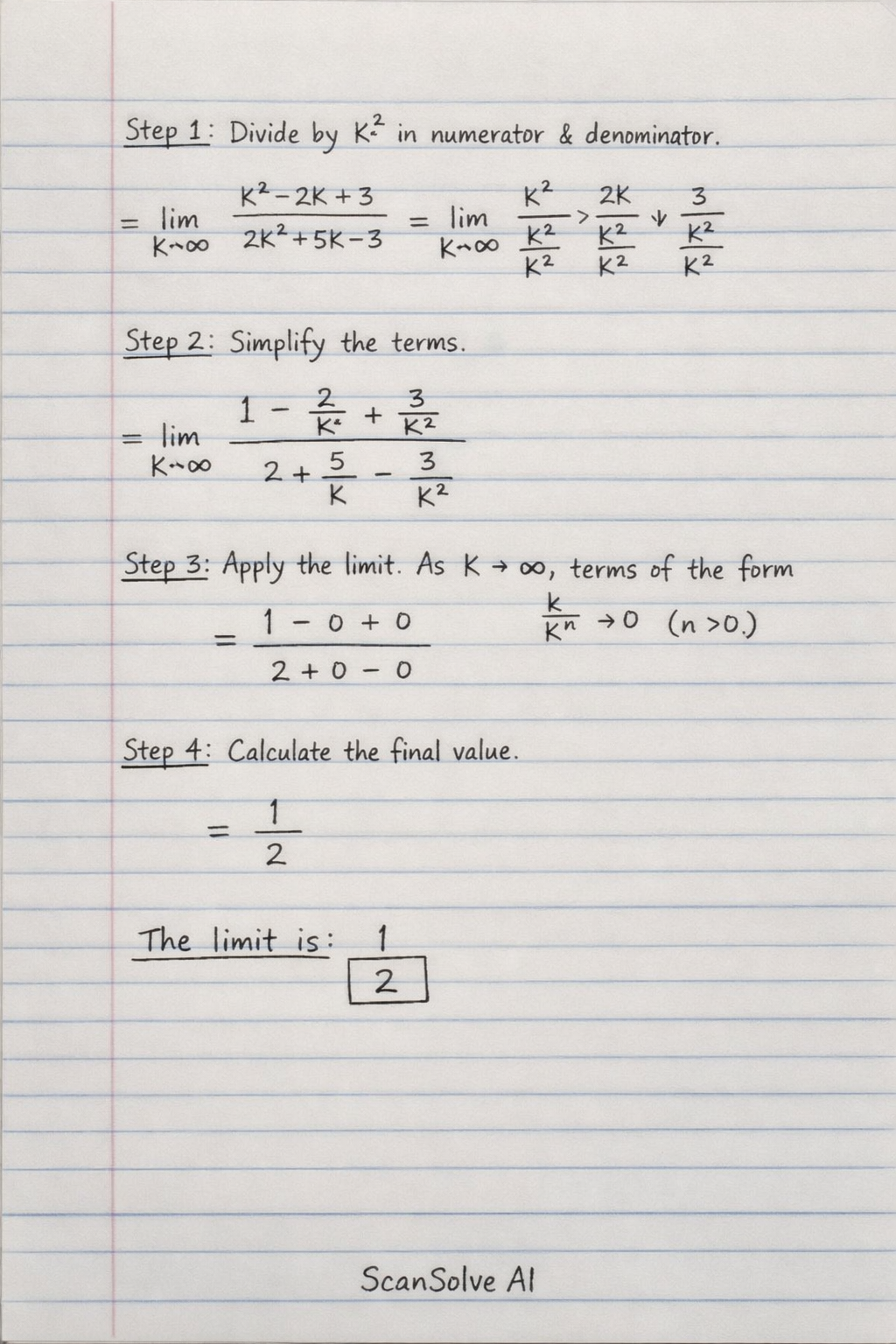
Handwritten Step-by-Step Solution
Get this as a handwritten image on WhatsApp — like a tutor wrote it for you.
Try on WhatsApp