This mathematics problem involves applying core mathematical principles and formulas. Below you will find a complete step-by-step solution with detailed explanations for each step, helping you understand not just the answer but the method behind it.
ScanSolve AI Answer
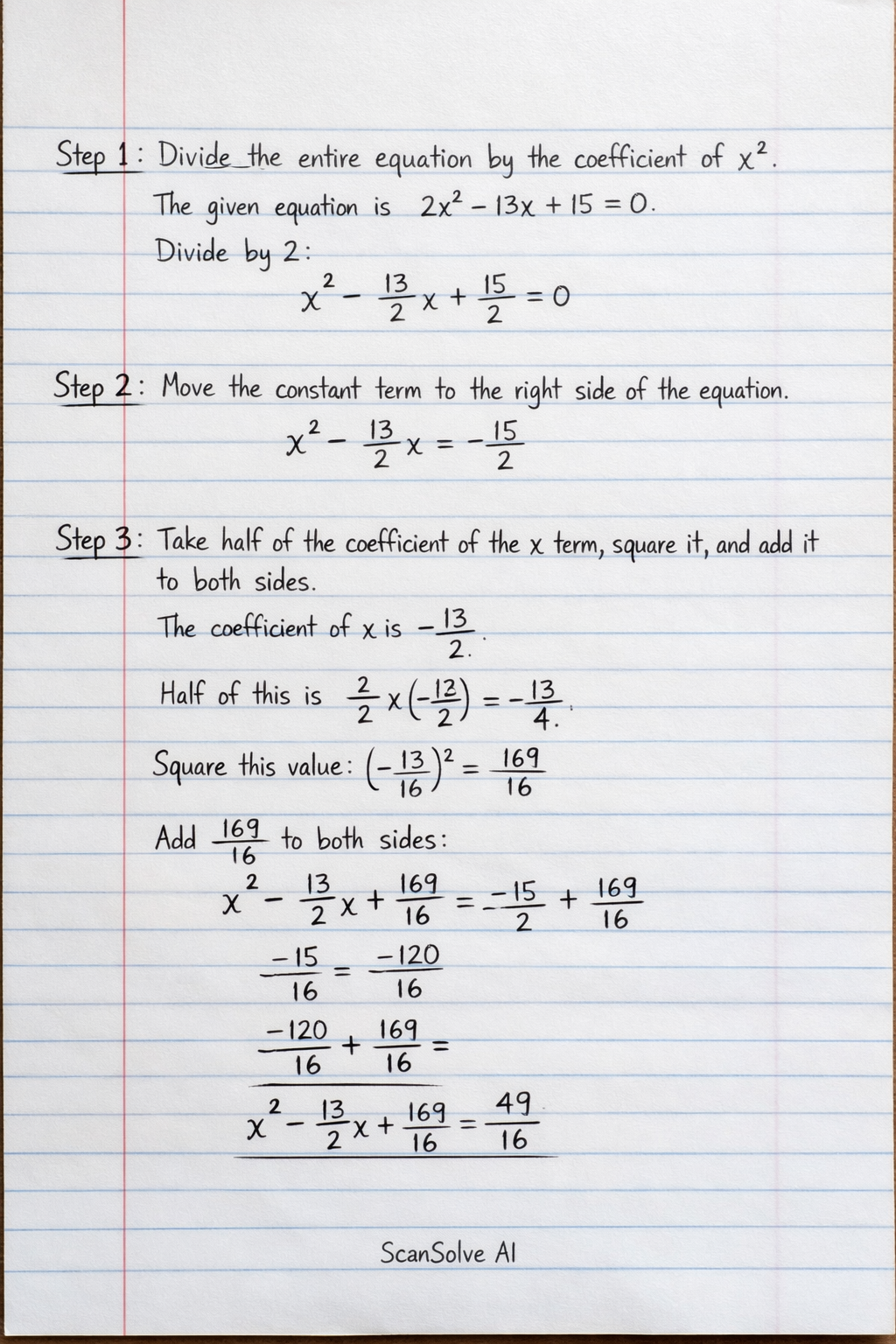
Step 1: Divide the entire equation by the coefficient of $x^2$.
The given equation is $2x^2 - 13x + 15 = 0$.
Divide by 2:
$$x^2 - \frac{13}{2}x + \frac{15}{2} = 0$$
Step 2: Move the constant term to the right side of the equation.
$$x^2 - \frac{13}{2}x = -\frac{15}{2}$$
Step 3: Take half of the coefficient of the $x$ term, square it, and add it to both sides of the equation.
The coefficient of $x$ is $-\frac{13}{2}$.
Half of this is $\frac{1}{2} \times \left(-\frac{13}{2}\right) = -\frac{13}{4}$.
Square this value: $\left(-\frac{13}{4}\right)^2 = \frac{169}{16}$.
Add $\frac{169}{16}$ to both sides:
$$x^2 - \frac{13}{2}x + \frac{169}{16} = -\frac{15}{2} + \frac{169}{16}$$
Step 4: Factor the left side as a perfect square trinomial and simplify the right side.
The left side factors as $\left(x - \frac{13}{4}\right)^2$.
For the right side, find a common denominator:
$$-\frac{15}{2} + \frac{169}{16} = -\frac{15 \times 8}{2 \times 8} + \frac{169}{16} = -\frac{120}{16} + \frac{169}{16} = \frac{169 - 120}{16} = \frac{49}{16}$$
So the equation becomes:
$$\left(x - \frac{13}{4}\right)^2 = \frac{49}{16}$$
Step 5: Take the square root of both sides.
$$x - \frac{13}{4} = \pm\sqrt{\frac{49}{16}}$$
$$x - \frac{13}{4} = \pm\frac{7}{4}$$
Step 6: Solve for $x$.
$$x = \frac{13}{4} \pm \frac{7}{4}$$
This gives two possible solutions:
$$x_1 = \frac{13}{4} + \frac{7}{4} = \frac{20}{4} = 5$$
$$x_2 = \frac{13}{4} - \frac{7}{4} = \frac{6}{4} = \frac{3}{2}$$
The solutions are $\boxed{x=5 \text{ or } x=\frac{3}{2}}$.
Send me the next one πΈ
Divide the entire equation by the coefficient of x^2.
|Mathematics
Divide the entire equation by the coefficient of x^2.
ScanSolve AI Answer
Step 1: Divide the entire equation by the coefficient of x2.
The given equation is 2x2β13x+15=0.
Divide by 2:
x2β213βx+215β=0
Step 2: Move the constant term to the right side of the equation.
x2β213βx=β215β
Step 3: Take half of the coefficient of the x term, square it, and add it to both sides of the equation.
The coefficient of x is β213β.
Half of this is 21βΓ(β213β)=β413β.
Square this value: (β413β)2=16169β.
Add 16169β to both sides:
x2β213βx+16169β=β215β+16169β
Step 4: Factor the left side as a perfect square trinomial and simplify the right side.
The left side factors as (xβ413β)2.
For the right side, find a common denominator:
β215β+16169β=β2Γ815Γ8β+16169β=β16120β+16169β=16169β120β=1649β
So the equation becomes:
(xβ413β)2=1649β
Step 5: Take the square root of both sides.
xβ413β=Β±1649ββxβ413β=Β±47β
Step 6: Solve for x.
x=413βΒ±47β
This gives two possible solutions:
x1β=413β+47β=420β=5x2β=413ββ47β=46β=23β
The solutions are x=5orx=23ββ.
Send me the next one πΈ
Need help with your own homework?
Get instant step-by-step solutions to any question. Free to start.