
We read your photo as:
Determine the domain for the first term, g(x) = ^-1((2-|x|)/(4)).
ScanSolve AI Answer
Step-by-step solution
5 stepsDetermine the domain for the first term, .
For to be defined, the argument must satisfy .
So, we must have:Multiply all parts by 4:
Subtract 2 from all parts:
Multiply all parts by -1 and reverse the inequality signs:
Since is always non-negative, the condition is always true. Thus, we only need to consider .
This implies .
So, the domain for the first term is .Determine the domain for the second term, .
For this term to be defined, two conditions must be met:
- The argument of the logarithm must be positive:
- The denominator cannot be zero, meaning . This implies .
So, the domain for the second term is .
Find the overall domain of .
The domain of is the intersection of and :
The intersection of and is .
Then, we must exclude from this interval.
So, the domain is , which can be written as .Compare the derived domain with the given form .
By comparing with , we can identify the values:
Calculate .
The final answer is .
Still stuck on this one?
Ask a follow-up, and the answer starts from this question.
More Mathematics Questions
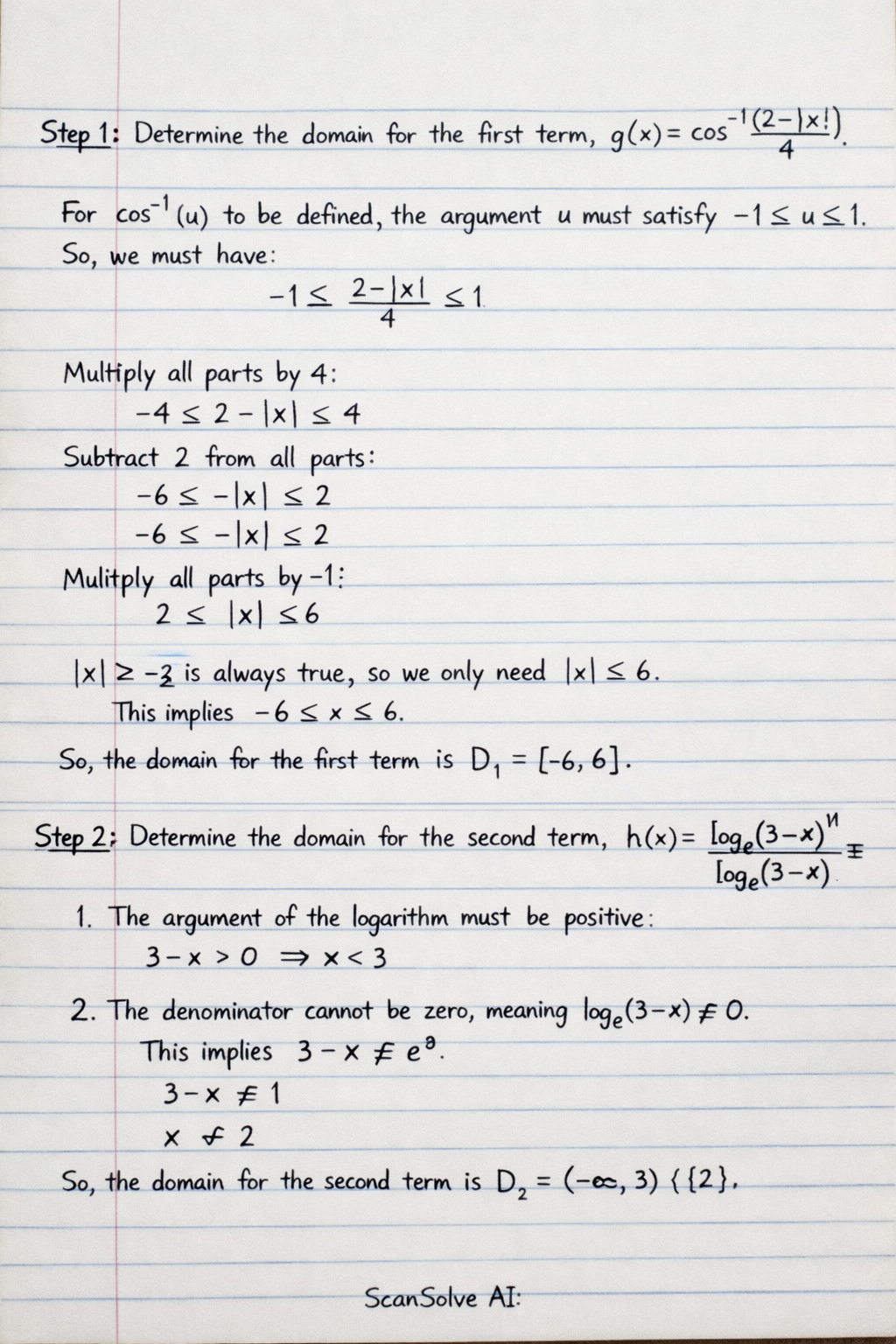
Handwritten Step-by-Step Solution
Get this as a handwritten image on WhatsApp — like a tutor wrote it for you.
Try on WhatsApp