
We read your photo as:
Write down the second and third terms of the quadratic number pattern, and calculate the value of the smallest term if the nth term is T_n = 2n2 − 28n + 87.
ScanSolve AI Answer
Step-by-step solution
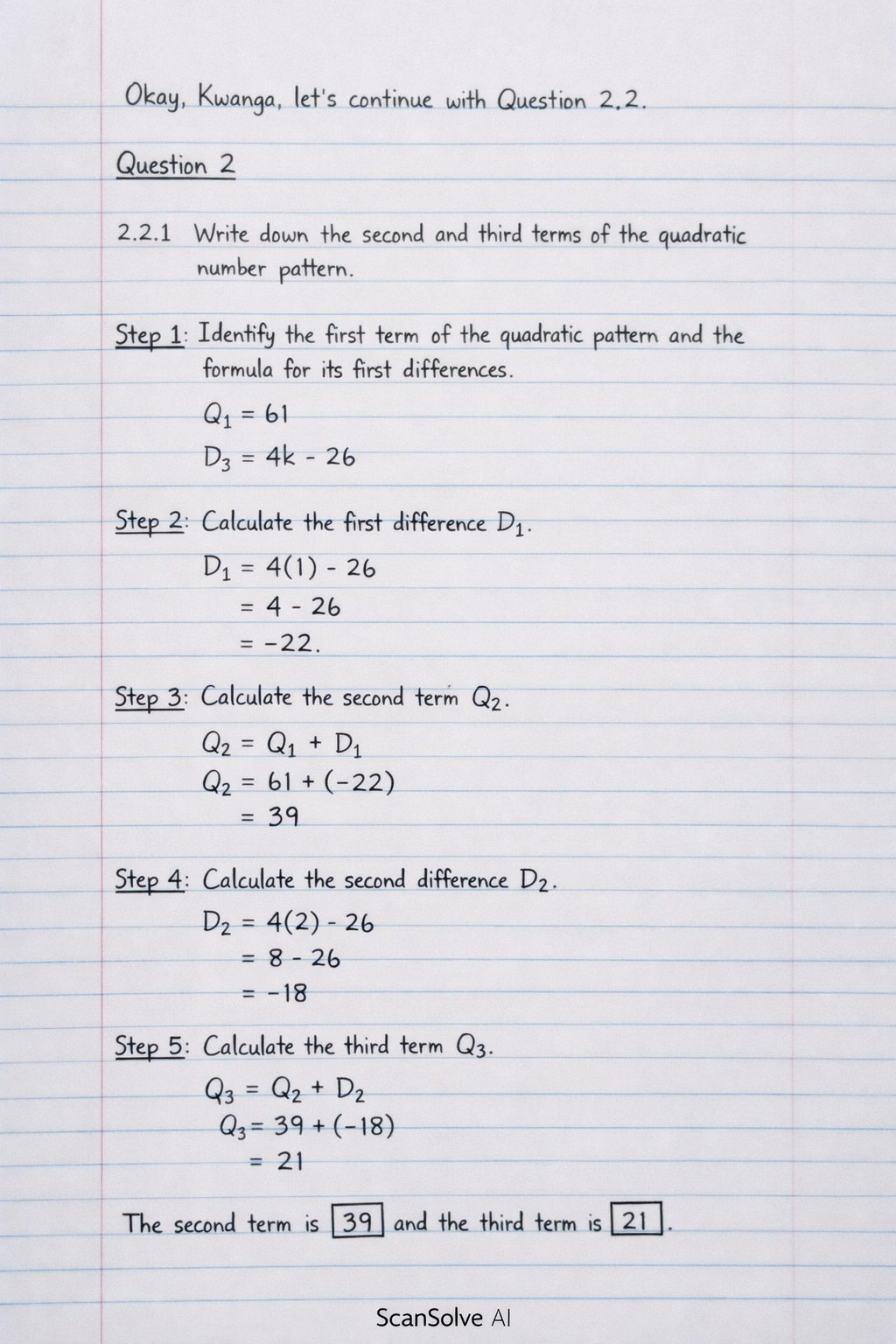
11 stepsOkay, Kwanga, let's continue with Question 2.2.
Question 2
2.2.1 Write down the second and third terms of the quadratic number pattern.
Identify the first term of the quadratic pattern and the formula for its first differences.
The first term of the quadratic number pattern is .
The first differences are given by .Calculate the first difference .
The first difference between the first and second terms is .
Calculate the second term .
The second term is the first term plus the first difference:
Calculate the second difference .
The first difference between the second and third terms is .
Calculate the third term .
The third term is the second term plus the second difference:
The second term is and the third term is .
2.2.2 If the term of the quadratic number pattern is given by , calculate the value of the smallest term.
Find the position (-value) where the smallest term occurs.
For a quadratic pattern , the smallest (or largest) term occurs at .
In the given formula , we have and .Since is an integer, the smallest term occurs at the 7th position.
Calculate the value of the smallest term by substituting into the formula.
The value of the smallest term is .
2.2.3 A constant is added to such that all the terms of the quadratic number pattern become positive. Determine the values of .
Understand the effect of adding a constant .
If a constant is added to each term , the new terms are .
For all terms to be positive, the smallest term of the new pattern must be greater than 0.Use the smallest term found in 2.2.2.
The smallest term of the original pattern is .
The smallest term of the new pattern will be .Set up the inequality for the smallest term to be positive.
Solve for .
The values of are .
Still stuck on this one?
Ask a follow-up, and the answer starts from this question.
More Mathematics Questions
Handwritten Step-by-Step Solution
Get this as a handwritten image on WhatsApp — like a tutor wrote it for you.
Try on WhatsApp