
Draw a circle theory
ScanSolve AI Answer
Step-by-step solution
2 steps"Circle theory" in geometry refers to the study of the properties and relationships of circles. Here are some fundamental concepts and theorems, along with how you would typically draw them:
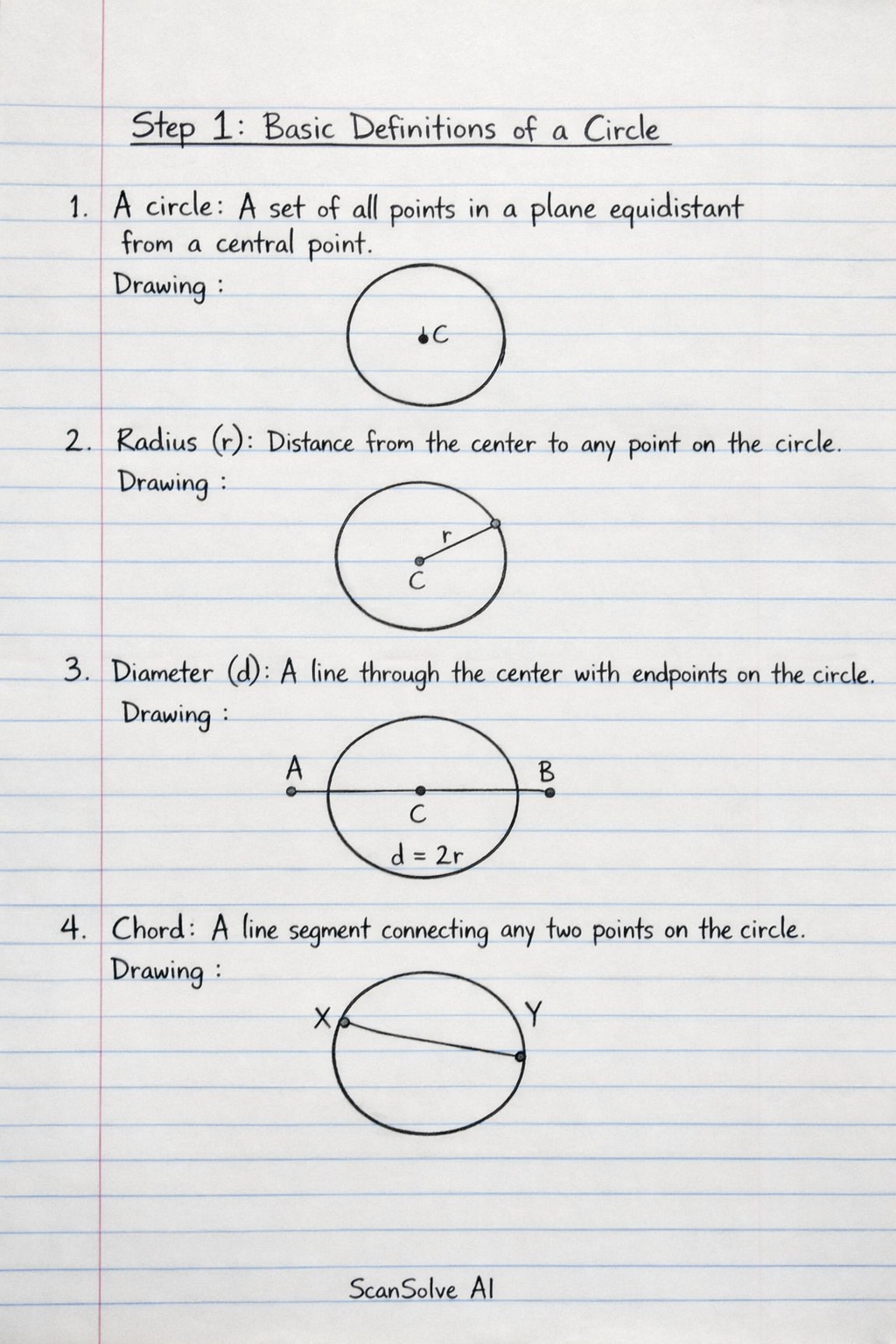
Basic Definitions of a Circle
- Circle: A set of all points in a plane that are equidistant from a central point.
- Drawing: Draw a central point (the center). Use a compass to draw a perfectly round curve around this center.
- Radius (): The distance from the center to any point on the circle.
- Drawing: Draw a line segment from the center to any point on the circle.
- Diameter (): A line segment passing through the center with endpoints on the circle. It is twice the radius ().
- Drawing: Draw a line segment through the center, connecting two points on the circle.
- Chord: A line segment connecting any two points on the circle. A diameter is the longest chord.
- Drawing: Draw a line segment connecting two points on the circle without necessarily passing through the center.
- Arc: A continuous portion of the circumference of a circle.
- Drawing: Highlight a section of the circle's curve between two points.
- Tangent: A straight line that touches the circle at exactly one point, called the point of tangency.
- Drawing: Draw a line that just grazes the circle at a single point.
- Circle: A set of all points in a plane that are equidistant from a central point.
Key Circle Theorems
-
Angle at the Center Theorem: The angle subtended by an arc at the center of a circle is twice the angle subtended by the same arc at any point on the remaining part of the circumference.
- Drawing: Draw a circle with center O. Mark two points A and B on the circumference. Draw lines OA and OB to form (angle at the center). Mark another point C on the circumference (on the major arc AB). Draw lines AC and BC to form (angle at the circumference). You will observe that .
-
Angles in the Same Segment Theorem: Angles subtended by the same arc in the same segment of a circle are equal.
- Drawing: Draw a circle. Mark two points A and B on the circumference to define an arc AB. Mark two other points C and D on the circumference within the same segment (e.g., on the major arc). Draw lines AC, BC, AD, and BD. You will find that .
-
Angle in a Semicircle Theorem: The angle subtended by a diameter at any point on the circumference is a right angle ().
- Drawing: Draw a circle with center O. Draw a diameter AB. Mark any point C on the circumference. Draw lines AC and BC. The angle will always be .
-
Tangent-Radius Property: The tangent at any point of a circle is perpendicular to the radius through the point of contact.
- Drawing: Draw a circle with center O. Draw a tangent line to the circle at a point P on the circumference. Draw the radius OP. The angle between the tangent line and the radius OP at point P will be .
-
Cyclic Quadrilateral Theorem: The opposite angles of a cyclic quadrilateral (a quadrilateral whose vertices all lie on the circumference of a circle) sum to .
- Drawing: Draw a circle. Mark four points A, B, C, and D on the circumference. Connect these points in order to form a quadrilateral ABCD. You will find that and .
-
Still stuck on this one?
Ask a follow-up, and the answer starts from this question.
More Mathematics Questions
Handwritten Step-by-Step Solution
Get this as a handwritten image on WhatsApp — like a tutor wrote it for you.
Try on WhatsApp