
We read your photo as:
Draw a circle with a radius of R = (100)/(2) = 50 mm. Label the center O.
ScanSolve AI Answer
Step-by-step solution
14 stepsHere are the steps to solve question 2:
2. a) i. Construct a regular pentagon within a circle of diameter 100.
Draw a circle with a radius of mm.
Label the center O.
Draw a horizontal diameter AB and a vertical radius OC.
Bisect the radius OB at point D.
(To do this, open your compass to a radius greater than half of OB, draw arcs from O and B, and connect their intersection points).
With D as the center and radius DC, draw an arc to intersect the extended diameter AB at point E.
The length CE is the side length of the regular pentagon.
With C as the center and radius CE, draw an arc to intersect the circle at point F.
CF is one side of the pentagon.
Using the compass set to length CE, mark off the remaining four vertices around the circle, starting from F.
Connect the five points (C, F, and the three other points) to form the regular pentagon.
2. a) ii. Measure and state the length of one side of the pentagon.
The theoretical side length of a regular pentagon inscribed in a circle of radius is given by .
The measured length of one side of the pentagon should be approximately .
2. b) i. Construct a square equal in area to a rectangle 70 x 40, making the longer side as the base.
Draw a line segment AB of length 70 mm (the longer side of the rectangle).
Extend the line segment AB to point C such that BC = 40 mm (the shorter side of the rectangle).
The total length AC is mm.
Find the midpoint M of the line segment AC.
(To do this, open your compass to a radius greater than half of AC, draw arcs from A and C, and connect their intersection points to find M).
With M as the center and radius MA (or MC), draw a semicircle with AC as its diameter.
From point B, draw a perpendicular line segment upwards until it intersects the semicircle at point D.
The length BD is the side length of the square that has an area equal to the rectangle.
Construct a square with side length BD.
2. b) ii. Measure and state the length of the square.
The area of the rectangle is .
Let the side length of the equivalent square be . Then .The measured length of one side of the square should be approximately .
Still stuck on this one?
Ask a follow-up, and the answer starts from this question.
More Mathematics Questions
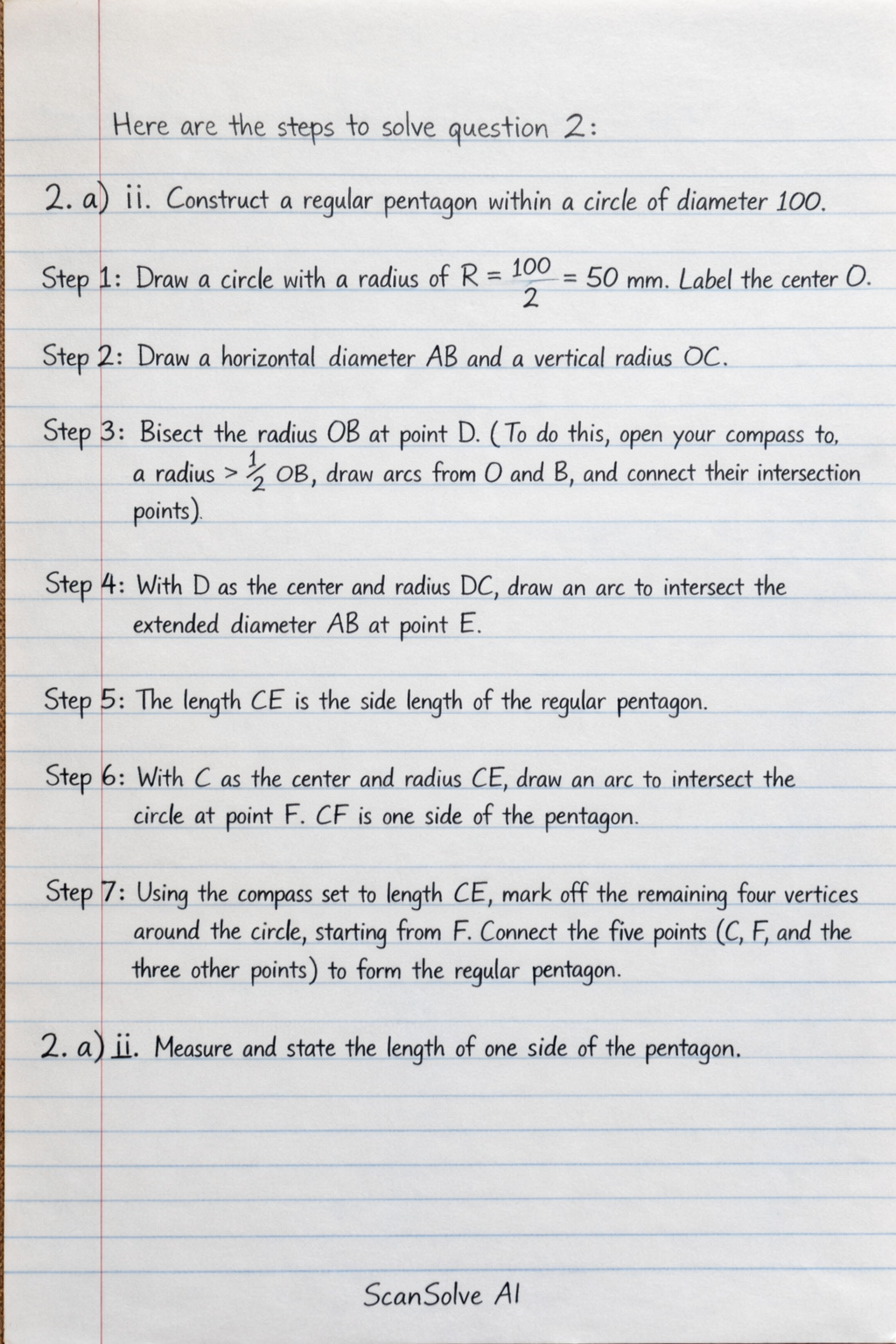
Handwritten Step-by-Step Solution
Get this as a handwritten image on WhatsApp — like a tutor wrote it for you.
Try on WhatsApp