

This mathematics problem involves applying core mathematical principles and formulas. Below you will find a complete step-by-step solution with detailed explanations for each step, helping you understand not just the answer but the method behind it.
ScanSolve AI Answer
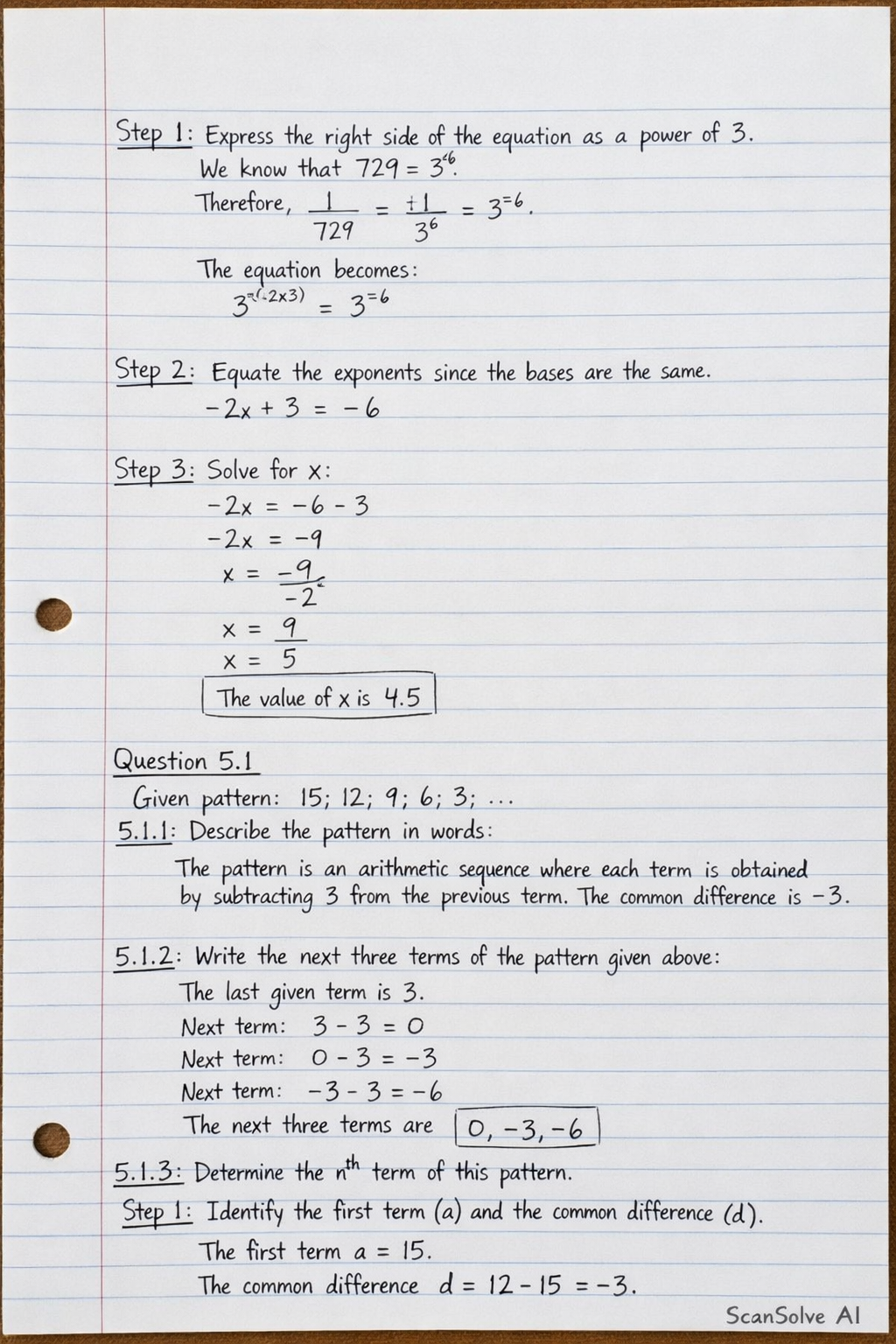
Step 1: Express the right side of the equation as a power of 3. We know that 729 = 3^6. Therefore, (1)/(729) = (1)/(3^6) = 3^-6. The equation becomes: 3^-2x+3 = 3^-6 Step 2: Equate the exponents since the bases are the same. -2x+3 = -6 Step 3: Solve for x. -2x = -6 - 3 -2x = -9 x = (-9)/(-2) x = (9)/(2) x = 4.5 The value of x is 4.5. --- Question 5.1 Given pattern: 15; 12; 9; 6; 3; 5.1.1: Describe the pattern in words. The pattern is an arithmetic sequence where each term is obtained by subtracting 3 from the previous term. The common difference is -3. 5.1.2: Write the next three terms of the pattern given above. The last given term is 3. • Next term: 3 - 3 = 0 • Next term: 0 - 3 = -3 • Next term: -3 - 3 = -6 The next three terms are 0, -3, -6. 5.1.3: Determine the n^th term of this pattern. Step 1: Identify the first term (a) and the common difference (d). The first term a = 15. The common difference d = 12 - 15 = -3. Step 2: Use the formula for the n^th term of an arithmetic sequence, T_n = a + (n-1)d. T_n = 15 + (n-1)(-3) T_n = 15 - 3n + 3 T_n = 18 - 3n The n^th term is T_n = 18 - 3n. 5.1.4: Determine the position of the term with the value of -45. Step 1: Set the n^th term formula equal to -45. 18 - 3n = -45 Step 2: Solve for n. -3n = -45 - 18 -3n = -63 n = (-63)/(-3) n = 21 The position of the term with the value of -45 is 21. 5.1.5: What will be the 50^th term? Step 1: Use the formula for the n^th term, T_n = 18 - 3n, and substitute n=50. T_50 = 18 - 3(50) T_50 = 18 - 150 T_50 = -132 The 50^th term will be -132. --- Question 6.1: Draw the graph of 3y = 9x - 18. Show all calculations. Step 1: Rewrite the equation in slope-intercept form (y = mx + c). 3y = 9x - 18 Divide all terms by 3: y = (9x)/(3) - (18)/(3) y = 3x - 6 Step 2: Find the y-intercept. The y-intercept is the point where x=0. y = 3(0) - 6 y = -6 The y-intercept is (0, -6). Step 3: Find the x-intercept. The x-intercept is the point where y=0. 0 = 3x - 6 3x = 6 x = (6)/(3) x = 2 The x-intercept is (2, 0). Step 4: To draw the graph, plot the y-intercept (0, -6) and the x-intercept (2, 0) on a coordinate plane. Then, draw a straight line passing through these two points. --- Question 6.2: Find the equation of this graph. Step 1: Identify two points on the given graph. From the graph, we can see the line passes through: • The y-intercept: (0, -2) • The x-intercept: (-2, 0) Step 2: Calculate the slope (m) using the two points (x_1, y_1) = (-2, 0) and (x_2, y_2) = (0, -2). The formula for slope is m = (y_2 - y_1)/(x_2 - x_1). m = (-2 - 0)/(0 - (-2)) m = (-2)/(2) m = -1 Step 3: Use the slope-intercept form y = mx + c. We found the slope m = -1. The y-intercept c is the y-coordinate where the line crosses the y-axis, which is -2. Substitute m = -1 and c = -2 into the equation: y = -1x - 2 y = -x - 2 The equation of the graph is y = -x - 2. --- Question 7.1.1: Calculate the size of x on the given diagram below. Step 1: Recognize that the angles on a straight line sum to 180^. The angles given are (x+30^), (x+40^), and (2x+10^). (x+30^) + (x+40^) + (2x+10^) = 180^ Step 2: Combine like terms and solve for x. x+x+2x + 30^+40^+10^ = 180^ 4x + 80^ = 180^ 4x = 180^ - 80^ 4x = 100^ x = (100^)/(4) x = 25^ The size of x is 25^. --- Question 7.1.2: Determine the size of p, q and r. Given that lines KL and MN are parallel, and GH is a transversal. Step 1: Determine the size of q. Angle q and the angle 133^ are vertically opposite angles. Vertically opposite angles are equal. q = 133^ Step 2: Determine the size of p. The angle adjacent to 133^ on the straight line MN is 180^ - 133^ = 47^. Angle p and this 47^ angle are alternate interior angles because KL MN. Alternate interior angles are equal. p = 47^ Alternatively, angle p and the angle corresponding to 133^ (which is 133^) are supplementary angles on a straight line. p + 133^ = 180^ p = 180^ - 133^ p = 47^ Step 3: Determine the size of r. Angle r and angle p are vertically opposite angles. Vertically opposite angles are equal. r = p r = 47^ The sizes are p = 47^, q = 133^, r = 47^. Send me the next one 📸