

This mathematics problem involves applying core mathematical principles and formulas. Below you will find a complete step-by-step solution with detailed explanations for each step, helping you understand not just the answer but the method behind it.
ScanSolve AI Answer
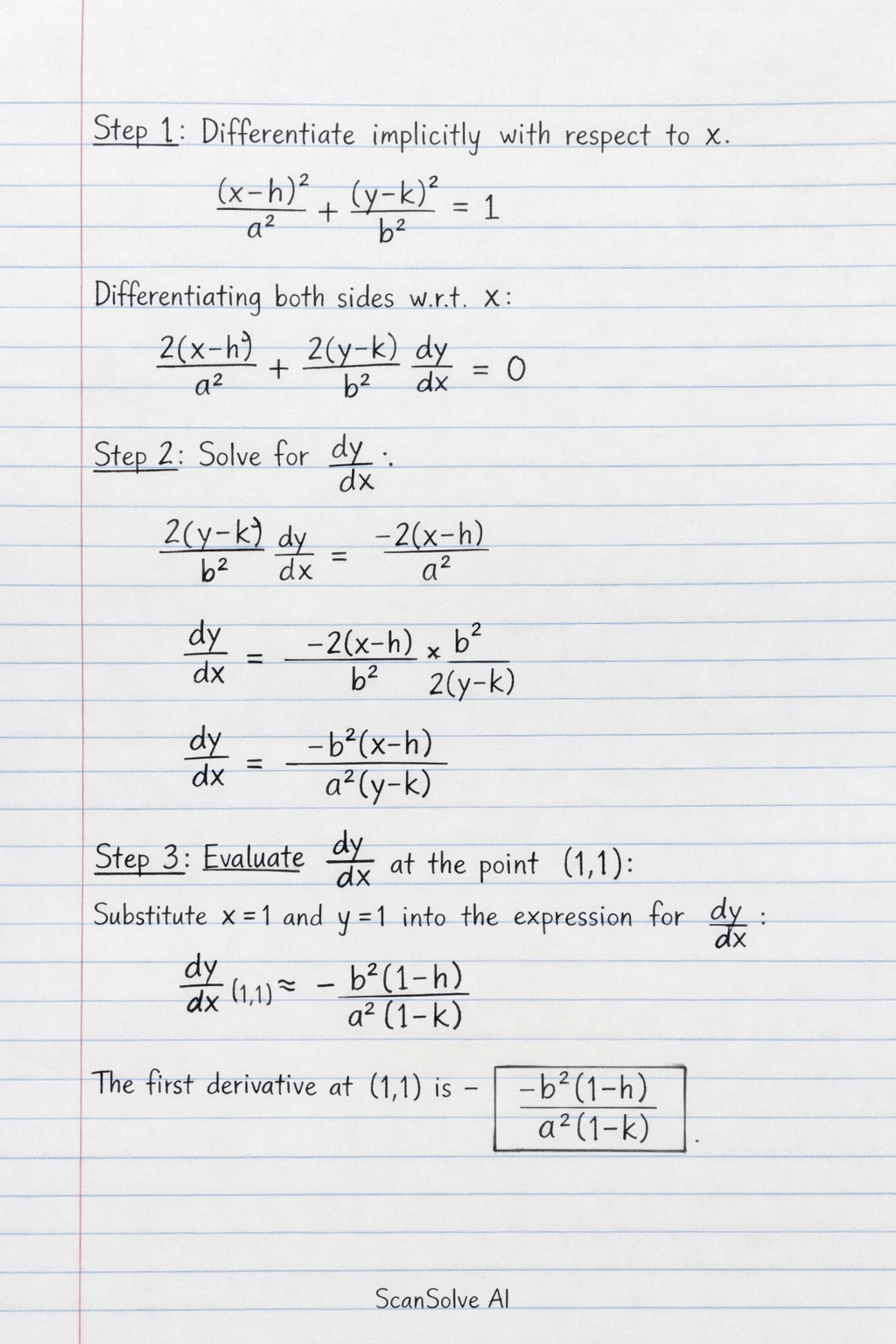
Step 1: Differentiate the given equation implicitly with respect to x. The equation is: ((x-h)^2)/(a^2) + ((y-k)^2)/(b^2) = 1 Differentiating both sides with respect to x: (2(x-h))/(a^2) + (2(y-k))/(b^2) (dy)/(dx) = 0 Step 2: Solve for (dy)/(dx). (2(y-k))/(b^2) (dy)/(dx) = -(2(x-h))/(a^2) (dy)/(dx) = -(2(x-h))/(a^2) · (b^2)/(2(y-k)) (dy)/(dx) = -(b^2(x-h))/(a^2(y-k)) Step 3: Evaluate (dy)/(dx) at the point (1,1). Substitute x=1 and y=1 into the expression for (dy)/(dx): (dy)/(dx) |_(1,1) = -(b^2(1-h))/(a^2(1-k)) The first derivative at (1,1) is -(b^2(1-h))/(a^2(1-k)). Step 4: Differentiate (dy)/(dx) with respect to x to find (d^2y)/(dx^2). We have (dy)/(dx) = -(b^2)/(a^2) (x-h)/(y-k). Using the quotient rule (d)/(dx)((u)/(v)) = (u'v - uv')/(v^2), where u = x-h and v = y-k: u' = 1 v' = (dy)/(dx) (d^2y)/(dx^2) = -(b^2)/(a^2) (1 · (y-k) - (x-h) dy)/(dx)(y-k)^2 Step 5: Substitute the expression for (dy)/(dx) into the equation for (d^2y)/(dx^2). Substitute (dy)/(dx) = -(b^2(x-h))/(a^2(y-k)): (d^2y)/(dx^2) = -(b^2)/(a^2) ((y-k) - (x-h) (-b^2(x-h))/(a^2(y-k)))(y-k)^2 (d^2y)/(dx^2) = -(b^2)/(a^2) ((y-k) + b^2(x-h)^2)/(a^2(y-k))(y-k)^2 To simplify the numerator, find a common denominator: (d^2y)/(dx^2) = -(b^2)/(a^2) (a^2(y-k)^2 + b^2(x-h)^2)/(a^2(y-k))(y-k)^2 (d^2y)/(dx^2) = -(b^2)/(a^4) (a^2(y-k)^2 + b^2(x-h)^2)/((y-k)^3) Step 6: Use the original equation to simplify the numerator. From the original equation, ((x-h)^2)/(a^2) + ((y-k)^2)/(b^2) = 1. Multiply by a^2 b^2: b^2(x-h)^2 + a^2(y-k)^2 = a^2 b^2. Substitute this into the expression for (d^2y)/(dx^2): (d^2y)/(dx^2) = -(b^2)/(a^4) (a^2 b^2)/((y-k)^3) (d^2y)/(dx^2) = -(b^4)/(a^2(y-k)^3) Step 7: Evaluate (d^2y)/(dx^2) at the point (1,1). Substitute y=1 into the expression for (d^2y)/(dx^2): (d^2y)/(dx^2) |_(1,1) = -(b^4)/(a^2(1-k)^3) The second derivative at (1,1) is -(b^4)/(a^2(1-k)^3). What's next?