

This mathematics problem involves applying core mathematical principles and formulas. Below you will find a complete step-by-step solution with detailed explanations for each step, helping you understand not just the answer but the method behind it.
ScanSolve AI Answer
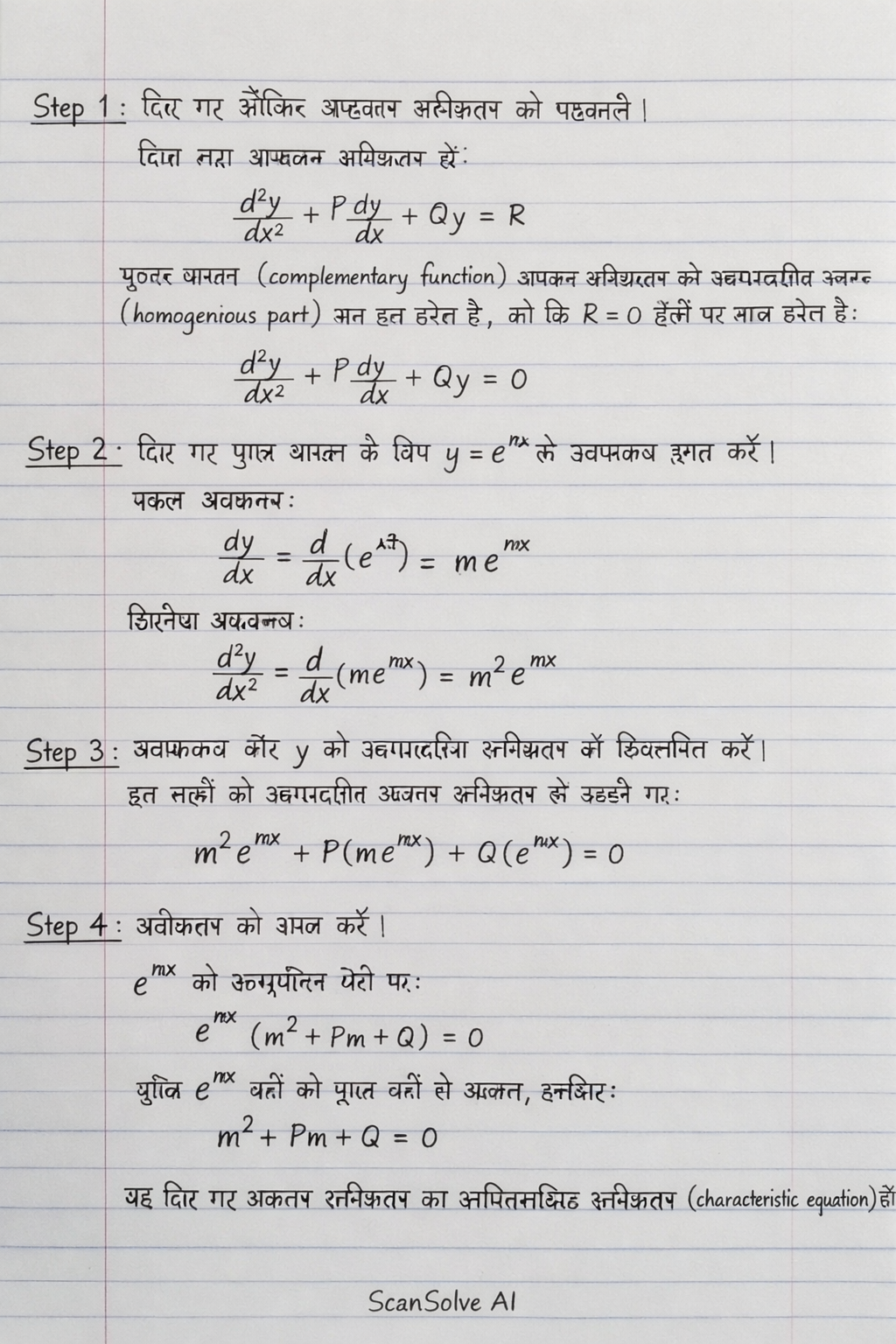
Step 1: दिए गए रैखिक अवकल समीकरण को पहचानें। दिया गया अवकल समीकरण है: (d^2y)/(dx^2) + P(dy)/(dx) + Qy = R पूरक फलन (complementary function) अवकल समीकरण के समघातीय भाग (homogeneous part) का हल होता है, जो कि R=0 होने पर प्राप्त होता है: (d^2y)/(dx^2) + P(dy)/(dx) + Qy = 0 Step 2: दिए गए पूरक फलन के भाग y = e^mx के अवकलज ज्ञात करें। यदि y = e^mx इस समघातीय समीकरण का एक हल है, तो हमें इसके प्रथम और द्वितीय अवकलज की आवश्यकता होगी: प्रथम अवकलज: (dy)/(dx) = (d)/(dx)(e^mx) = me^mx द्वितीय अवकलज: (d^2y)/(dx^2) = (d)/(dx)(me^mx) = m^2e^mx Step 3: अवकलज और y को समघातीय समीकरण में प्रतिस्थापित करें। इन मानों को समघातीय अवकल समीकरण में रखने पर: m^2e^mx + P(me^mx) + Q(e^mx) = 0 Step 4: समीकरण को सरल करें। e^mx को उभयनिष्ठ (common) लेने पर: e^mx(m^2 + Pm + Q) = 0 चूंकि e^mx कभी भी शून्य नहीं हो सकता, इसलिए कोष्ठक के अंदर का व्यंजक शून्य होना चाहिए: m^2 + Pm + Q = 0 यह दिए गए अवकल समीकरण का अभिलाक्षणिक समीकरण (characteristic equation) है। Step 5: प्राप्त परिणाम की तुलना दिए गए विकल्पों से करें। हमें m^2 + Pm + Q = 0 प्राप्त हुआ है, जो विकल्प (4) से मेल खाता है। The final answer is (4) m^2 + mP + Q = 0. अगला प्रश्न भेजें 📸