
We read your photo as:
Evaluate each of the following limits: a) lim(z->2) (z3 + 2z - 6) b) lim(z->infinity) (4z2 + 3z - 2)/(z2 + 3z + 1)
ScanSolve AI Answer
Answers
2 partsStep-by-step solution
7 stepslet's keep going with the next part of your exercise!
We're going to "evaluate each of the following," which means finding the value of these expressions as gets closer and closer to a certain number, or very, very big.
2. Evaluate each of the following.
Part a· 3 steps
Imagine you have a smooth road, and you want to know the height of the road when you're exactly at mile marker 2. Since this road (function) is smooth, you can just plug in the mile marker number to find the height!
Substitute into the expression.
Calculate the values.
Simplify the expression.
The limit is .
Part b
Now, imagine you're flying very high in an airplane, looking down at two very tall buildings. You want to know which building is taller, but they're both so huge that the little details (like a flag on top or a small balcony) don't really matter. What matters most is the main height of each building.
In this math problem, when goes to "infinity" (), it means is becoming incredibly, incredibly large. When is huge, the terms with the highest power of (like ) become much, much more important than the terms with smaller powers of (like or just a number).
Identify the highest power of in the denominator.
The highest power of in the denominator () is .
Divide every term in the numerator and the denominator by .
Simplify the terms.
Remember that as , any number divided by (or , etc.) goes to 0.
Evaluate the limit.
The limit is .
Try one yourself
A new problem that tests the same skill.
Still stuck on this one?
Ask a follow-up, and the answer starts from this question.
More Mathematics Questions
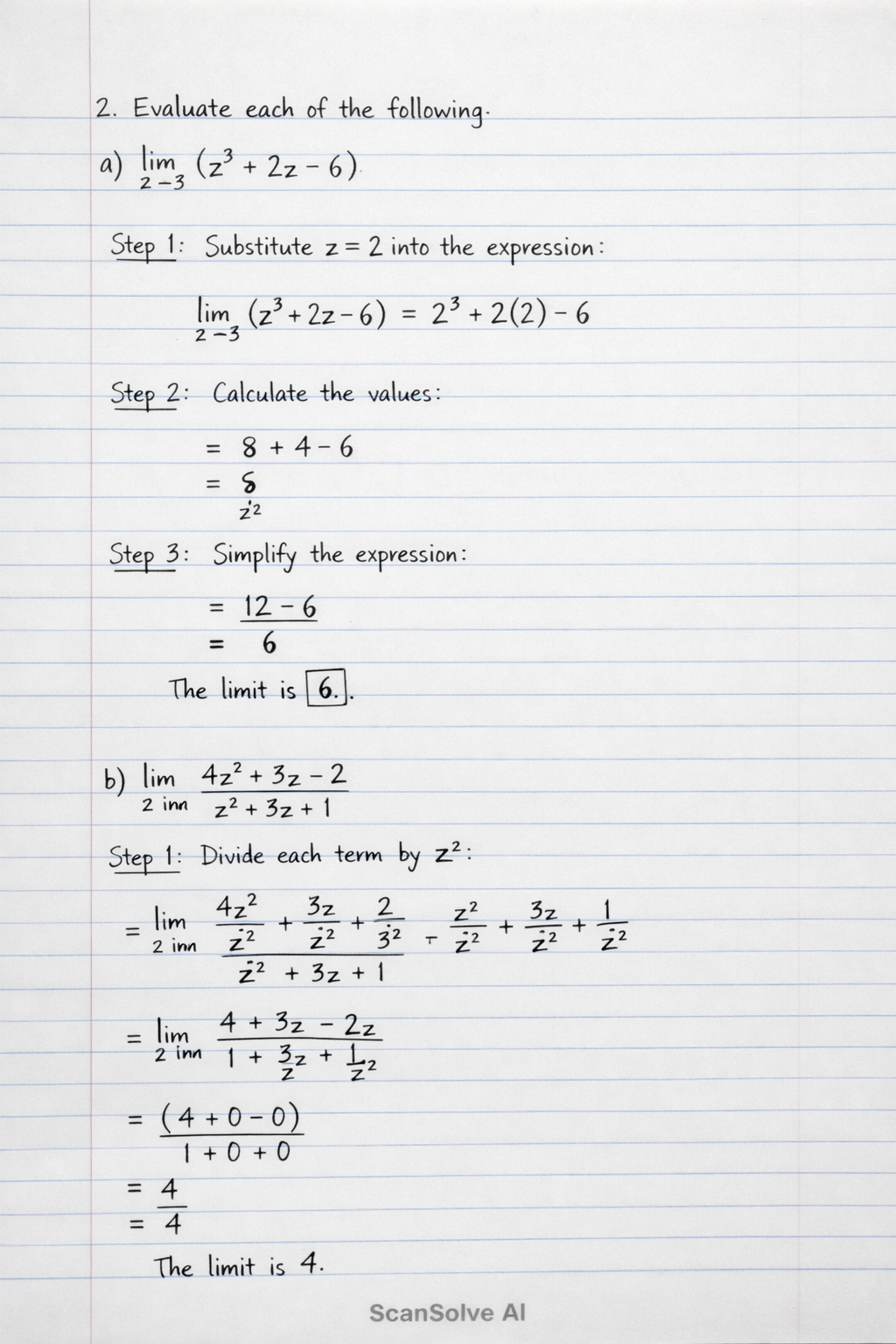
Handwritten Step-by-Step Solution
Get this as a handwritten image on WhatsApp — like a tutor wrote it for you.
Try on WhatsApp