We read your photo as:

Solve the equation: 2x - 4 2x = 0 for 0^ x 180^.

Mathematics

ScanSolve AI Answer

Step-by-step solution

6 steps

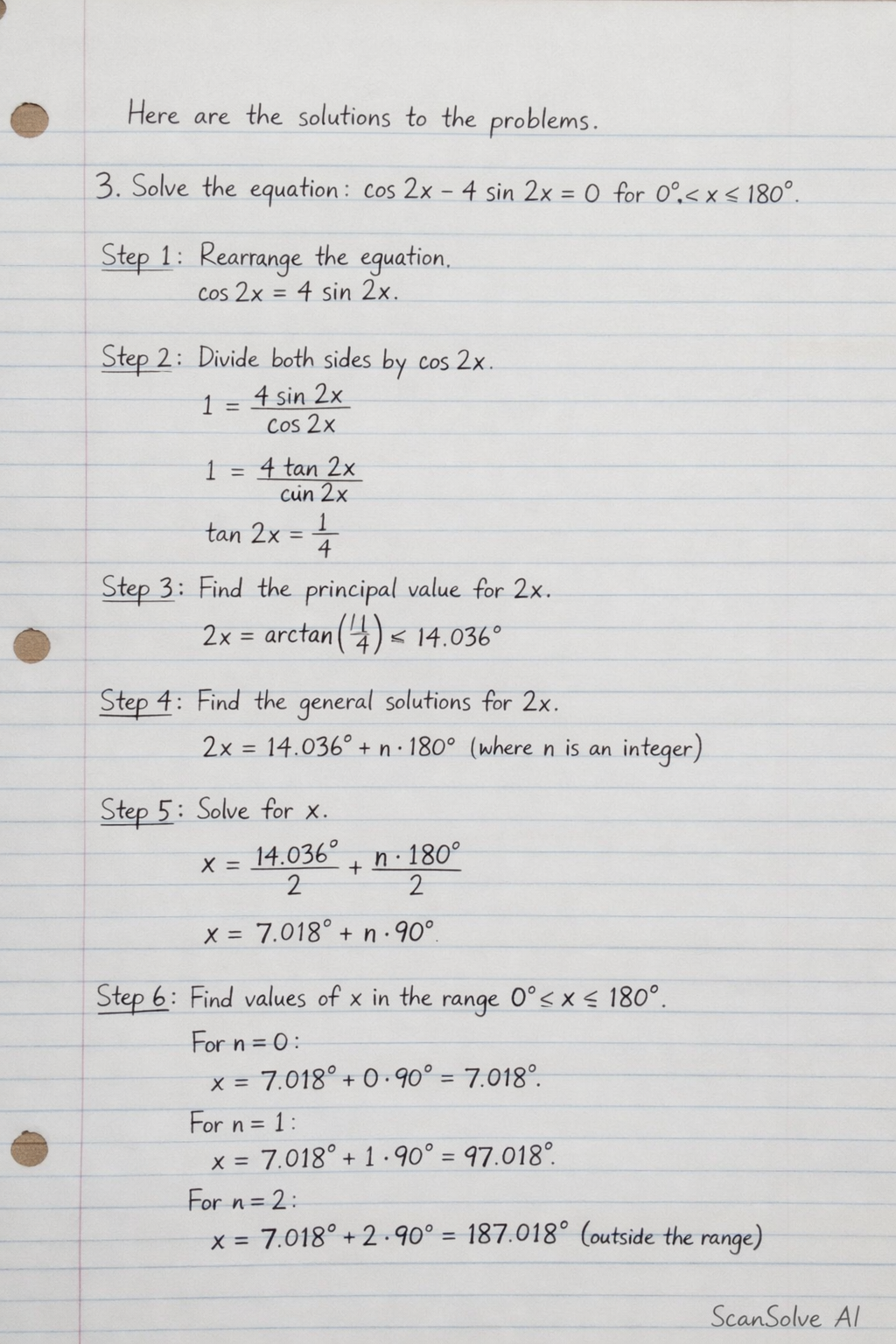
Here are the solutions to the problems.

3. Solve the equation: cos⁡2x−4sin⁡2x=0\cos 2x - 4 \sin 2x = 0 for 0∘≤x≤180∘0^\circ \le x \le 180^\circ.

  1. Rearrange the equation.

    cos⁡2x=4sin⁡2x\cos 2x = 4 \sin 2x
  2. Divide both sides by cos⁡2x\cos 2x (assuming cos⁡2x≠0\cos 2x \neq 0).

    1=4sin⁡2xcos⁡2x1 = 4 \frac{\sin 2x}{\cos 2x} 1=4tan⁡2x1 = 4 \tan 2x tan⁡2x=14\tan 2x = \frac{1}{4}
  3. Find the principal value for $2x$.

    2x=arctan⁡(14)≈14.036∘2x = \arctan\left(\frac{1}{4}\right) \approx 14.036^\circ
  4. Find the general solutions for $2x$.

    Since tan⁡2x\tan 2x is positive, 2x2x can be in the first or third quadrant.

    2x=14.036∘+n⋅180∘where n is an integer2x = 14.036^\circ + n \cdot 180^\circ \quad \text{where } n \text{ is an integer}
  5. Solve for xx.

    x=14.036∘2+n⋅180∘2x = \frac{14.036^\circ}{2} + n \cdot \frac{180^\circ}{2} x=7.018∘+n⋅90∘x = 7.018^\circ + n \cdot 90^\circ
  6. Find values of xx in the range 0∘≤x≤180∘0^\circ \le x \le 180^\circ.

    For n=0n=0:

    x=7.018∘+0⋅90∘=7.018∘x = 7.018^\circ + 0 \cdot 90^\circ = 7.018^\circ

    For n=1n=1:

    x=7.018∘+1⋅90∘=97.018∘x = 7.018^\circ + 1 \cdot 90^\circ = 97.018^\circ

    For n=2n=2:

    x=7.018∘+2⋅90∘=187.018∘(outside the range)x = 7.018^\circ + 2 \cdot 90^\circ = 187.018^\circ \quad (\text{outside the range})

    The final answers are 7.02∘,97.02∘\boxed{7.02^\circ, 97.02^\circ} (rounded to two decimal places).

    4. A team of 5 players is to be selected from 7 boys and 6 girls. If the team must have more girls than boys, in how many ways can the team be selected?
    Let BB be the number of boys and GG be the number of girls.
    Total players to be selected = 5.
    Total boys available = 7.
    Total girls available = 6.
    Condition: G>BG > B and B+G=5B+G=5.

    We list the possible combinations of boys and girls that satisfy the conditions:

    • Case 1: 2 boys and 3 girls (2+3=52+3=5, 3>23>2) Number of ways = (72)×(63)\binom{7}{2} \times \binom{6}{3} (72)=7!2!(7−2)!=7×62×1=21\binom{7}{2} = \frac{7!}{2!(7-2)!} = \frac{7 \times 6}{2 \times 1} = 21 (63)=6!3!(6−3)!=6×5×43×2×1=20\binom{6}{3} = \frac{6!}{3!(6-3)!} = \frac{6 \times 5 \times 4}{3 \times 2 \times 1} = 20 Ways for Case 1 = 21×20=42021 \times 20 = 420
    • Case 2: 1 boy and 4 girls (1+4=51+4=5, 4>14>1) Number of ways = (71)×(64)\binom{7}{1} \times \binom{6}{4} (71)=7\binom{7}{1} = 7 (64)=6!4!(6−4)!=6×52×1=15\binom{6}{4} = \frac{6!}{4!(6-4)!} = \frac{6 \times 5}{2 \times 1} = 15 Ways for Case 2 = 7×15=1057 \times 15 = 105
    • Case 3: 0 boys and 5 girls (0+5=50+5=5, 5>05>0) Number of ways = (70)×(65)\binom{7}{0} \times \binom{6}{5} (70)=1\binom{7}{0} = 1 (65)=6!5!(6−5)!=61=6\binom{6}{5} = \frac{6!}{5!(6-5)!} = \frac{6}{1} = 6 Ways for Case 3 = 1×6=61 \times 6 = 6

    Total number of ways = Sum of ways for all valid cases.
    Total ways = $42

Was this helpful?

Still stuck on this one?

Ask a follow-up, and the answer starts from this question.

Got a different question?Ask your own question
Handwritten step-by-step solution preview

Handwritten Step-by-Step Solution

Get this as a handwritten image on WhatsApp — like a tutor wrote it for you.

Try on WhatsApp