We read your photo as:

Determine the equation for g(x)and leave the answer in the form y = ... Determine the equation of g-1(x). Give the answer in the form x =... Write down an equation for the asymptote of g-1(x).

Mathematics

ScanSolve AI Answer

Answers

3 parts
1.1

x=5+976 or x=5−976x = \frac{5 + \sqrt{97}}{6} \text{ or } x = \frac{5 - \sqrt{97}}{6}

1.2

a=−5,b=2a = -5, b = 2

1.3

k=3k = 3

Step-by-step solution

13 steps

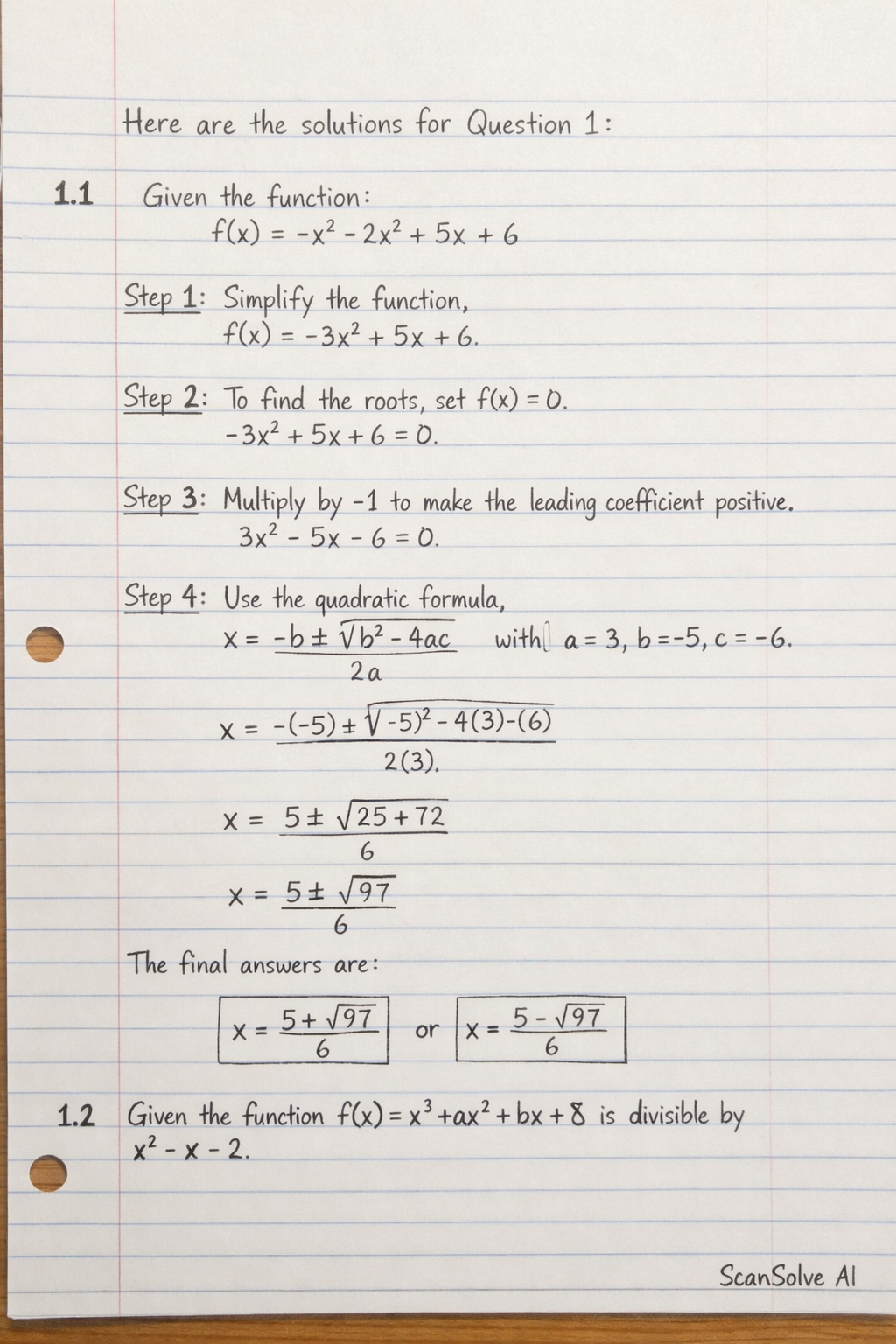
Part 1.1· 4 steps

Given the function:

f(x)=−x2−2x2+5x+6f(x) = -x^2 - 2x^2 + 5x + 6
  1. Simplify the function.

    f(x)=−3x2+5x+6f(x) = -3x^2 + 5x + 6
  2. To find the roots, set f(x)=0f(x) = 0.

    −3x2+5x+6=0-3x^2 + 5x + 6 = 0
  3. Multiply by −1-1 to make the leading coefficient positive.

    3x2−5x−6=03x^2 - 5x - 6 = 0
  4. Use the quadratic formula x=−b±b2−4ac2ax = \frac{-b \pm \sqrt{b^2 - 4ac}}{2a} with a=3a=3, b=−5b=-5, c=−6c=-6.

    x=−(−5)±(−5)2−4(3)(−6)2(3)x = \frac{-(-5) \pm \sqrt{(-5)^2 - 4(3)(-6)}}{2(3)} x=5±25+726x = \frac{5 \pm \sqrt{25 + 72}}{6} x=5±976x = \frac{5 \pm \sqrt{97}}{6}

    The final answers are:

    x=5+976 or x=5−976\boxed{x = \frac{5 + \sqrt{97}}{6} \text{ or } x = \frac{5 - \sqrt{97}}{6}}

Part 1.2

a=−5,b=2a = -5, b = 2

Given the function f(x)=x3+ax2+bx+8f(x) = x^3 + ax^2 + bx + 8 is divisible by x2−x−2x^2 - x - 2.

  1. Factorize the divisor x2−x−2x^2 - x - 2.

    x2−x−2=(x−2)(x+1)x^2 - x - 2 = (x-2)(x+1)
  2. Since f(x)f(x) is divisible by (x−2)(x+1)(x-2)(x+1), it means x=2x=2 and x=−1x=-1 are roots of f(x)f(x).

    Therefore, f(2)=0f(2) = 0 and f(−1)=0f(-1) = 0.

  3. Substitute x=2x=2 into f(x)f(x) and set it to 0.

    f(2)=(2)3+a(2)2+b(2)+8=0f(2) = (2)^3 + a(2)^2 + b(2) + 8 = 0 8+4a+2b+8=08 + 4a + 2b + 8 = 0 4a+2b+16=04a + 2b + 16 = 0

    Divide by 2:

    2a+b+8=0  ⟹  2a+b=−8(Equation 1)2a + b + 8 = 0 \implies 2a + b = -8 \quad \text{(Equation 1)}
  4. Substitute x=−1x=-1 into f(x)f(x) and set it to 0.

    f(−1)=(−1)3+a(−1)2+b(−1)+8=0f(-1) = (-1)^3 + a(-1)^2 + b(-1) + 8 = 0 −1+a−b+8=0-1 + a - b + 8 = 0 a−b+7=0  ⟹  a−b=−7(Equation 2)a - b + 7 = 0 \implies a - b = -7 \quad \text{(Equation 2)}
  5. Solve the system of linear equations (Equation 1 and Equation 2).

    Add Equation 1 and Equation 2:

    (2a+b)+(a−b)=−8+(−7)(2a + b) + (a - b) = -8 + (-7) 3a=−153a = -15 a=−5a = -5
  6. Substitute a=−5a=-5 into Equation 2 to find bb.

    −5−b=−7-5 - b = -7 −b=−7+5-b = -7 + 5 −b=−2-b = -2 b=2b = 2

    The final answers are:

    a=−5,b=2\boxed{a = -5, b = 2}

Part 1.3

k=3k = 3

Given the function f(x)=x3−kx2−x+13f(x) = x^3 - kx^2 - x + 13. When divided by x−3x-3, the remainder is 10.

  1. Apply the Remainder Theorem, which states that if a polynomial f(x)f(x) is divided by x−cx-c, the remainder is f(c)f(c).

    In this case, c=3c=3 and the remainder is 10, so f(3)=10f(3) = 10.

  2. Substitute x=3x=3 into f(x)f(x) and set it equal to 10.

    f(3)=(3)3−k(3)2−(3)+13=10f(3) = (3)^3 - k(3)^2 - (3) + 13 = 10 27−9k−3+13=1027 - 9k - 3 + 13 = 10
  3. Simplify and solve for kk.

    37−9k=1037 - 9k = 10 −9k=10−37-9k = 10 - 37 −9k=−27-9k = -27 k=−27−9k = \frac{-27}{-9} k=3k = 3

    The final answer is:

    k=3\boxed{k = 3}
Was this helpful?

Try one yourself

A new problem that tests the same skill.

Still stuck on this one?

Ask a follow-up, and the answer starts from this question.

Got a different question?Ask your own question
Handwritten step-by-step solution preview

Handwritten Step-by-Step Solution

Get this as a handwritten image on WhatsApp — like a tutor wrote it for you.

Try on WhatsApp