
We read your photo as:
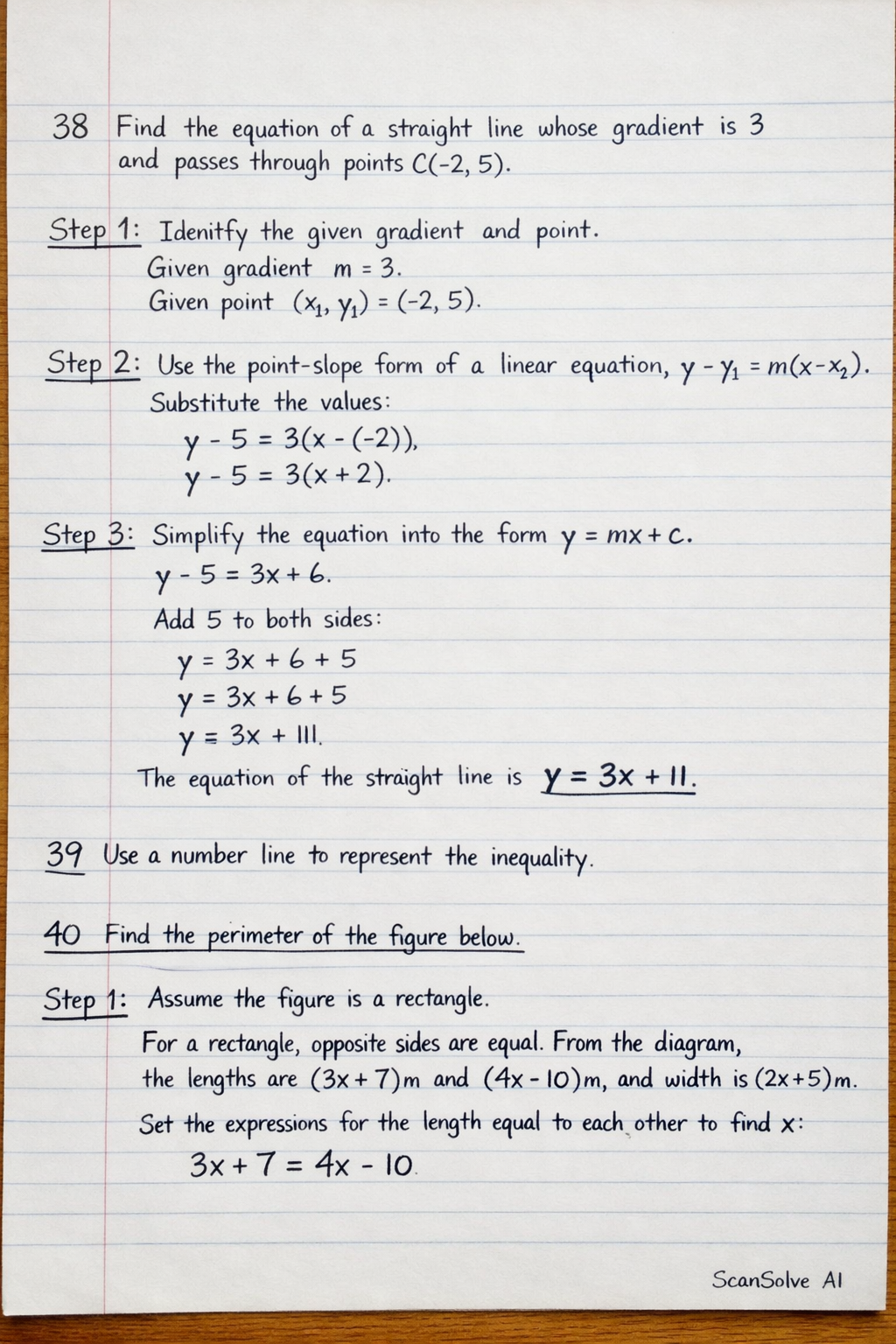
Find the equation of a straight line whose gradient is 3 and passes through point C(-2, 5).
ScanSolve AI Answer
Answer
Step-by-step solution
15 steps38 Find the equation of a straight line whose gradient is 3 and passes through points C(-2, 5).
Identify the given gradient and point.
Given gradient .
Given point .Use the point-slope form of a linear equation, .
Substitute the values:
Simplify the equation into the form .
Add 5 to both sides:
The equation of the straight line is .
39 Use a number line to represent the inequality.
The inequality to be represented is not provided in the image. Therefore, it is not possible to represent it on a number line.
40 Find the perimeter of the figure below.
Assume the figure is a rectangle.
For a rectangle, opposite sides are equal. From the diagram, the lengths are and , and the width is .
Set the expressions for the length equal to each other to find :Solve for .
Subtract from both sides:
Add 10 to both sides:
Calculate the actual length and width of the rectangle.
Length m.
Width m.Calculate the perimeter.
The perimeter of a rectangle is given by .
The perimeter of the figure is .
41 Solve for y in: .
Add 5 to both sides of the equation.
Multiply both sides by 2 to solve for .
The value of is .
42 Find the gradient of the line shown.
Identify the coordinates of the two points on the line.
The points are and .
Let and .Use the gradient formula.
The gradient is given by:
Substitute the values and calculate.
The gradient of the line is .
43 Find the gradient of the line shown below points C(-2, -3) and (8, 7).
Identify the coordinates of the two points.
The points are and .
Let and .Use the gradient formula.
Substitute the values and calculate.
The gradient of the line is .
Try one yourself
A new problem that tests the same skill.
Still stuck on this one?
Ask a follow-up, and the answer starts from this question.
More Mathematics Questions
Handwritten Step-by-Step Solution
Get this as a handwritten image on WhatsApp — like a tutor wrote it for you.
Try on WhatsApp