Determine the equation of the circle with diameter NP, where N(-2; 3) and P(4; -7). Then, find the equation of the tangent to the circle at point N.
|Mathematics
Determine the equation of the circle with diameter NP, where N(-2; 3) and P(4; -7). Then, find the equation of the tangent to the circle at point N.
ScanSolve AI Answer
Answer
(x−1)2+(y+2)2=34
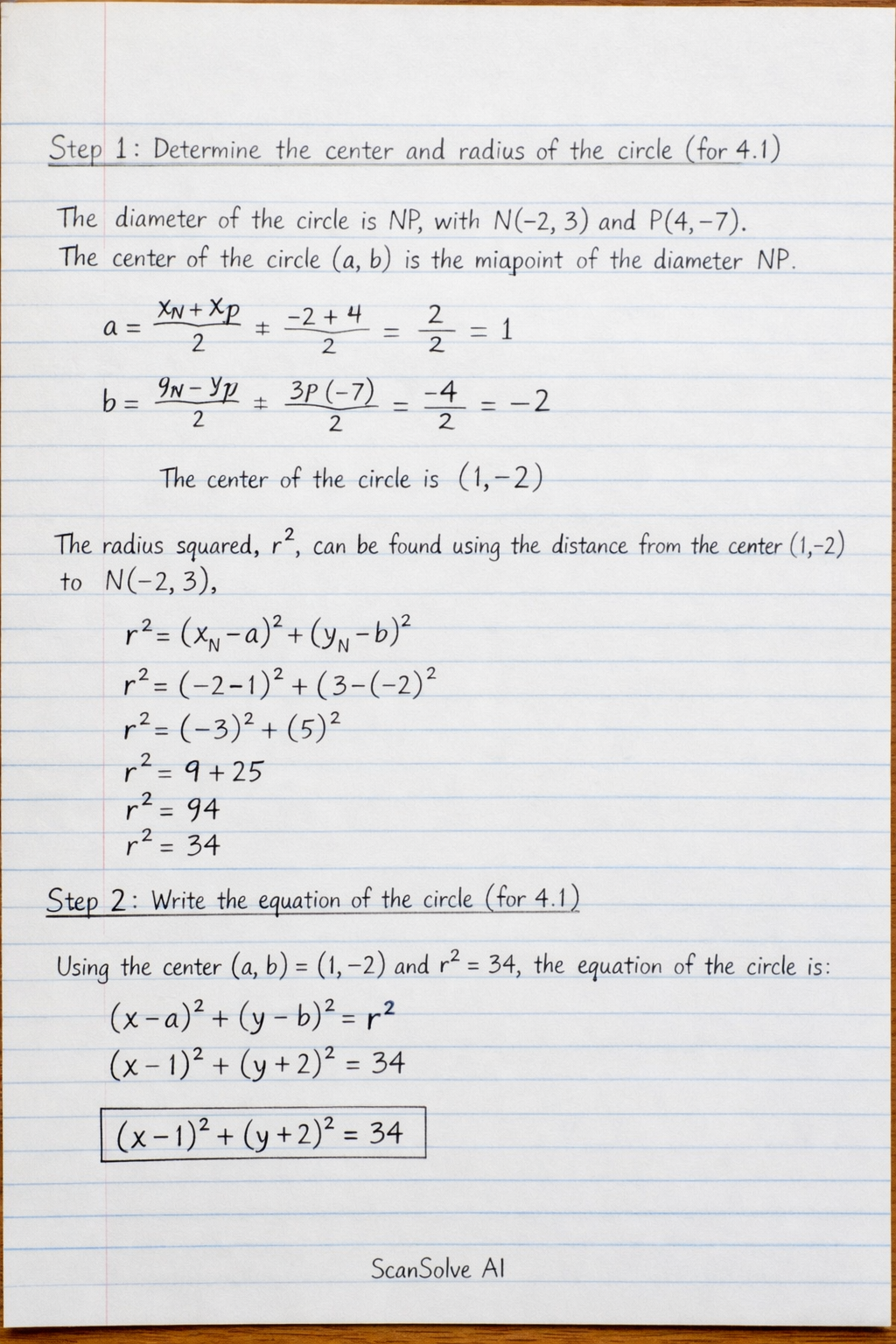
Step 1: Determine the center and radius of the circle (for 4.1)
The diameter of the circle is NP, with N(−2;3) and P(4;−7).
The center of the circle (a;b) is the midpoint of the diameter NP.
a=2xN+xP=2−2+4=22=1b=2yN+yP=23+(−7)=2−4=−2
The center of the circle is (1;−2).
The radius squared, r2, can be found using the distance from the center (1;−2) to N(−2;3).
r2=(xN−a)2+(yN−b)2r2=(−2−1)2+(3−(−2))2r2=(−3)2+(5)2r2=9+25r2=34
Step 2: Write the equation of the circle (for 4.1)
Using the center (a;b)=(1;−2) and r2=34, the equation of the circle is:
(x−a)2+(y−b)2=r2(x−1)2+(y−(−2))2=34(x−1)2+(y+2)2=34
Step 3: Determine the equation of the tangent at N (for 4.2)
The tangent to the circle at N(−2;3) is perpendicular to the radius CN, where C is the center (1;−2).
First, calculate the gradient of the radius CN:
mCN=xN−xCyN−yC=−2−13−(−2)=−35=−35
The gradient of the tangent line, mtangent, is the negative reciprocal of mCN:
mtangent=−mCN1=−−351=53
Now, use the point-slope form y−y1=m(x−x1) with N(−2;3) and mtangent=53:
y−3=53(x−(−2))y−3=53(x+2)y−3=53x+56y=53x+56+3y=53x+56+515y=53x+521
Step 4: Calculate the size of NP^Q (for 4.3)
Given N(−2;3), P(4;−7), and Q(4;3). NP is the diameter.
An angle subtended by a diameter at any point on the circumference is 90∘. Therefore, NQ^P=90∘.
This means △NPQ is a right-angled triangle at Q.
Calculate the lengths of the sides NQ and PQ:
NQ=(xQ−xN)2+(yQ−yN)2=(4−(−2))2+(3−3)2=(6)2+(0)2=36=6PQ=(xQ−xP)2+(yQ−yP)2=(4−4)2+(3−(−7))2=(0)2+(10)2=100=10
In the right-angled triangle △NPQ, we can use trigonometry to find NP^Q:
tan(NP^Q)=adjacentopposite=PQNQ=106=53NP^Q=arctan(53)NP^Q≈30.9637∘
Rounding to one decimal place:
NP^Q≈31.0∘
Step 5: Calculate the value of AreaofthecircleAreaof△PQN (for 4.4)
First, calculate the area of △PQN. Since it's a right-angled triangle at Q:
Area of △PQN=21×base×height=21×PQ×NQ
Was this helpful?
Need help with your own homework?
Get instant step-by-step solutions to any question. Free to start.
This mathematics problem involves applying core mathematical principles and formulas. Below you will find a complete step-by-step solution with detailed explanations for each step, helping you understand not just the answer but the method behind it.
ScanSolve AI Answer
Step 1: Determine the center and radius of the circle (for 4.1) The diameter of the circle is NP, with N(-2; 3) and P(4; -7). The center of the circle (a; b) is the midpoint of the diameter NP. a = (x_N + x_P)/(2) = (-2 + 4)/(2) = (2)/(2) = 1 b = (y_N + y_P)/(2) = (3 + (-7))/(2) = (-4)/(2) = -2 The center of the circle is (1; -2). The radius squared, r^2, can be found using the distance from the center (1; -2) to N(-2; 3). r^2 = (x_N - a)^2 + (y_N - b)^2 r^2 = (-2 - 1)^2 + (3 - (-2))^2 r^2 = (-3)^2 + (5)^2 r^2 = 9 + 25 r^2 = 34 Step 2: Write the equation of the circle (for 4.1) Using the center (a; b) = (1; -2) and r^2 = 34, the equation of the circle is: (x - a)^2 + (y - b)^2 = r^2 (x - 1)^2 + (y - (-2))^2 = 34 (x - 1)^2 + (y + 2)^2 = 34 Step 3: Determine the equation of the tangent at N (for 4.2) The tangent to the circle at N(-2; 3) is perpendicular to the radius CN, where C is the center (1; -2). First, calculate the gradient of the radius CN: m_CN = (y_N - y_C)/(x_N - x_C) = (3 - (-2))/(-2 - 1) = (5)/(-3) = -(5)/(3) The gradient of the tangent line, m_tangent, is the negative reciprocal of m_CN: m_tangent = -(1)/(m_CN) = -(1)/(-5)3 = (3)/(5) Now, use the point-slope form y - y_1 = m(x - x_1) with N(-2; 3) and m_tangent = (3)/(5): y - 3 = (3)/(5)(x - (-2)) y - 3 = (3)/(5)(x + 2) y - 3 = (3)/(5)x + (6)/(5) y = (3)/(5)x + (6)/(5) + 3 y = (3)/(5)x + (6)/(5) + (15)/(5) y = (3)/(5)x + (21)/(5) Step 4: Calculate the size of NPQ (for 4.3) Given N(-2; 3), P(4; -7), and Q(4; 3). NP is the diameter. An angle subtended by a diameter at any point on the circumference is 90^. Therefore, NQP = 90^. This means NPQ is a right-angled triangle at Q. Calculate the lengths of the sides NQ and PQ: NQ = sqrt((x_Q - x_N)^2 + (y_Q - y_N)^2) = sqrt((4 - (-2))^2 + (3 - 3)^2) = sqrt((6)^2 + (0)^2) = sqrt(36) = 6 PQ = sqrt((x_Q - x_P)^2 + (y_Q - y_P)^2) = sqrt((4 - 4)^2 + (3 - (-7))^2) = sqrt((0)^2 + (10)^2) = sqrt(100) = 10 In the right-angled triangle NPQ, we can use trigonometry to find NPQ: (NPQ) = oppositeadjacent = (NQ)/(PQ) = (6)/(10) = (3)/(5) NPQ = ((3)/(5)) NPQ ≈ 30.9637^ Rounding to one decimal place: NPQ ≈ 31.0^ Step 5: Calculate the value of Area of PQNArea of the circle (for 4.4) First, calculate the area of PQN. Since it's a right-angled triangle at Q: Area of PQN = (1)/(2) × base × height = (1)/(2) × PQ × NQ