
We read your photo as:
Simplify ((1)/(2) + 2(1)/(2)) - (5(1)/(2) - 1(1)/(2)) (b) Solve for n in the equation 2n2 = 4n. (c) Use logarithm tables to evaluate (734.6)/(56.4).
ScanSolve AI Answer
Answers
3 partsStep-by-step solution
12 stepsHere are the solutions to the problems.
Part a· 5 steps
Simplify:
Convert all mixed numbers to improper fractions.
Perform the addition inside the first parenthesis.
Perform the subtraction inside the second parenthesis.
Perform the final subtraction.
Simplify the fraction.
Part b
Solve for in the equation .
Move all terms to one side to set the equation to zero.
Factor out the common term, $2n$.
Set each factor equal to zero and solve for .
Part c
Use logarithm tables to evaluate:
Let . We will use the property .
Find the logarithm of 734.6.
The characteristic is 2 (since there are 3 digits before the decimal point, ).
Using logarithm tables, the mantissa for 734.6 is approximately 0.8660.
So, .Find the logarithm of 56.4.
The characteristic is 1 (since there are 2 digits before the decimal point, ).
Using logarithm tables, the mantissa for 56.4 is approximately 0.7513.
So, .Subtract the logarithms.
Find the antilogarithm of 1.1147.
The characteristic is 1, which means the number has digits before the decimal point.
Using antilogarithm tables, the antilog of the mantissa 0.1147 is approximately 1.302.
Therefore, .
Try one yourself
A new problem that tests the same skill.
Still stuck on this one?
Ask a follow-up, and the answer starts from this question.
More Mathematics Questions
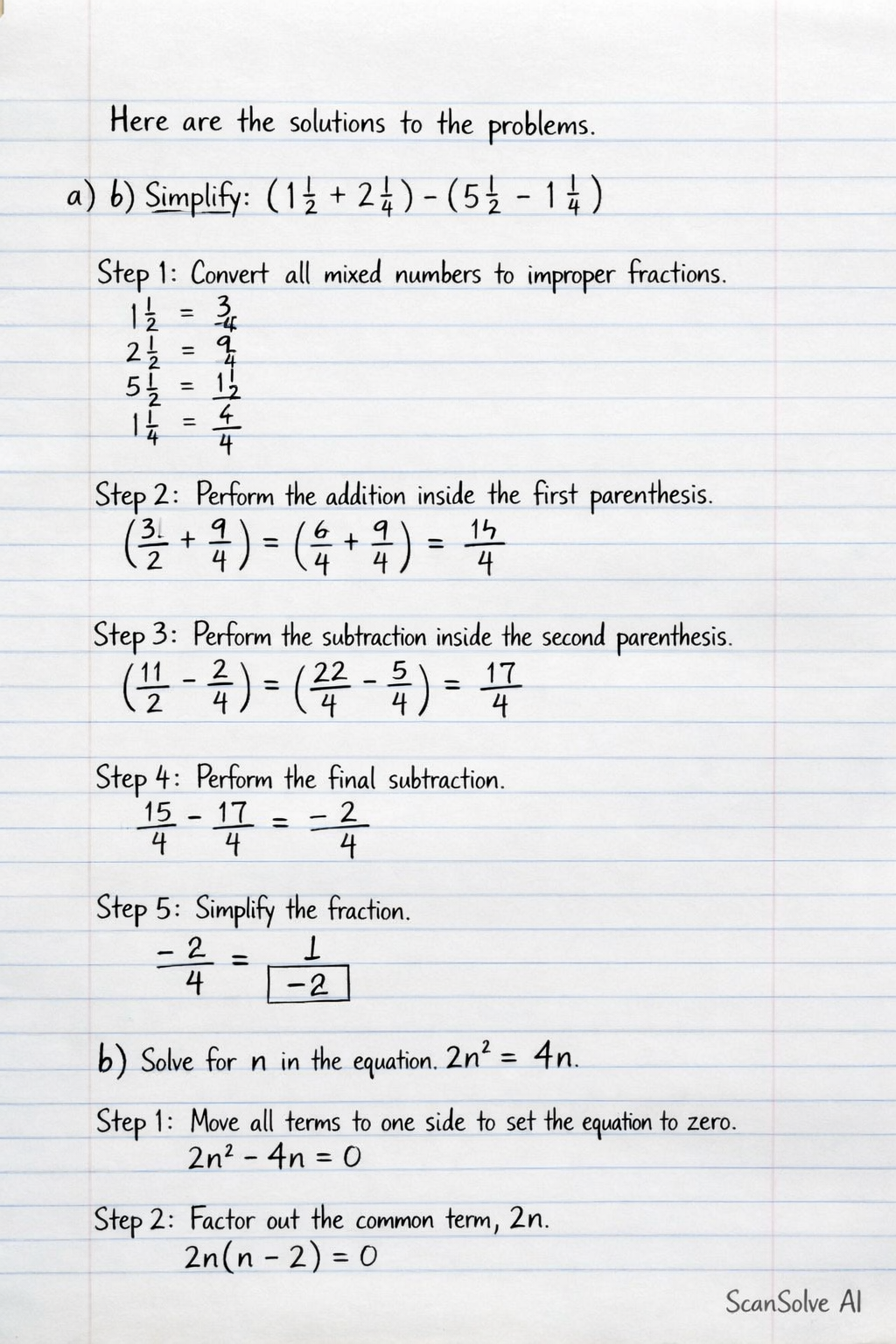
Handwritten Step-by-Step Solution
Get this as a handwritten image on WhatsApp — like a tutor wrote it for you.
Try on WhatsApp