We read your photo as:

Find the equation of the tangent to the curve y = 5 − 2x − x2 at the point (1, 2). Use the quotient rule to differentiate y = 3x/(x2+1).

Mathematics

ScanSolve AI Answer

Answers

3 parts
4

4x5+4x3−6x2+3(2x2+1)2\frac{4x^5 + 4x^3 - 6x^2 + 3}{(2x^2+1)^2}

i

30xcos⁡(3x2)30x \cos(3x^2)

ii

2sec⁡2(x)x\frac{2 \sec^2(\sqrt{x})}{\sqrt{x}}

Step-by-step solution

8 steps

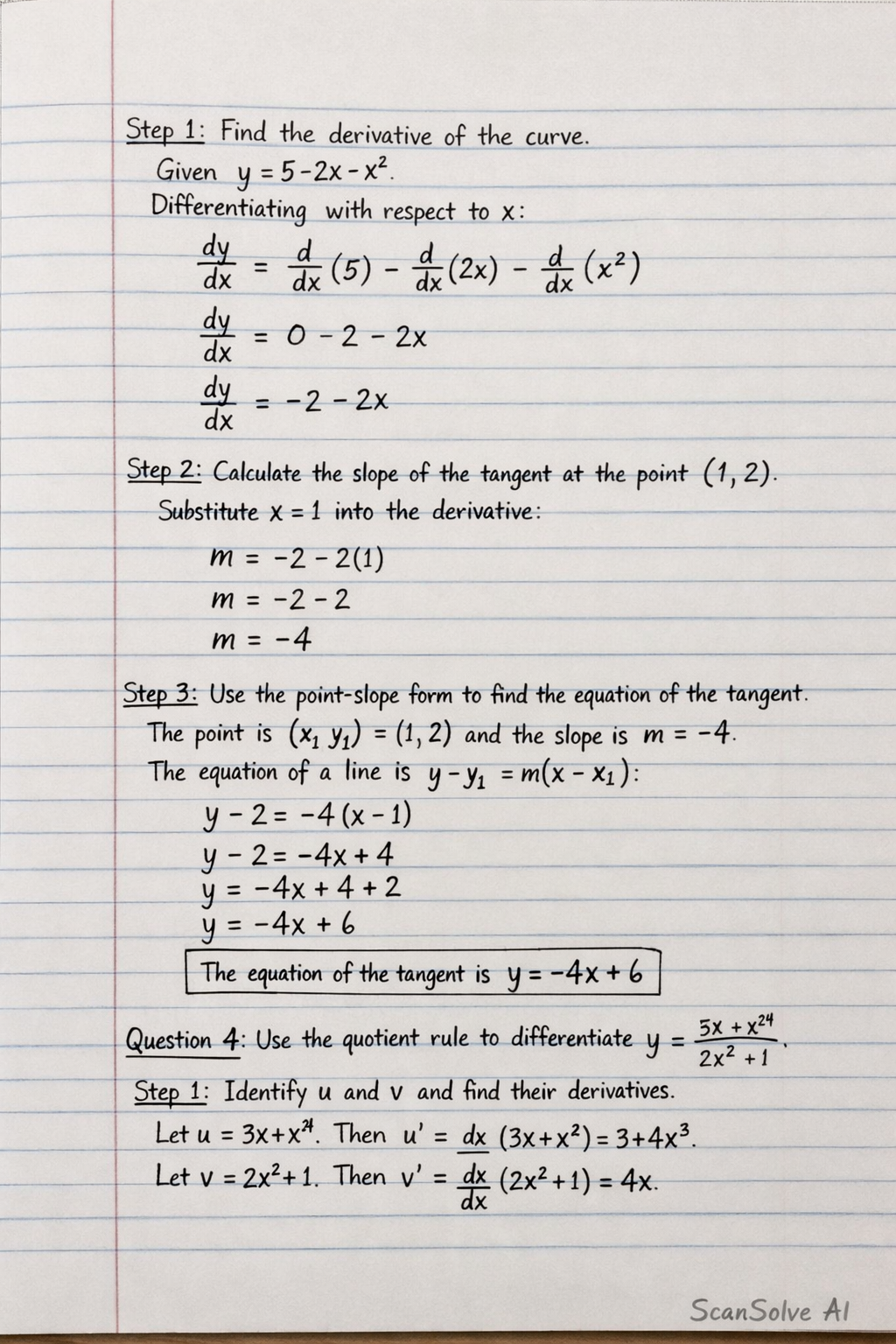
Step 1: Find the derivative of the curve.
Given y=5−2x−x2y = 5 - 2x - x^2.
Differentiating with respect to xx:

dydx=ddx(5)−ddx(2x)−ddx(x2)\frac{dy}{dx} = \frac{d}{dx}(5) - \frac{d}{dx}(2x) - \frac{d}{dx}(x^2) dydx=0−2−2x\frac{dy}{dx} = 0 - 2 - 2x dydx=−2−2x\frac{dy}{dx} = -2 - 2x

Step 2: Calculate the slope of the tangent at the point (1,2)(1, 2).
Substitute x=1x=1 into the derivative:

m=−2−2(1)m = -2 - 2(1) m=−2−2m = -2 - 2 m=−4m = -4

Step 3: Use the point-slope form to find the equation of the tangent.
The point is (x1,y1)=(1,2)(x_1, y_1) = (1, 2) and the slope is m=−4m = -4.
The equation of a line is y−y1=m(x−x1)y - y_1 = m(x - x_1).

y−2=−4(x−1)y - 2 = -4(x - 1) y−2=−4x+4y - 2 = -4x + 4 y=−4x+4+2y = -4x + 4 + 2 y=−4x+6y = -4x + 6

The equation of the tangent is y=−4x+6\boxed{y = -4x + 6}.

Part 4· 4 steps

Use the quotient rule to differentiate y=3x+x42x2+1y = \frac{3x+x^4}{2x^2+1}.

  1. Identify uu and vv and find their derivatives.

    Let u=3x+x4u = 3x+x^4. Then u′=ddx(3x+x4)=3+4x3u' = \frac{d}{dx}(3x+x^4) = 3 + 4x^3.
    Let v=2x2+1v = 2x^2+1. Then v′=ddx(2x2+1)=4xv' = \frac{d}{dx}(2x^2+1) = 4x.

  2. Apply the quotient rule formula dydx=vu′−uv′v2\frac{dy}{dx} = \frac{v u' - u v'}{v^2}.

    dydx=(2x2+1)(3+4x3)−(3x+x4)(4x)(2x2+1)2\frac{dy}{dx} = \frac{(2x^2+1)(3+4x^3) - (3x+x^4)(4x)}{(2x^2+1)^2}
  3. Expand and simplify the numerator.

    Numerator:
    (2x2+1)(3+4x3)=6x2+8x5+3+4x3=8x5+4x3+6x2+3(2x^2+1)(3+4x^3) = 6x^2 + 8x^5 + 3 + 4x^3 = 8x^5 + 4x^3 + 6x^2 + 3
    (3x+x4)(4x)=12x2+4x5(3x+x^4)(4x) = 12x^2 + 4x^5
    Subtracting the second from the first:
    (8x5+4x3+6x2+3)−(12x2+4x5)(8x^5 + 4x^3 + 6x^2 + 3) - (12x^2 + 4x^5)
    =8x5+4x3+6x2+3−12x2−4x5= 8x^5 + 4x^3 + 6x^2 + 3 - 12x^2 - 4x^5
    =4x5+4x3−6x2+3= 4x^5 + 4x^3 - 6x^2 + 3

  4. Write the final derivative.

    dydx=4x5+4x3−6x2+3(2x2+1)2\frac{dy}{dx} = \boxed{\frac{4x^5 + 4x^3 - 6x^2 + 3}{(2x^2+1)^2}}

Part 5

Find f′(x)f'(x).

Part i

30xcos⁡(3x2)30x \cos(3x^2)

f(x)=5sin⁡(3x2)f(x) = 5 \sin(3x^2)

  1. Apply the chain rule.

    Let u=3x2u = 3x^2. Then dudx=6x\frac{du}{dx} = 6x.
    The derivative of 5sin⁡(u)5 \sin(u) with respect to uu is 5cos⁡(u)5 \cos(u).

  2. Multiply the derivatives.

    f′(x)=5cos⁡(u)⋅dudxf'(x) = 5 \cos(u) \cdot \frac{du}{dx} f′(x)=5cos⁡(3x2)⋅(6x)f'(x) = 5 \cos(3x^2) \cdot (6x) f′(x)=30xcos⁡(3x2)f'(x) = \boxed{30x \cos(3x^2)}

Part ii

2sec⁡2(x)x\frac{2 \sec^2(\sqrt{x})}{\sqrt{x}}

f(x)=4tan⁡(x)f(x) = 4 \tan(\sqrt{x})

  1. Apply the chain rule.

    Let u=x=x1/2u = \sqrt{x} = x^{1/2}. Then dudx=12x−1/2=12x\frac{du}{dx} = \frac{1}{2}x^{-1/2} = \frac{1}{2\sqrt{x}}.
    The derivative of 4tan⁡(u)4 \tan(u) with respect to uu is 4sec⁡2(u)4 \sec^2(u).

  2. Multiply the derivatives.

    f′(x)=4sec⁡2(u)⋅dudxf'(x) = 4 \sec^2(u) \cdot \frac{du}{dx} f′(x)=4sec⁡2(x)⋅(12x)f'(x) = 4 \sec^2(\sqrt{x}) \cdot \left(\frac{1}{2\sqrt{x}}\right) f′(x)=2sec⁡2(x)xf'(x) = \boxed{\frac{2 \sec^2(\sqrt{x})}{\sqrt{x}}}
Was this helpful?

Still stuck on this one?

Ask a follow-up, and the answer starts from this question.

Got a different question?Ask your own question
Handwritten step-by-step solution preview

Handwritten Step-by-Step Solution

Get this as a handwritten image on WhatsApp — like a tutor wrote it for you.

Try on WhatsApp