
We read your photo as:
Evaluate: ∫(e^x(1+x))/sin²(xe^x) dx
ScanSolve AI Answer
Answer
Step-by-step solution
7 stepsHere's the solution for Q. 19:
Q. 19. Let and be non-collinear vectors. If vector is coplanar with and , then prove that there exist unique scalars and such that . Hence, find and for , , .
Proof of uniqueness:
Assume there are two sets of scalars and such that and .
Then, we have:
Rearranging the terms:
Since and are non-collinear vectors, they are linearly independent.
This means that the only way for a linear combination of and to be the zero vector is if all the scalar coefficients are zero.
Therefore:This proves that the scalars and are unique.
Finding and for the given vectors:
We are given , , and .
We need to find and such that .
Substitute the given vectors into the equation:Distribute the scalars and group the and components
Equate the coefficients of and on both sides to form a system of linear equations
Equation 1 (for ):
Equation 2 (for ):
Solve the system of equations.
From Equation 1, express in terms of :
Substitute this into Equation 2:
Substitute the value of back into the expression for
The unique scalars are and .
The unique scalars are .
Try one yourself
A new problem that tests the same skill.
Still stuck on this one?
Ask a follow-up, and the answer starts from this question.
More Mathematics Questions
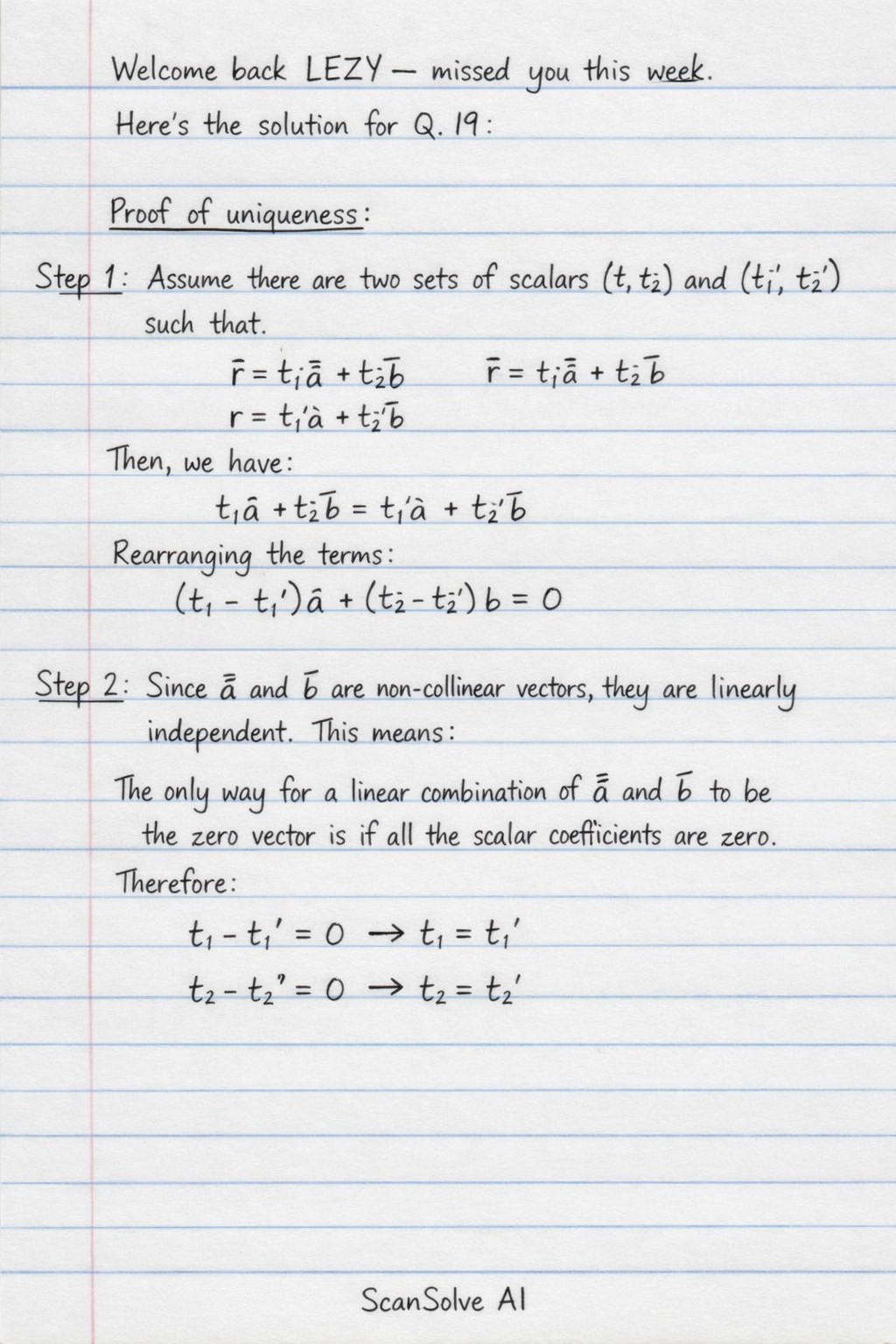
Handwritten Step-by-Step Solution
Get this as a handwritten image on WhatsApp — like a tutor wrote it for you.
Try on WhatsApp