
We read your photo as:
Expand (1 - 1/2x)6 to the fourth term.
Mathematics
ScanSolve AI Answer
Answer
Step-by-step solution
5 stepsTo expand to the fourth term, we use the binomial theorem, which states that:
In this case, , , and .
Calculate the first term ().
Calculate the second term ().
Calculate the third term ().
Calculate the fourth term ().
Combine the terms.
The expansion to the fourth term is the sum of these terms:
The expansion of to the fourth term is .
Was this helpful?
Try one yourself
A new problem that tests the same skill.
Still stuck on this one?
Ask a follow-up, and the answer starts from this question.
Got a different question?Ask your own question
More Mathematics Questions
QExpand (1−2x)6 using binomial theoremQExpand (4a2 + 12a + 9)3.5 up to fourth term, hence solve for (6.05)7QExpand (1/x + 1)5 up to the fourth term, hence use the expansion to estimate (1.04)5 correct to 4…QExpand the first three terms of (1+(x)/(2))10 using the binomial theorem.QExpand (2x + 3)4 using the binomial theorem.
Browse by topic:Algebra
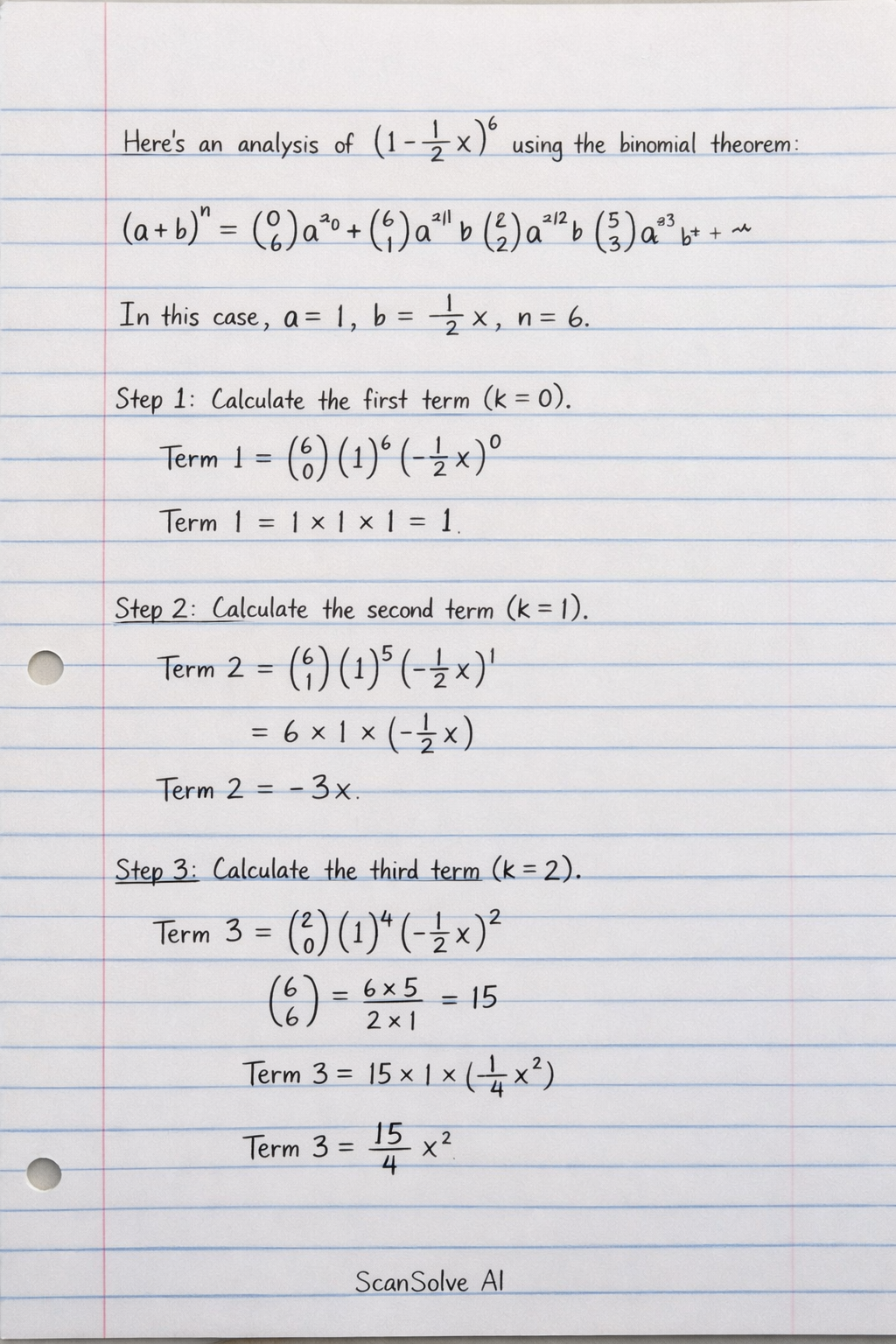
Handwritten Step-by-Step Solution
Get this as a handwritten image on WhatsApp — like a tutor wrote it for you.
Try on WhatsApp