

This mathematics problem involves applying core mathematical principles and formulas. Below you will find a complete step-by-step solution with detailed explanations for each step, helping you understand not just the answer but the method behind it.
ScanSolve AI Answer
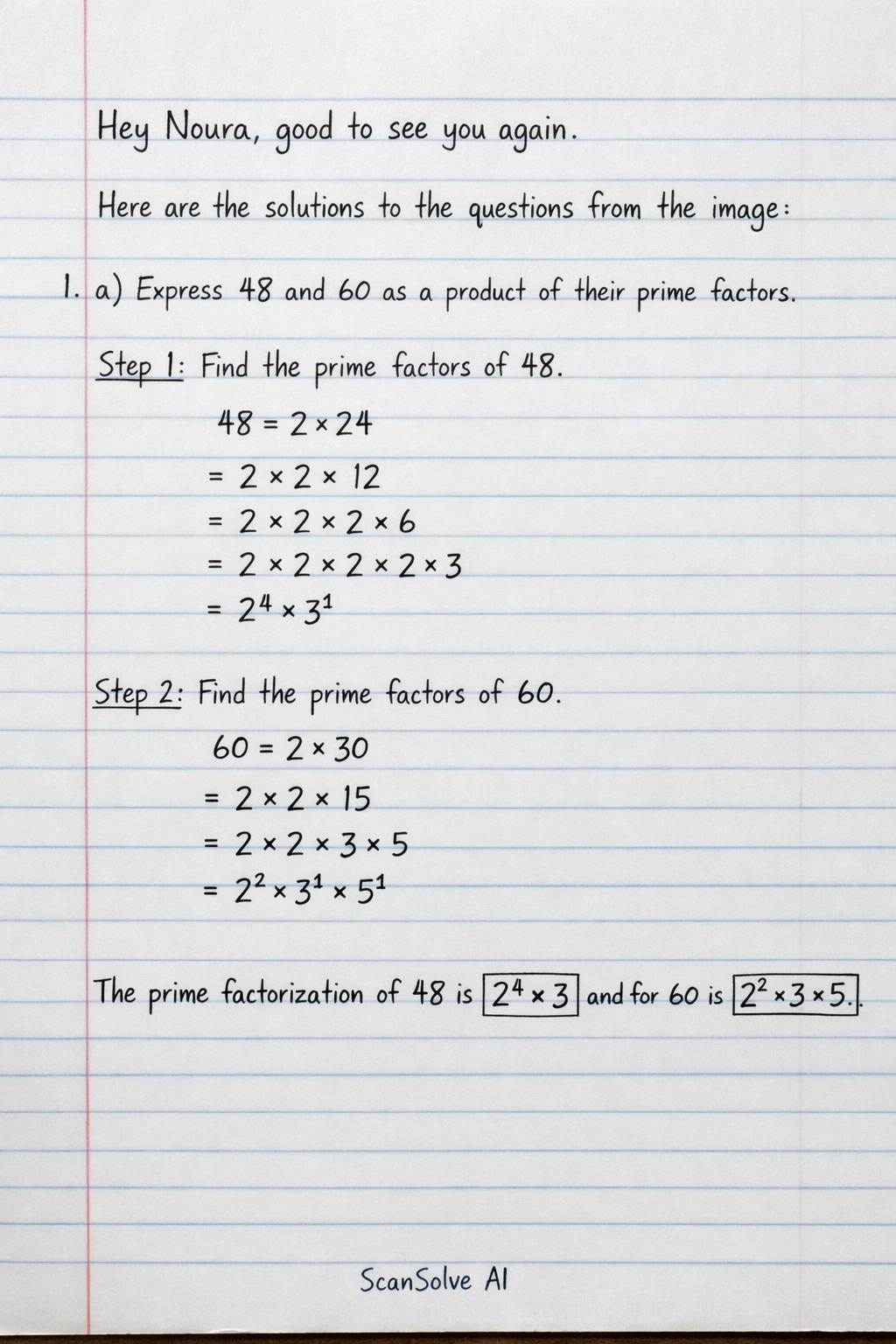
Hey Noura, good to see you again. Here are the solutions to the questions from the image: 1. a) Express 48 and 60 as a product of their prime factors. Step 1: Find the prime factors of 48. 48 = 2 × 24 = 2 × 2 × 12 = 2 × 2 × 2 × 6 = 2 × 2 × 2 × 2 × 3 = 2^4 × 3^1 Step 2: Find the prime factors of 60. 60 = 2 × 30 = 2 × 2 × 15 = 2 × 2 × 3 × 5 = 2^2 × 3^1 × 5^1 The prime factorization of 48 is 2^4 × 3 and for 60 is 2^2 × 3 × 5. b) Hence, find the LCM and GCD of 48 and 60. Step 1: Use the prime factorizations from part (a). 48 = 2^4 × 3^1 × 5^0 60 = 2^2 × 3^1 × 5^1 Step 2: Find the Greatest Common Divisor (GCD). For GCD, take the lowest power of each common prime factor. Common prime factors are 2 and 3. Lowest power of 2 is 2^2. Lowest power of 3 is 3^1. GCD(48, 60) = 2^2 × 3^1 = 4 × 3 = 12 Step 3: Find the Least Common Multiple (LCM). For LCM, take the highest power of all prime factors present in either number. Highest power of 2 is 2^4. Highest power of 3 is 3^1. Highest power of 5 is 5^1. LCM(48, 60) = 2^4 × 3^1 × 5^1 = 16 × 3 × 5 = 240 The GCD of 48 and 60 is 12 and the LCM is 240. c) A packet of sweets is shared between Amina, Pauline and Sharon in the ratio 2:3:5. If Pauline received 42 sweets, how many did Sharon receive? Step 1: Determine the value of one ratio part. The ratio for Amina : Pauline : Sharon is 2:3:5. Pauline's share corresponds to 3 parts of the ratio. Given that Pauline received 42 sweets, we can find the value of one part: 3 parts = 42 sweets 1 part = (42)/(3) = 14 sweets Step 2: Calculate Sharon's share. Sharon's share corresponds to 5 parts of the ratio. Sharon's sweets = 5 parts × 14 sweets/part Sharon's sweets = 70 sweets Sharon received 70 sweets. d) A right circular cone has a base diameter of 12 cm and a height of 8 cm. Find the total surface area. Step 1: Determine the radius and calculate the slant height. The base diameter is 12 cm, so the radius r = (12)/(2) = 6 cm. The height h = 8 cm. The slant height l can be found using the Pythagorean theorem: l = sqrt(r^2 + h^2) l = sqrt(6^2 + 8^2) l = sqrt(36 + 64) l = sqrt(100) l = 10 cm Step 2: Calculate the area of the base. The area of the circular base is A_base = r^2. A_base = × (6)^2 A_base = 36 cm^2 Step 3: Calculate the lateral surface area. The lateral surface area is A_lateral = r l. A_lateral = × 6 × 10 A_lateral = 60 cm^2 Step 4: Calculate the total surface area. The total surface area (TSA) is the sum of the base area and the lateral surface area. TSA = A_base + A_lateral TSA = 36 + 60 TSA = 96 cm^2 The total surface area is 96 cm^2. What's next?