
We read your photo as:
Express (7)/(x-3) - (8)/(1-2x) as a single fraction in its simplest form.
ScanSolve AI Answer
Answer
Step-by-step solution
8 stepsPart a· 5 steps
To express the given expression as a single fraction, we find a common denominator.
Find the common denominator.
The common denominator for and is .
Rewrite each fraction with the common denominator.
Combine the fractions and simplify the numerator.
Expand the denominator.
Write the final simplified fraction.
To make the leading term in the denominator positive, we can multiply the numerator and denominator by :
The final answer is .
Part b· 3 steps
(i) To draw a tree diagram, we consider the probabilities at each stage of selection.
Initially, there are 2 green (G) balls and 3 blue (B) balls, making a total of 5 balls.
First selection probabilities.
- Probability of selecting a Green ball first (G1):
- Probability of selecting a Blue ball first (B1):
Second selection probabilities (without replacement).
-
If the first ball was Green (G1): Remaining balls: 1 Green, 3 Blue (total 4 balls).
- Probability of selecting a Green ball second (G2 | G1):
- Probability of selecting a Blue ball second (B2 | G1):
-
If the first ball was Blue (B1): Remaining balls: 2 Green, 2 Blue (total 4 balls).
- Probability of selecting a Green ball second (G2 | B1):
- Probability of selecting a Blue ball second (B2 | B1):
-
Tree Diagram Illustration.
Here is a textual representation of the tree diagram:
- First Selection
- Branch 1: Green (G)
- Probability:
- Second Selection (after G)
- Branch 1.1: Green (G)
- Probability:
- Outcome: GG
- Branch 1.2: Blue (B)
- Probability:
- Outcome: GB
- Branch 1.1: Green (G)
- Branch 2: Blue (B)
- Probability:
- Second Selection (after B)
- Branch 2.1: Green (G)
- Probability:
- Outcome: BG
- Branch 2.2: Blue (B)
- Probability:
- Outcome: BB
- Branch 2.1: Green (G)
- Branch 1: Green (G)
- First Selection
Try one yourself
A new problem that tests the same skill.
Still stuck on this one?
Ask a follow-up, and the answer starts from this question.
More Mathematics Questions
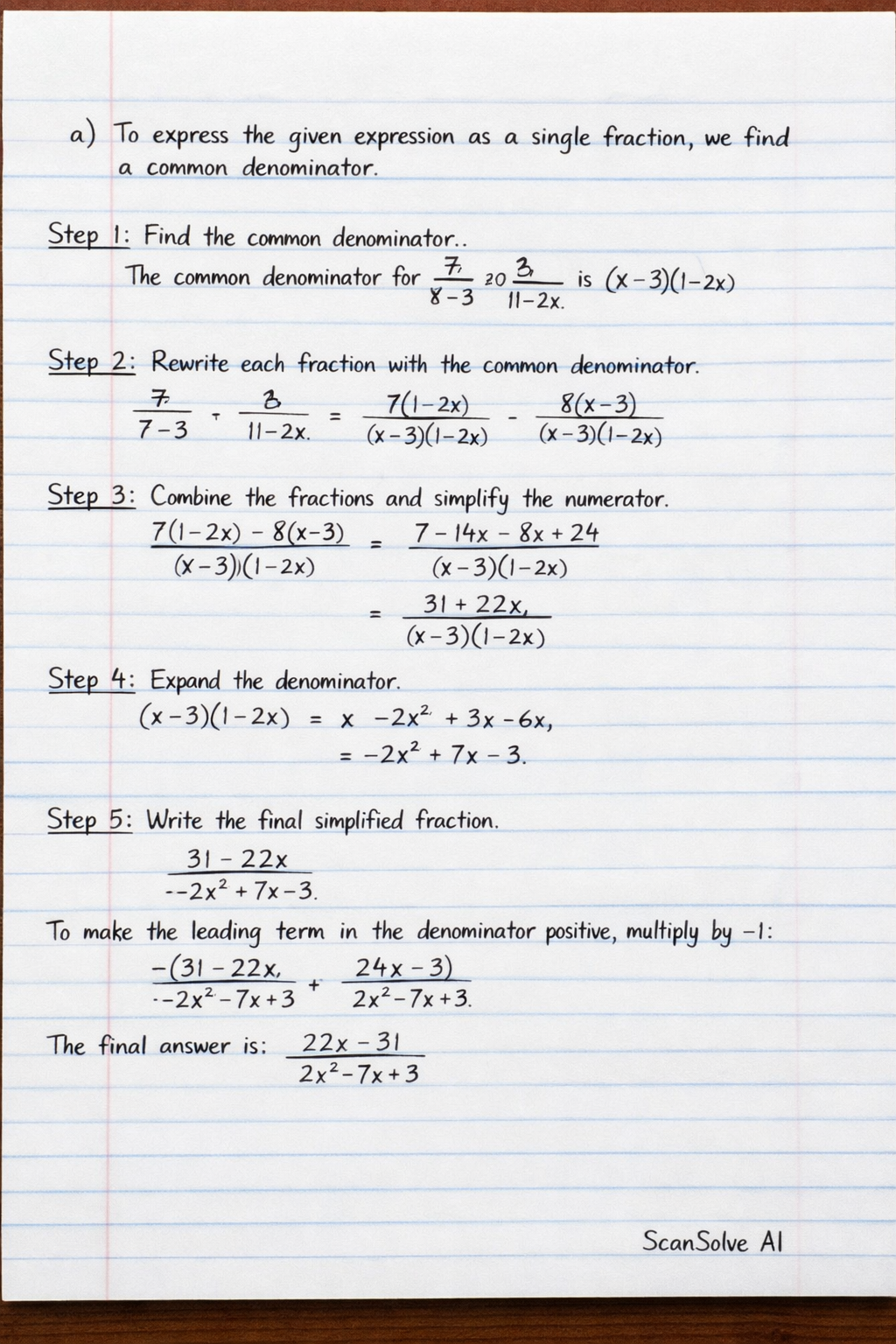
Handwritten Step-by-Step Solution
Get this as a handwritten image on WhatsApp — like a tutor wrote it for you.
Try on WhatsApp