We read your photo as:

Evaluate the expression: (9 1/2 - 3 1/3 ÷ 5/9) / (3/5 of 6 1/4 + 1 1/2)

Mathematics

ScanSolve AI Answer

Step-by-step solution

14 steps

Here are the solutions to the problems.

:

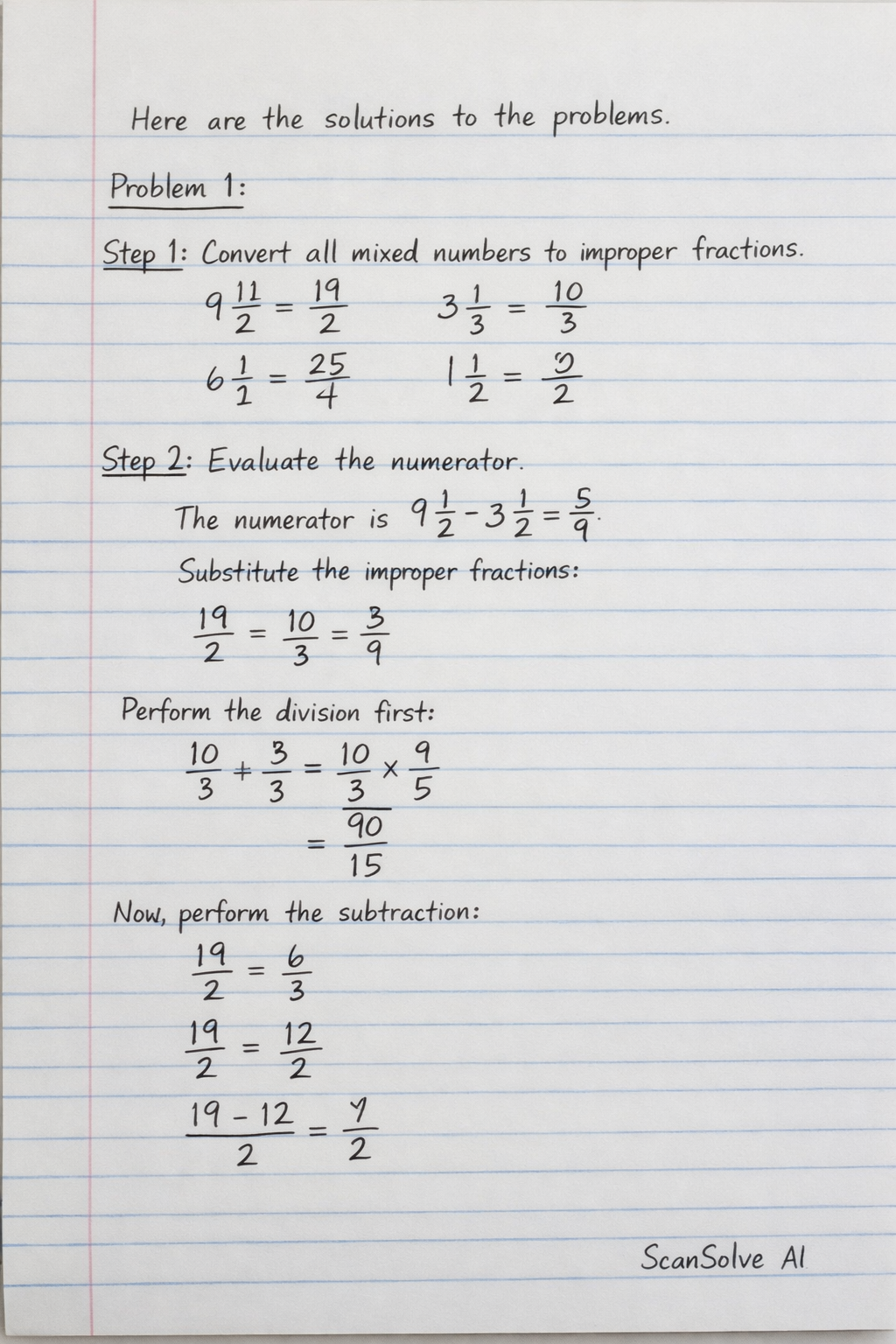
  1. Convert all mixed numbers to improper fractions.

    912=1929\frac{1}{2} = \frac{19}{2} 313=1033\frac{1}{3} = \frac{10}{3} 614=2546\frac{1}{4} = \frac{25}{4} 112=321\frac{1}{2} = \frac{3}{2}
  2. Evaluate the numerator.

    The numerator is 912−313÷599\frac{1}{2} - 3\frac{1}{3} \div \frac{5}{9}.
    Substitute the improper fractions:

    192−103÷59\frac{19}{2} - \frac{10}{3} \div \frac{5}{9}

    Perform the division first:

    103÷59=103×95=10×93×5=9015=6\frac{10}{3} \div \frac{5}{9} = \frac{10}{3} \times \frac{9}{5} = \frac{10 \times 9}{3 \times 5} = \frac{90}{15} = 6

    Now, perform the subtraction:

    192−6=192−122=19−122=72\frac{19}{2} - 6 = \frac{19}{2} - \frac{12}{2} = \frac{19 - 12}{2} = \frac{7}{2}
  3. Evaluate the denominator.

    The denominator is 35 of 614+112\frac{3}{5} \text{ of } 6\frac{1}{4} + 1\frac{1}{2}.
    "of" means multiplication. Substitute the improper fractions:

    35×254+32\frac{3}{5} \times \frac{25}{4} + \frac{3}{2}

    Perform the multiplication first:

    35×254=3×255×4=7520=154\frac{3}{5} \times \frac{25}{4} = \frac{3 \times 25}{5 \times 4} = \frac{75}{20} = \frac{15}{4}

    Now, perform the addition:

    154+32=154+64=15+64=214\frac{15}{4} + \frac{3}{2} = \frac{15}{4} + \frac{6}{4} = \frac{15 + 6}{4} = \frac{21}{4}
  4. Divide the numerator by the denominator.

    72214=72×421=7×42×21=2842\frac{\frac{7}{2}}{\frac{21}{4}} = \frac{7}{2} \times \frac{4}{21} = \frac{7 \times 4}{2 \times 21} = \frac{28}{42}

    Simplify the fraction by dividing both numerator and denominator by their greatest common divisor, which is 14:

    28÷1442÷14=23\frac{28 \div 14}{42 \div 14} = \frac{2}{3}

    The evaluated expression is 23\boxed{\frac{2}{3}}.

    :

  5. Express all terms in the equation with a base of 2.

    The equation is 32(x−3)×8(x+4)=64÷2x32^{(x-3)} \times 8^{(x+4)} = 64 \div 2^x.

    32=2532 = 2^5 8=238 = 2^3 64=2664 = 2^6

    Substitute these into the equation:

    (25)(x−3)×(23)(x+4)=26÷2x(2^5)^{(x-3)} \times (2^3)^{(x+4)} = 2^6 \div 2^x
  6. Apply the exponent rules (am)n=amn(a^m)^n = a^{mn}, am×an=am+na^m \times a^n = a^{m+n}, and am÷an=am−na^m \div a^n = a^{m-n}.

    25(x−3)×23(x+4)=26−x2^{5(x-3)} \times 2^{3(x+4)} = 2^{6-x} 25x−15×23x+12=26−x2^{5x-15} \times 2^{3x+12} = 2^{6-x} 2(5x−15)+(3x+12)=26−x2^{(5x-15) + (3x+12)} = 2^{6-x} 28x−3=26−x2^{8x-3} = 2^{6-x}
  7. Equate the exponents since the bases are the same.

    8x−3=6−x8x - 3 = 6 - x
  8. Solve for xx.

    Add xx to both sides:

    8x+x−3=68x + x - 3 = 6 9x−3=69x - 3 = 6

    Add 3 to both sides:

    9x=6+39x = 6 + 3 9x=99x = 9

    Divide by 9:

    x=99x = \frac{9}{9} x=1x = 1

    The value of xx is 1\boxed{1}.

    :

  9. Set the recurring decimal equal to xx.

    Let x=17.804˙x = 17.80\dot{4}, which means x=17.80444...x = 17.80444...

  10. Multiply xx by a power of 10 to move the non-repeating part to the left of the decimal point.

    The non-repeating part is '80'. There are two digits.

    100x=1780.444...(Equation 1)100x = 1780.444... \quad (\text{Equation 1})
  11. Multiply xx by a power of 10 to move one full repeating block to the left of the decimal point, along with the non-repeating part.

    The repeating part is '4'. There is one repeating digit. So, we multiply by 103=100010^3 = 1000.

    1000x=17804.444...(Equation 2)1000x = 17804.444... \quad (\text{Equation 2})
  12. Subtract Equation 1 from Equation 2.

    1000x−100x=17804.444...−1780.444...1000x - 100x = 17804.444... - 1780.444... 900x=16024900x = 16024
  13. Solve for xx and simplify the fraction.

    x=16024900x = \frac{16024}{900}

    Divide both the numerator and the denominator by their greatest common divisor. Both are divisible by 4.

    x=16024÷4900÷4=4006225x = \frac{16024 \div 4}{900 \div 4} = \frac{4006}{225}
  14. Convert the improper fraction to a mixed fraction.

    Divide 4006 by 225:

    4006÷225=17 with a remainder4006 \div 225 = 17 \text{ with a remainder} 17×225=382517 \times 225 = 3825 Remainder=4006−3825=181\text{Remainder} = 4006 - 3825 = 181

    So, the mixed fraction is 1718122517\frac{181}{225}.
    The fraction 181225\frac{181}{225} is in its simplest form because 181 is a prime number and 225 is not divisible by 181.
    The recurring decimal as a mixed fraction is 17181225\boxed{17\frac{181}{225}}.

Was this helpful?

Still stuck on this one?

Ask a follow-up, and the answer starts from this question.

Got a different question?Ask your own question
Handwritten step-by-step solution preview

Handwritten Step-by-Step Solution

Get this as a handwritten image on WhatsApp — like a tutor wrote it for you.

Try on WhatsApp