We read your photo as:

Evaluate the expression: (sin 135° - cos 360°) / (sin 150° + cos 225°)

Mathematics

ScanSolve AI Answer

Answer

2\sqrt{2}

Step-by-step solution

5 steps
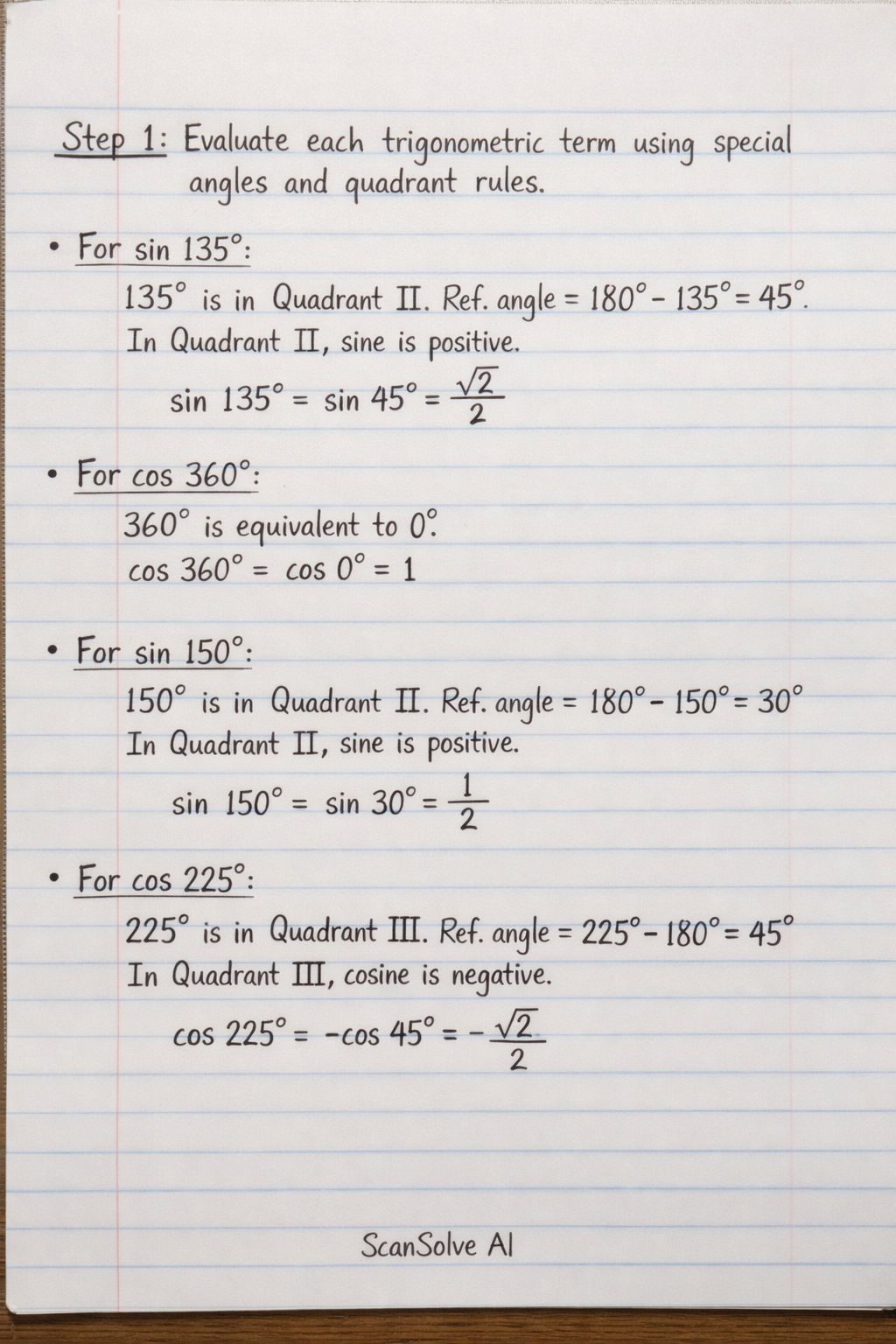
  1. Evaluate each trigonometric term using special angles and quadrant rules.

    • For sin⁡135∘\sin 135^\circ: 135∘135^\circ is in Quadrant II. The reference angle is 180∘−135∘=45∘180^\circ - 135^\circ = 45^\circ. In Quadrant II, sine is positive.

      sin⁡135∘=sin⁡45∘=22\sin 135^\circ = \sin 45^\circ = \frac{\sqrt{2}}{2}
    • For cos⁡360∘\cos 360^\circ: 360∘360^\circ is equivalent to 0∘0^\circ.

      cos⁡360∘=cos⁡0∘=1\cos 360^\circ = \cos 0^\circ = 1
    • For sin⁡150∘\sin 150^\circ: 150∘150^\circ is in Quadrant II. The reference angle is 180∘−150∘=30∘180^\circ - 150^\circ = 30^\circ. In Quadrant II, sine is positive.

      sin⁡150∘=sin⁡30∘=12\sin 150^\circ = \sin 30^\circ = \frac{1}{2}
    • For cos⁡225∘\cos 225^\circ: 225∘225^\circ is in Quadrant III. The reference angle is 225∘−180∘=45∘225^\circ - 180^\circ = 45^\circ. In Quadrant III, cosine is negative.

      cos⁡225∘=−cos⁡45∘=−22\cos 225^\circ = -\cos 45^\circ = -\frac{\sqrt{2}}{2}
  2. Substitute these values into the given expression.

    The expression is:

    sin⁡135∘−cos⁡360∘sin⁡150∘+cos⁡225∘\frac{\sin 135^\circ - \cos 360^\circ}{\sin 150^\circ + \cos 225^\circ}

    Substitute the values:

    22−112+(−22)\frac{\frac{\sqrt{2}}{2} - 1}{\frac{1}{2} + \left(-\frac{\sqrt{2}}{2}\right)} 22−112−22\frac{\frac{\sqrt{2}}{2} - 1}{\frac{1}{2} - \frac{\sqrt{2}}{2}}
  3. Simplify the numerator and the denominator.

    Numerator:

    22−1=2−22\frac{\sqrt{2}}{2} - 1 = \frac{\sqrt{2} - 2}{2}

    Denominator:

    12−22=1−22\frac{1}{2} - \frac{\sqrt{2}}{2} = \frac{1 - \sqrt{2}}{2}
  4. Perform the division.

    2−221−22=2−22×21−2\frac{\frac{\sqrt{2} - 2}{2}}{\frac{1 - \sqrt{2}}{2}} = \frac{\sqrt{2} - 2}{2} \times \frac{2}{1 - \sqrt{2}} =2−21−2= \frac{\sqrt{2} - 2}{1 - \sqrt{2}}
  5. Rationalize the denominator.

    Multiply the numerator and denominator by the conjugate of the denominator, which is 1+21 + \sqrt{2}.

    (2−2)(1+2)(1−2)(1+2)\frac{(\sqrt{2} - 2)(1 + \sqrt{2})}{(1 - \sqrt{2})(1 + \sqrt{2})}

    Expand the numerator:

    (2−2)(1+2)=2(1)+2(2)−2(1)−2(2)(\sqrt{2} - 2)(1 + \sqrt{2}) = \sqrt{2}(1) + \sqrt{2}(\sqrt{2}) - 2(1) - 2(\sqrt{2}) =2+2−2−22= \sqrt{2} + 2 - 2 - 2\sqrt{2} =−2= -\sqrt{2}

    Expand the denominator using the difference of squares formula (a−b)(a+b)=a2−b2(a-b)(a+b) = a^2 - b^2:

    (1−2)(1+2)=12−(2)2(1 - \sqrt{2})(1 + \sqrt{2}) = 1^2 - (\sqrt{2})^2 =1−2= 1 - 2 =−1= -1

    Now, substitute these back into the fraction:

    −2−1=2\frac{-\sqrt{2}}{-1} = \sqrt{2}

    The simplified expression is 2\sqrt{2}.

Was this helpful?

Try one yourself

A new problem that tests the same skill.

Still stuck on this one?

Ask a follow-up, and the answer starts from this question.

Got a different question?Ask your own question
Handwritten step-by-step solution preview

Handwritten Step-by-Step Solution

Get this as a handwritten image on WhatsApp — like a tutor wrote it for you.

Try on WhatsApp