f(x)=x2 * sqrt(1-x2) find f'(x)

Mathematics
f(x)=x2 * sqrt(1-x2) find f'(x)

ScanSolve AI Answer

Answer

x(23x2)1x2\frac{x(2 - 3x^2)}{\sqrt{1 - x^2}}

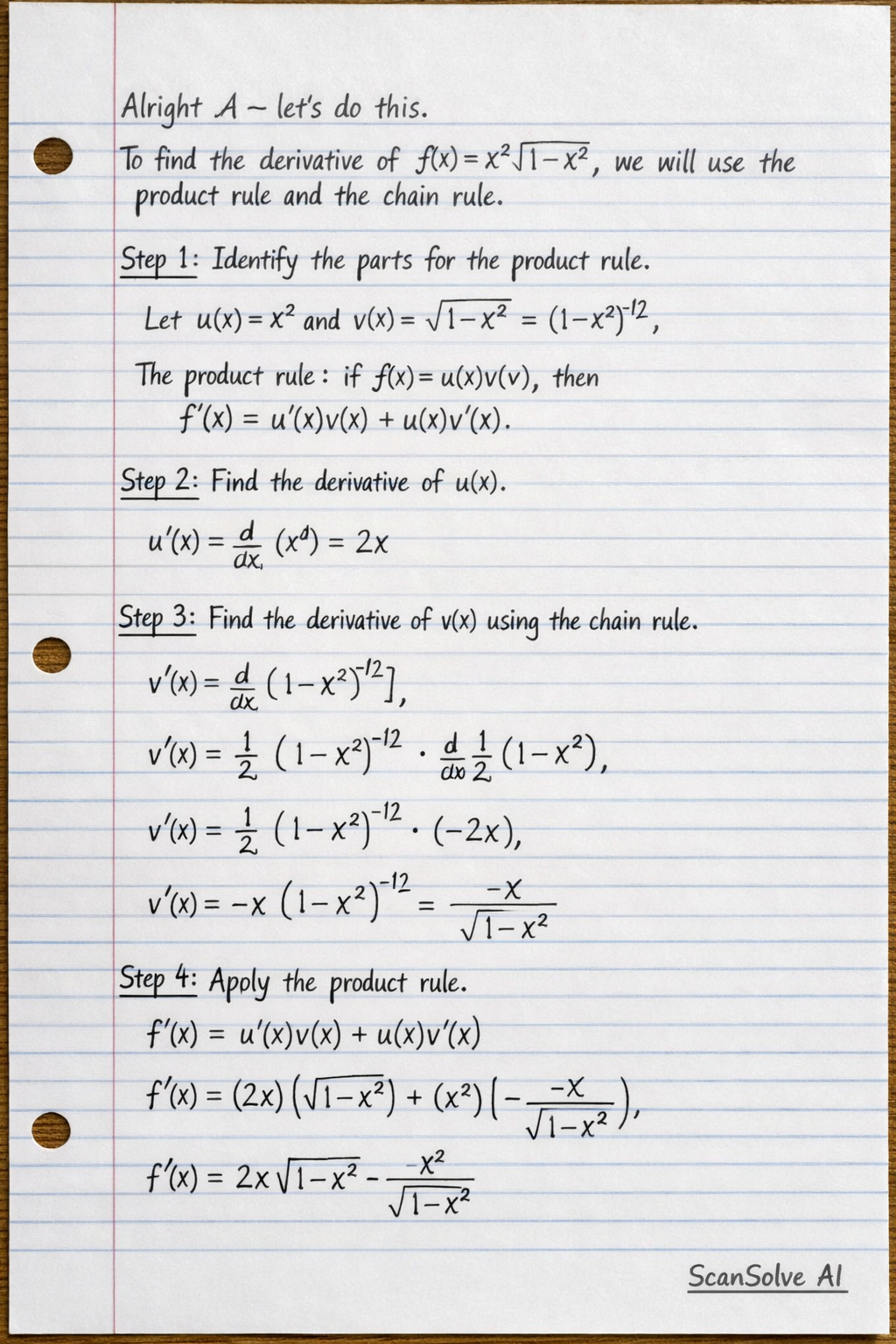
To find the derivative of f(x)=x21x2f(x) = x^2 \sqrt{1 - x^2}, we will use the product rule and the chain rule.

Step 1: Identify the parts for the product rule. Let u(x)=x2u(x) = x^2 and v(x)=1x2=(1x2)1/2v(x) = \sqrt{1 - x^2} = (1 - x^2)^{1/2}. The product rule states that if f(x)=u(x)v(x)f(x) = u(x)v(x), then f(x)=u(x)v(x)+u(x)v(x)f'(x) = u'(x)v(x) + u(x)v'(x).

Step 2: Find the derivative of u(x)u(x). u(x)=ddx(x2)=2xu'(x) = \frac{d}{dx}(x^2) = 2x

Step 3: Find the derivative of v(x)v(x) using the chain rule. v(x)=ddx((1x2)1/2)v'(x) = \frac{d}{dx}((1 - x^2)^{1/2}) Apply the power rule and chain rule: v(x)=12(1x2)1/2ddx(1x2)v'(x) = \frac{1}{2}(1 - x^2)^{-1/2} \cdot \frac{d}{dx}(1 - x^2) v(x)=12(1x2)1/2(2x)v'(x) = \frac{1}{2}(1 - x^2)^{-1/2} \cdot (-2x) v(x)=x(1x2)1/2=x1x2v'(x) = -x(1 - x^2)^{-1/2} = \frac{-x}{\sqrt{1 - x^2}}

Step 4: Apply the product rule. f(x)=u(x)v(x)+u(x)v(x)f'(x) = u'(x)v(x) + u(x)v'(x) f(x)=(2x)(1x2)+(x2)(x1x2)f'(x) = (2x)(\sqrt{1 - x^2}) + (x^2)\left(\frac{-x}{\sqrt{1 - x^2}}\right) f(x)=2x1x2x31x2f'(x) = 2x\sqrt{1 - x^2} - \frac{x^3}{\sqrt{1 - x^2}}

Step 5: Combine the terms by finding a common denominator. The common denominator is 1x2\sqrt{1 - x^2}. f(x)=2x1x21x21x2x31x2f'(x) = \frac{2x\sqrt{1 - x^2} \cdot \sqrt{1 - x^2}}{\sqrt{1 - x^2}} - \frac{x^3}{\sqrt{1 - x^2}} f(x)=2x(1x2)x31x2f'(x) = \frac{2x(1 - x^2) - x^3}{\sqrt{1 - x^2}} f(x)=2x2x3x31x2f'(x) = \frac{2x - 2x^3 - x^3}{\sqrt{1 - x^2}} f(x)=2x3x31x2f'(x) = \frac{2x - 3x^3}{\sqrt{1 - x^2}}

Step 6: Factor the numerator. f(x)=x(23x2)1x2f'(x) = \frac{x(2 - 3x^2)}{\sqrt{1 - x^2}}

The final answer is x(23x2)1x2\boxed{\frac{x(2 - 3x^2)}{\sqrt{1 - x^2}}}.

Send me the next one 📸

Was this helpful?

Need help with your own homework?

Get instant step-by-step solutions to any question. Free to start.

Ask Your Question
Handwritten step-by-step solution preview

Handwritten Step-by-Step Solution

Get this as a handwritten image on WhatsApp — like a tutor wrote it for you.

Try on WhatsApp

Still have questions?

Quick Answer

To find the derivative of f(x) = x^2 sqrt(1 - x^2), we will use the product rule and the chain rule.

f(x)=x2 * sqrt(1-x2) find f'(x)
Mathematics

This mathematics problem involves applying core mathematical principles and formulas. Below you will find a complete step-by-step solution with detailed explanations for each step, helping you understand not just the answer but the method behind it.

ScanSolve AI Answer
To find the derivative of f(x) = x^2 sqrt(1 - x^2), we will use the product rule and the chain rule. Step 1: Identify the parts for the product rule. Let u(x) = x^2 and v(x) = sqrt(1 - x^2) = (1 - x^2)^1/2. The product rule states that if f(x) = u(x)v(x), then f'(x) = u'(x)v(x) + u(x)v'(x). Step 2: Find the derivative of u(x). u'(x) = (d)/(dx)(x^2) = 2x Step 3: Find the derivative of v(x) using the chain rule. v'(x) = (d)/(dx)((1 - x^2)^1/2) Apply the power rule and chain rule: v'(x) = (1)/(2)(1 - x^2)^-1/2 · (d)/(dx)(1 - x^2) v'(x) = (1)/(2)(1 - x^2)^-1/2 · (-2x) v'(x) = -x(1 - x^2)^-1/2 = (-x)/(sqrt(1 - x^2)) Step 4: Apply the product rule. f'(x) = u'(x)v(x) + u(x)v'(x) f'(x) = (2x)(sqrt(1 - x^2)) + (x^2)((-x)/(sqrt(1 - x^2))) f'(x) = 2xsqrt(1 - x^2) - (x^3)/(sqrt(1 - x^2)) Step 5: Combine the terms by finding a common denominator. The common denominator is sqrt(1 - x^2). f'(x) = 2xsqrt(1 - x^2) · sqrt(1 - x^2)sqrt(1 - x^2) - (x^3)/(sqrt(1 - x^2)) f'(x) = (2x(1 - x^2) - x^3)/(sqrt(1 - x^2)) f'(x) = (2x - 2x^3 - x^3)/(sqrt(1 - x^2)) f'(x) = (2x - 3x^3)/(sqrt(1 - x^2)) Step 6: Factor the numerator. f'(x) = (x(2 - 3x^2))/(sqrt(1 - x^2)) The final answer is (x(2 - 3x^2))/(sqrt(1 - x^2)). Send me the next one 📸