
We read your photo as:
Factorise Completely: 6ab - 3ac A. 3a(2b - c) B. 3(2ab - ac) C. ca(6b - 3c) D. 6a(b - c)
ScanSolve AI Answer
Answer
Step-by-step solution
6 stepsTo factorise the expression completely, we need to find the greatest common factor (GCF) of the terms.
Identify the terms in the expression.
The terms are and .
Find the greatest common factor of the numerical coefficients.
The coefficients are 6 and 3. The GCF of 6 and 3 is 3.
Find the greatest common factor of the variables.
Both terms contain the variable .
The first term has , but the second term does not.
The second term has , but the first term does not.
So, the common variable factor is .Combine the numerical and variable GCFs to find the overall GCF.
The GCF of $6ab$ and $3ac$ is $3a$.
Divide each term in the original expression by the GCF.
For the first term:
For the second term:Write the factored expression by placing the GCF outside the parentheses and the results from Step 5 inside.
Comparing this result with the given options:
A.
B.
C.
D.The correct option is A.
The final answer is .
Try one yourself
A new problem that tests the same skill.
Still stuck on this one?
Ask a follow-up, and the answer starts from this question.
More Mathematics Questions
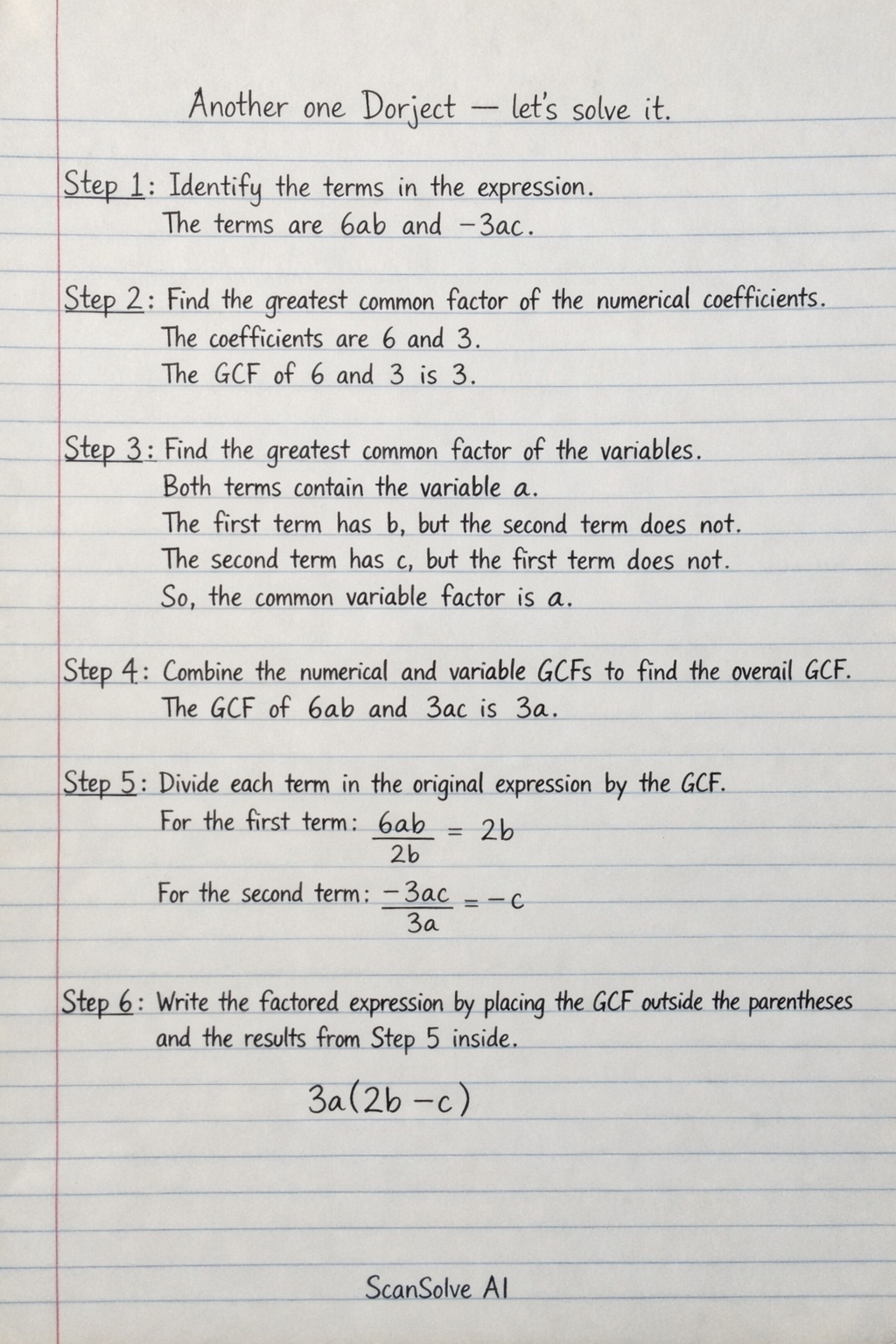
Handwritten Step-by-Step Solution
Get this as a handwritten image on WhatsApp — like a tutor wrote it for you.
Try on WhatsApp