We read your photo as:

Factorise the following expressions completely. Leave your answers in simplest form:

Mathematics

ScanSolve AI Answer

Step-by-step solution

32 steps

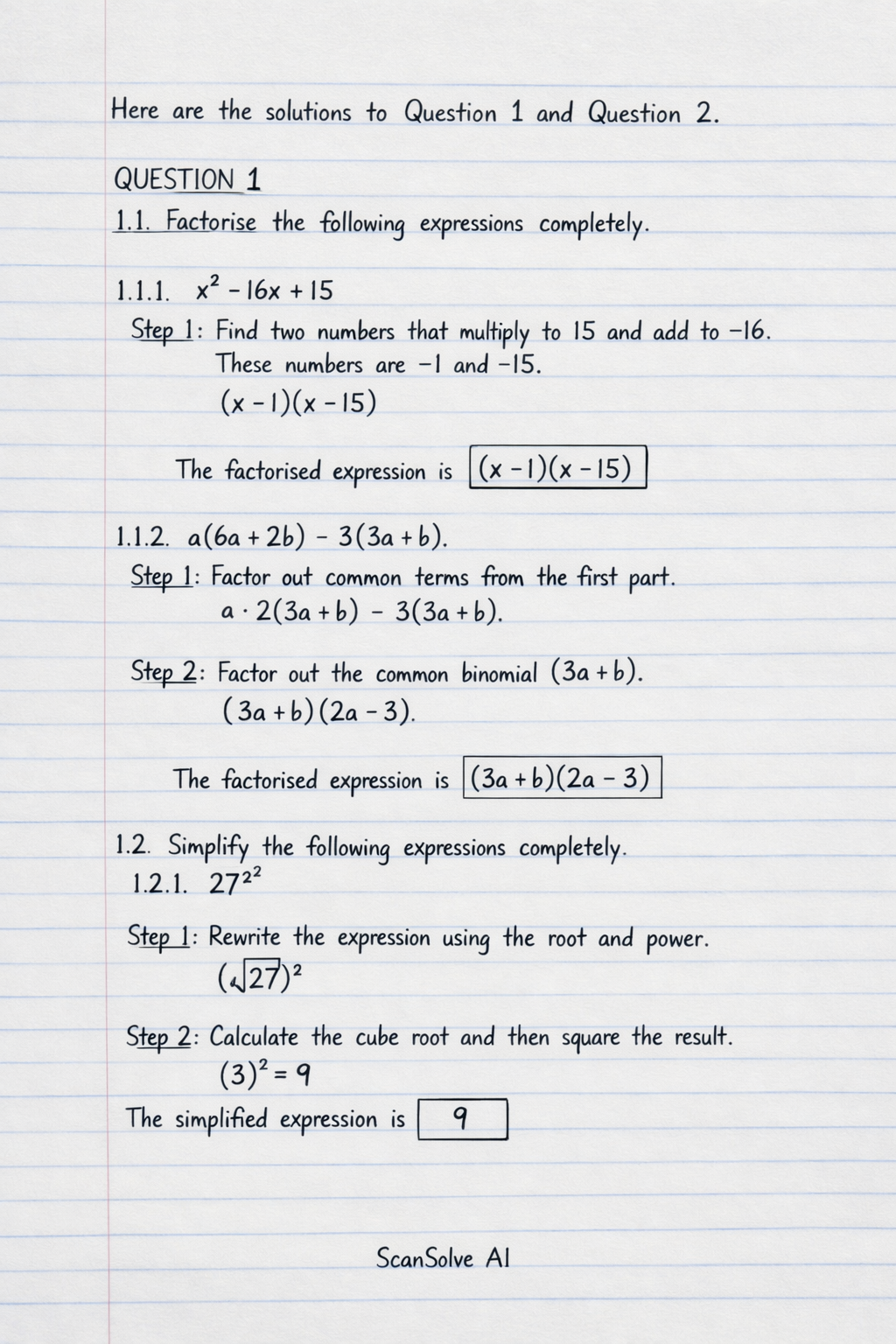
Here are the solutions to Question 1 and Question 2.

QUESTION 1

1.1 Factorise the following expressions completely.

1.1.1 x2−16x+15x^2 - 16x + 15

  1. Find two numbers that multiply to 15 and add to -16.

    These numbers are -1 and -15.

    (x−1)(x−15)(x-1)(x-15)

    The factorised expression is (x−1)(x−15)\boxed{(x-1)(x-15)}.

    1.1.2 a(6a+2b)−3(3a+b)a(6a + 2b) - 3(3a + b)

  2. Factor out common terms from the first part.

    a⋅2(3a+b)−3(3a+b)a \cdot 2(3a+b) - 3(3a+b)
  3. Factor out the common binomial (3a+b)(3a+b).

    (3a+b)(2a−3)(3a+b)(2a-3)

    The factorised expression is (3a+b)(2a−3)\boxed{(3a+b)(2a-3)}.

    1.2 Simplify the following expressions completely.

    1.2.1 272327^{\frac{2}{3}}

  4. Rewrite the expression using the root and power.

    (273)2(\sqrt[3]{27})^2
  5. Calculate the cube root and then square the result.

    (3)2=9(3)^2 = 9

    The simplified expression is 9\boxed{9}.

    1.2.2 x+3x−3×x3−27x2−9+x2+3x+9x−3\frac{x+3}{x-3} \times \frac{x^3-27}{x^2-9} + \frac{x^2+3x+9}{x-3}

  6. Factorise the terms in the multiplication part.

    Use difference of cubes a3−b3=(a−b)(a2+ab+b2)a^3-b^3=(a-b)(a^2+ab+b^2) and difference of squares a2−b2=(a−b)(a+b)a^2-b^2=(a-b)(a+b).

    x+3x−3×(x−3)(x2+3x+9)(x−3)(x+3)+x2+3x+9x−3\frac{x+3}{x-3} \times \frac{(x-3)(x^2+3x+9)}{(x-3)(x+3)} + \frac{x^2+3x+9}{x-3}
  7. Cancel common factors in the multiplication.

    x+3x−3×(x−3)(x2+3x+9)(x−3)(x+3)+x2+3x+9x−3\frac{\cancel{x+3}}{\cancel{x-3}} \times \frac{\cancel{(x-3)}(x^2+3x+9)}{\cancel{(x-3)}\cancel{(x+3)}} + \frac{x^2+3x+9}{x-3} =x2+3x+9x−3+x2+3x+9x−3= \frac{x^2+3x+9}{x-3} + \frac{x^2+3x+9}{x-3}
  8. Add the fractions since they have the same denominator.

    =(x2+3x+9)+(x2+3x+9)x−3= \frac{(x^2+3x+9) + (x^2+3x+9)}{x-3} =2(x2+3x+9)x−3= \frac{2(x^2+3x+9)}{x-3}

    The simplified expression is ∗2(x2+3x+9)x−3∗\boxed*{\frac{2(x^2+3x+9)}{x-3}*}.

    1.2.3 3x+1−3x+23x+2+3x\frac{3^{x+1} - 3^{x+2}}{3^{x+2} + 3^x}

  9. Factor out the common term 3x3^x from the numerator and denominator.

    3x⋅31−3x⋅323x⋅32+3x⋅1\frac{3^x \cdot 3^1 - 3^x \cdot 3^2}{3^x \cdot 3^2 + 3^x \cdot 1}
  10. Factor out 3x3^x from both numerator and denominator.

    3x(3−32)3x(32+1)\frac{3^x(3 - 3^2)}{3^x(3^2 + 1)}
  11. Simplify the terms inside the parentheses and cancel 3x3^x.

    3x(3−9)3x(9+1)=−610\frac{3^x(3 - 9)}{3^x(9 + 1)} = \frac{-6}{10}
  12. Simplify the fraction.

    =−35= -\frac{3}{5}

    The simplified expression is ∗−35∗\boxed*{-\frac{3}{5}*}.

    QUESTION 2

    2.1 Solve for x:

    2.1.1 2⋅32x=182 \cdot 3^{2x} = 18

  13. Divide both sides by 2.

    32x=1823^{2x} = \frac{18}{2} 32x=93^{2x} = 9
  14. Express 9 as a power of 3.

    32x=323^{2x} = 3^2
  15. Equate the exponents.

    2x=22x = 2
  16. Solve for xx.

    x=1x = 1

    The solution is x=1\boxed{x=1}.

    2.1.2 2x−13≥2x+1\frac{2x-1}{3} \ge 2x+1

  17. Multiply both sides by 3 to eliminate the denominator.

    2x−1≥3(2x+1)2x-1 \ge 3(2x+1)
  18. Distribute on the right side.

    2x−1≥6x+32x-1 \ge 6x+3
  19. Gather xx terms on one side and constants on the other.

    −1−3≥6x−2x-1 - 3 \ge 6x - 2x −4≥4x-4 \ge 4x
  20. Divide by 4.

    −44≥x\frac{-4}{4} \ge x −1≥xorx≤−1-1 \ge x \quad \text{or} \quad x \le -1

    The solution is x≤−1\boxed{x \le -1}.

    2.1.3 2x2−x−10=02x^2 - x - 10 = 0

  21. Factor the quadratic expression.

    Find two numbers that multiply to 2×(−10)=−202 \times (-10) = -20 and add to -1. These numbers are -5 and 4.

    2x2−5x+4x−10=02x^2 - 5x + 4x - 10 = 0
  22. Factor by grouping.

    x(2x−5)+2(2x−5)=0x(2x-5) + 2(2x-5) = 0 (2x−5)(x+2)=0(2x-5)(x+2) = 0
  23. Set each factor to zero and solve for xx.

    2x−5=0orx+2=02x-5 = 0 \quad \text{or} \quad x+2 = 0 2x=5orx=−22x = 5 \quad \text{or} \quad x = -2 x=52orx=−2x = \frac{5}{2} \quad \text{or} \quad x = -2

    The solutions are ∗x=52 or x=−2∗\boxed*{x=\frac{5}{2} \text{ or } x=-2*}.

    2.2 How much must be added to (x+5)(x−5)(x+5)(x-5) so that it will be equal to (x+1)(x−25)(x+1)(x-25)?

  24. Let the amount to be added be AA.

    Set up the equation.

    (x+5)(x−5)+A=(x+1)(x−25)(x+5)(x-5) + A = (x+1)(x-25)
  25. Expand both sides of the equation.

    (x2−25)+A=x2−25x+x−25(x^2 - 25) + A = x^2 - 25x + x - 25 x2−25+A=x2−24x−25x^2 - 25 + A = x^2 - 24x - 25
  26. Isolate AA by subtracting terms from both sides.

    A=(x2−24x−25)−(x2−25)A = (x^2 - 24x - 25) - (x^2 - 25) A=x2−24x−25−x2+25A = x^2 - 24x - 25 - x^2 + 25
  27. Simplify the expression for AA.

    A=−24xA = -24x

    The amount that must be added is −24x\boxed{-24x}.

    2.3 Solve for x and y simultaneously:
    Equation 1: y−3x=−2y - 3x = -2
    Equation 2: 7x−2y=87x - 2y = 8

  28. From Equation 1, express yy in terms of xx.

    y=3x−2(Equation 3)y = 3x - 2 \quad \text{(Equation 3)}
  29. Substitute Equation 3 into Equation 2.

    7x−2(3x−2)=87x - 2(3x - 2) = 8
  30. Distribute and simplify.

    7x−6x+4=87x - 6x + 4 = 8 x+4=8x + 4 = 8
  31. Solve for xx.

    x=8−4x = 8 - 4 x=4x = 4
  32. Substitute the value of xx back into Equation 3 to find yy.

    y=3(4)−2y = 3(4) - 2 y=12−2y = 12 - 2 y=10y = 10

    The solutions are ∗x=4,y=10∗\boxed*{x=4, y=10*}.

Was this helpful?

Still stuck on this one?

Ask a follow-up, and the answer starts from this question.

Got a different question?Ask your own question
Handwritten step-by-step solution preview

Handwritten Step-by-Step Solution

Get this as a handwritten image on WhatsApp — like a tutor wrote it for you.

Try on WhatsApp