
We read your photo as:
Given the following algebraic expressions: 1.1 Fully factorise each expression 1.2 Determine the LCM of all four expressions. Simplify the following algebraic fractions: 2.1 2.2
Mathematics
ScanSolve AI Answer
Step-by-step solution
6 stepsHere's the solution for Question 2.1:
2.1.1 Fully factorise each expression
Factorize the first expression.
This is a perfect square trinomial of the form . Here, and .
Factorize the second expression.
This is a difference of squares of the form . Here, and .
Factorize the third expression.
Factor out the common term .
Factorize the fourth expression.
First, factor out the common numerical factor, which is 3.
Now, factor the quadratic expression . We look for two terms that multiply to and add to . These are and .
So, the fully factorized expression is:
2.1.2 Determine the LCM of all four expressions.
List all unique factors from the factorized expressions and identify their highest powers.
The factorized expressions are:
The unique factors are:
- Numerical factor: 3 (from expression 4)
- Algebraic factors: , , ,
The highest powers for each unique factor are:
- (from expression 1)
- (from expression 2)
- (from expression 4)
Multiply all unique factors raised to their highest powers to find the LCM.
Was this helpful?
Still stuck on this one?
Ask a follow-up, and the answer starts from this question.
Got a different question?Ask your own question
More Mathematics Questions
QSimplify the following algebraic expressions.Q1 Write down all the possible factors for each of the following expressions. 1.2 Determine the…QWrite down all the possible factors for each of the following expressions. Determine the H.C.F. of…QFind the Least Common Multiple (LCM) of the given algebraic expressions and numbers.
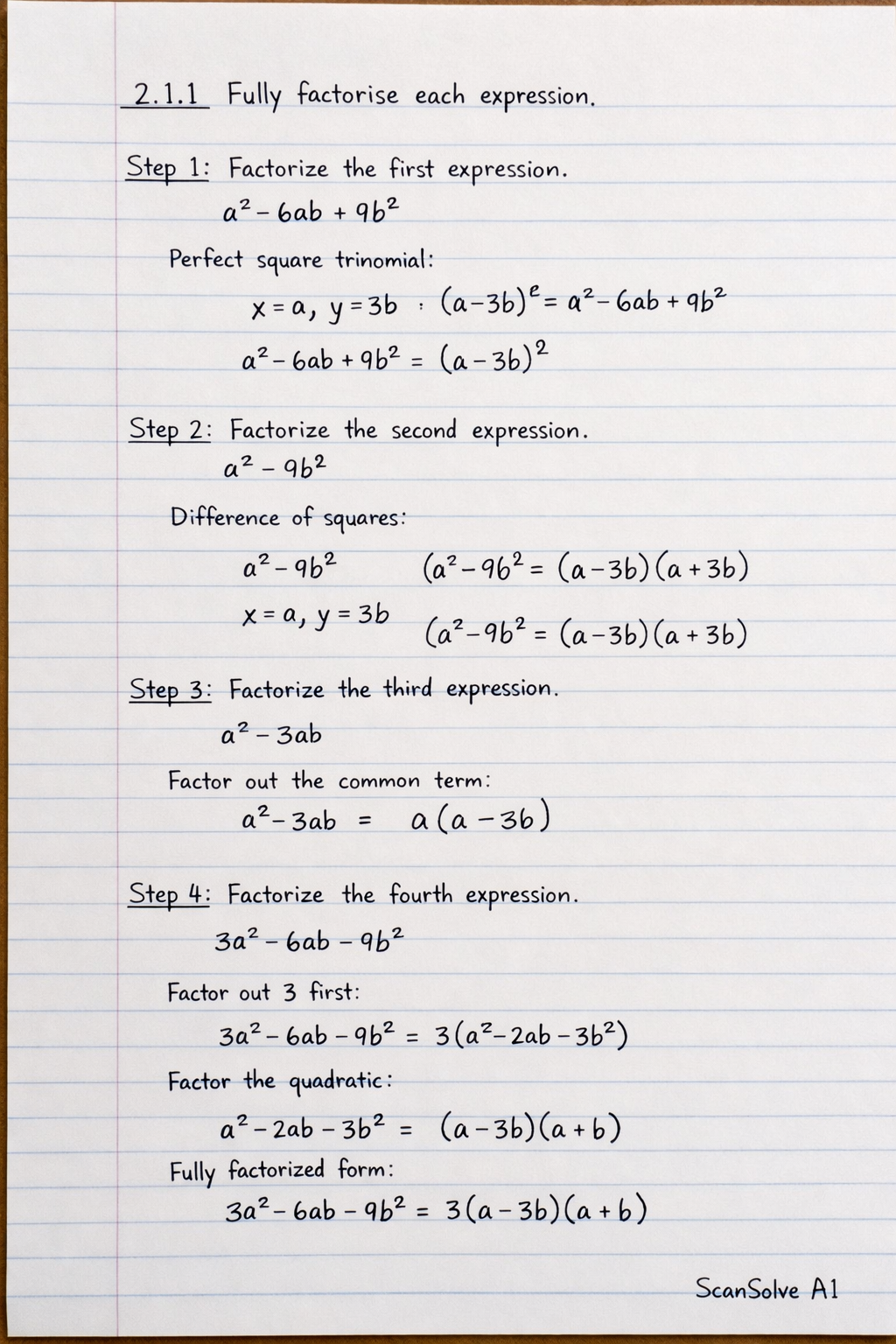
Handwritten Step-by-Step Solution
Get this as a handwritten image on WhatsApp — like a tutor wrote it for you.
Try on WhatsApp