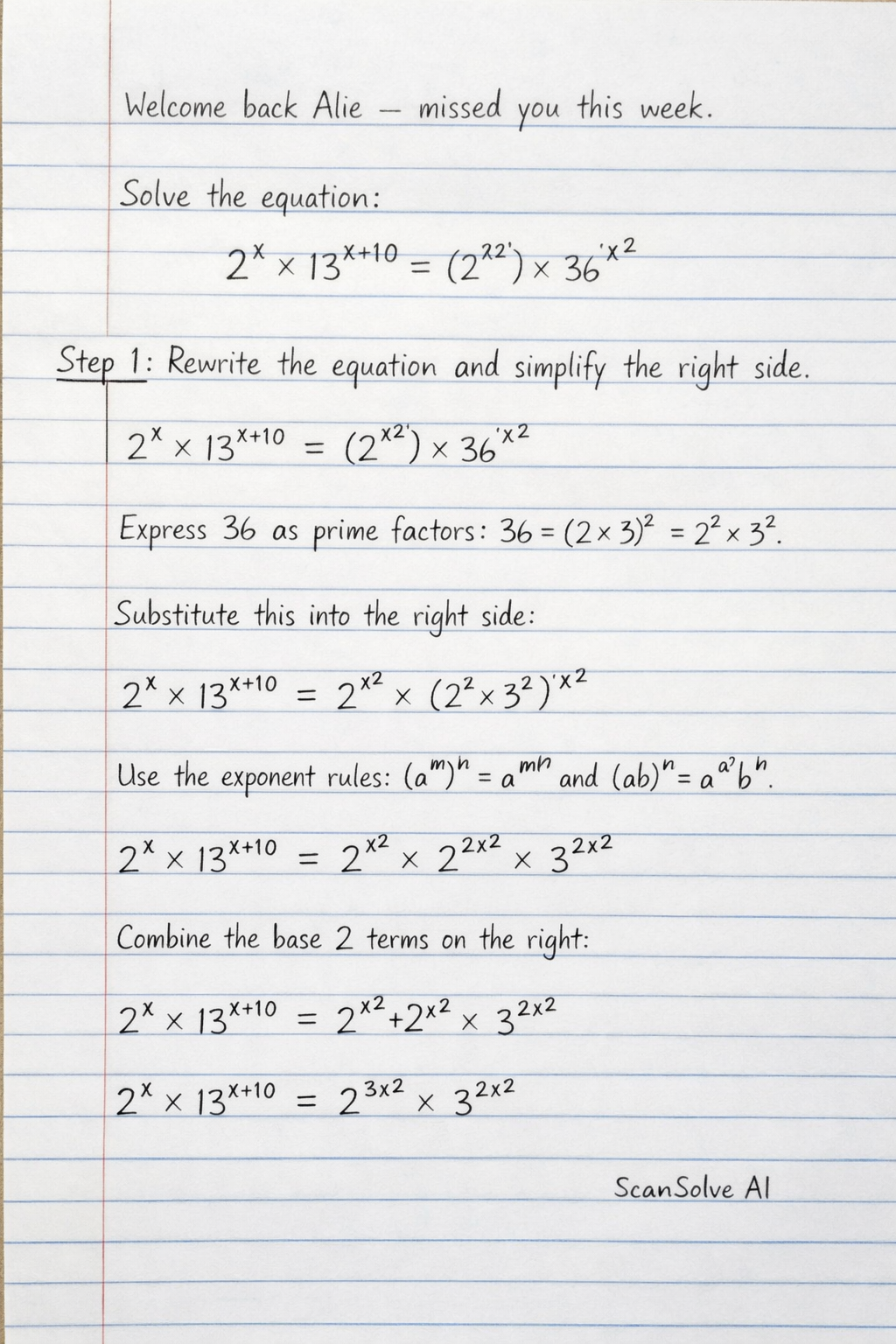
The problem asks to solve the equation:
2x×13x+10∼(2x2)×36x2
We will assume the symbol ∼ represents an equals sign (=), as is common in mathematical problems of this type.
Step 1: Rewrite the equation and simplify the right side.
The equation is:
2x×13x+10=(2x2)×36x2
First, express 36 in terms of its prime factors: 36=62=(2×3)2=22×32.
Now substitute this into the right side of the equation:
2x×13x+10=2x2×(22×32)x2
Apply the exponent rule (am)n=amn and (ab)n=anbn:
2x×13x+10=2x2×22x2×32x2
Combine the terms with base 2 on the right side using the rule am×an=am+n:
2x×13x+10=2x2+2x2×32x22x×13x+10=23x2×32x2
Step 2: Take the logarithm of both sides.
To solve for x, we take the logarithm (e.g., base 10 logarithm, denoted as log) of both sides. Use the logarithm properties log(ab)=loga+logb and log(ab)=bloga:
log(2x×13x+10)=log(23x2×32x2)xlog2+(x+10)log13=3x2log2+2x2log3
Step 3: Rearrange the equation into a standard quadratic form Ax2+Bx+C=0.
Expand the terms:
xlog2+xlog13+10log13=3x2log2+2x2log3
Move all terms to one side to form a quadratic equation:
(3log2+2log3)x2−(log2+log13)x−10log13=0
Use logarithm properties loga+logb=log(ab) and bloga=log(ab):
(log(23)+log(32))x2−(log(2×13))x−10log13=0(log8+log9)x2−(log26)x−10log13=0(log(8×9))x2−(log26)x−10log13=0(log72)x2−(log26)x−10log13=0
This is a quadratic equation where A=log72, B=−log26, and C=−10log13.
Step 4: Apply the quadratic formula to find x.
The quadratic formula is x=2A−B±B2−4AC.
x=2(log72)−(−log26)±(−log26)2−4(log72)(−10log13)x=2log72log26±(log26)2+40(log72)(log13)
This is the exact solution for x.
Step 5: Calculate the numerical values (using base-10 logarithms, rounded to 4 decimal places).
log72≈1.8573log26≈1.4150log13≈1.1139
Substitute these values into the quadratic formula:
A≈1.8573B≈−1.4150C≈−10×1.1139=−11.1390
Calculate the discriminant Δ=B2−4AC:
Δ≈(−1.4150)2−4(1.8573)(−11.1390)Δ≈2.0022+82.7285Δ≈84.7307Δ≈84.7307≈9.2050
Now, calculate the two possible values for x:
x=2(1.8573)1.4150±9.2050x=3.71461.4150±9.2050x1=3.71461.4150+9.2050=3.714610.6200≈2.8590x2=3.71461.4150−9.2050=3.7146−7.7900≈−2.0972
The solutions for x are approximately:
x≈2.8590orx≈−2.0972
Send me the next one 📸
Was this helpful?
Need help with your own homework?
Get instant step-by-step solutions to any question. Free to start.
The problem asks to solve the equation: 2^x × 13^x+10 (2^x^2) × 36^x^2 We will assume the symbol represents an equals sign (=), as is common in mathematical problems of this type.
This mathematics problem involves applying core mathematical principles and formulas. Below you will find a complete step-by-step solution with detailed explanations for each step, helping you understand not just the answer but the method behind it.
ScanSolve AI Answer
The problem asks to solve the equation: 2^x × 13^x+10 (2^x^2) × 36^x^2 We will assume the symbol represents an equals sign (=), as is common in mathematical problems of this type. Step 1: Rewrite the equation and simplify the right side. The equation is: 2^x × 13^x+10 = (2^x^2) × 36^x^2 First, express 36 in terms of its prime factors: 36 = 6^2 = (2 × 3)^2 = 2^2 × 3^2. Now substitute this into the right side of the equation: 2^x × 13^x+10 = 2^x^2 × (2^2 × 3^2)^x^2 Apply the exponent rule (a^m)^n = a^mn and (ab)^n = a^n b^n: 2^x × 13^x+10 = 2^x^2 × 2^2x^2 × 3^2x^2 Combine the terms with base 2 on the right side using the rule a^m × a^n = a^m+n: 2^x × 13^x+10 = 2^x^2 + 2x^2 × 3^2x^2 2^x × 13^x+10 = 2^3x^2 × 3^2x^2 Step 2: Take the logarithm of both sides. To solve for x, we take the logarithm (e.g., base 10 logarithm, denoted as ) of both sides. Use the logarithm properties (ab) = a + b and (a^b) = b a: (2^x × 13^x+10) = (2^3x^2 × 3^2x^2) x 2 + (x+10) 13 = 3x^2 2 + 2x^2 3 Step 3: Rearrange the equation into a standard quadratic form Ax^2 + Bx + C = 0. Expand the terms: x 2 + x 13 + 10 13 = 3x^2 2 + 2x^2 3 Move all terms to one side to form a quadratic equation: (3 2 + 2 3)x^2 - ( 2 + 13)x - 10 13 = 0 Use logarithm properties a + b = (ab) and b a = (a^b): ((2^3) + (3^2))x^2 - ((2 × 13))x - 10 13 = 0 ( 8 + 9)x^2 - ( 26)x - 10 13 = 0 ((8 × 9))x^2 - ( 26)x - 10 13 = 0 ( 72)x^2 - ( 26)x - 10 13 = 0 This is a quadratic equation where A = 72, B = - 26, and C = -10 13. Step 4: Apply the quadratic formula to find x. The quadratic formula is x = -B ± sqrt(B^2 - 4AC)2A. x = -(- 26) ± sqrt((- 26)^2 - 4( 72)(-10 13))2( 72) x = 26 ± sqrt(( 26)^2 + 40 ( 72)( 13))2 72 This is the exact solution for x. Step 5: Calculate the numerical values (using base-10 logarithms, rounded to 4 decimal places). 72 ≈ 1.8573 26 ≈ 1.4150 13 ≈ 1.1139 Substitute these values into the quadratic formula: A ≈ 1.8573 B ≈ -1.4150 C ≈ -10 × 1.1139 = -11.1390 Calculate the discriminant = B^2 - 4AC: ≈ (-1.4150)^2 - 4(1.8573)(-11.1390) ≈ 2.0022 + 82.7285 ≈ 84.7307 sqrt() ≈ sqrt(84.7307) ≈ 9.2050 Now, calculate the two possible values for x: x = (1.4150 ± 9.2050)/(2(1.8573)) x = (1.4150 ± 9.2050)/(3.7146) x_1 = (1.4150 + 9.2050)/(3.7146) = (10.6200)/(3.7146) ≈ 2.8590 x_2 = (1.4150 - 9.2050)/(3.7146) = (-7.7900)/(3.7146) ≈ -2.0972 The solutions for x are approximately: x ≈ 2.8590 or x ≈ -2.0972 Send me the next one 📸