We read your photo as:

ABCD and CFGE are identical parallelograms. HCB and EDC are identical right-angled triangles. (a) Find ∠w. (b) Find ∠y. (c) Circle the words that describe BHF in the statement: BHF (is / is not) a straight line because the sum of angles BHC and CHF (is / is not) 180°.

Mathematics

ScanSolve AI Answer

Answers

2 parts
a

100∘100^\circ

b

66∘66^\circ

Step-by-step solution

8 steps

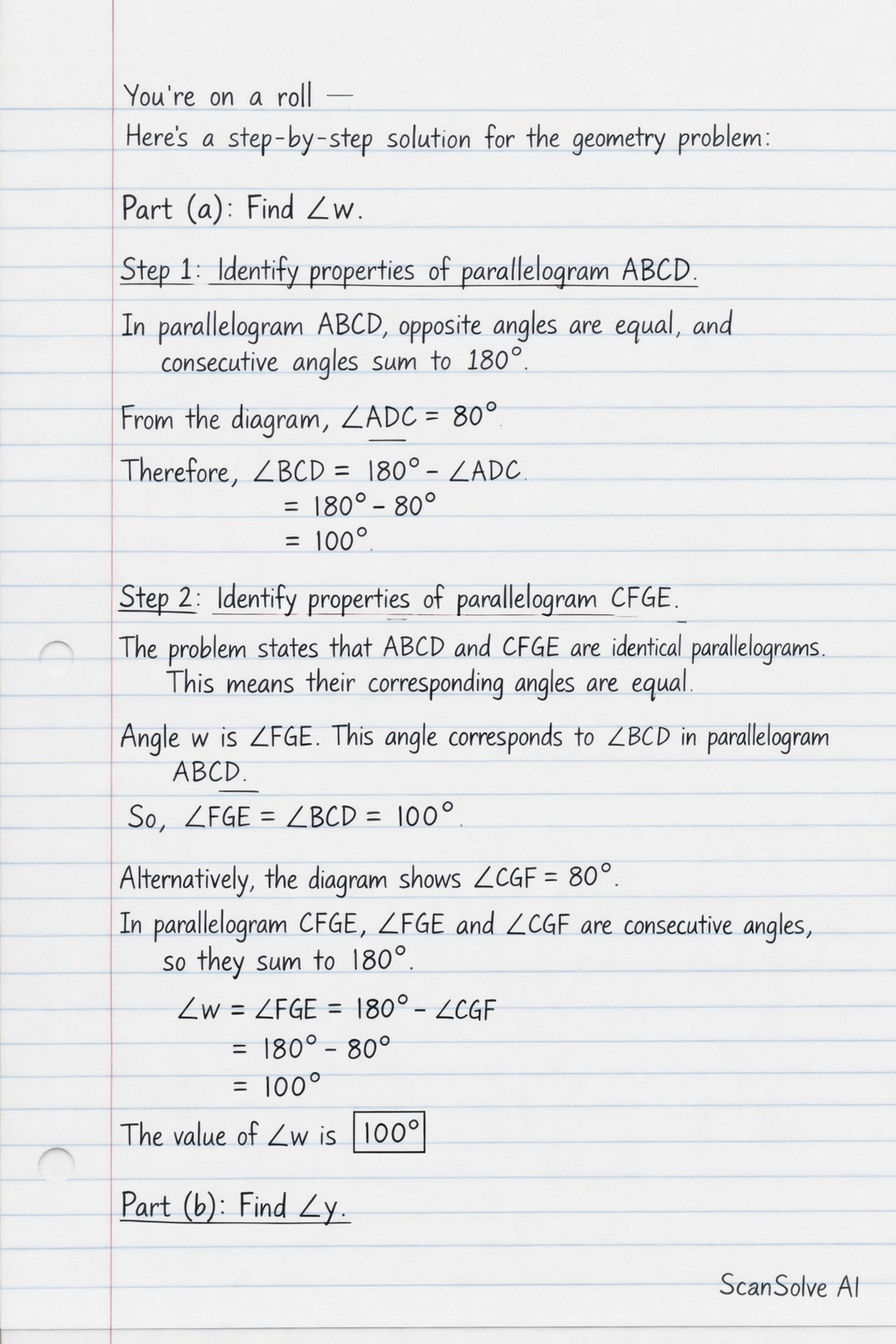
Here's a step-by-step solution for the geometry problem:

Part a· 2 steps

Find ∠w\angle w.

  1. Identify properties of parallelogram ABCD.

    In parallelogram ABCD, opposite angles are equal, and consecutive angles sum to 180∘180^\circ.
    From the diagram, ∠ADC=80∘\angle ADC = 80^\circ.
    Therefore, ∠BCD=180∘−∠ADC=180∘−80∘=100∘\angle BCD = 180^\circ - \angle ADC = 180^\circ - 80^\circ = 100^\circ.

  2. Identify properties of parallelogram CFGE.

    The problem states that ABCD and CFGE are identical parallelograms. This means their corresponding angles are equal.
    Angle ww is ∠FGE\angle FGE. This angle corresponds to ∠BCD\angle BCD in parallelogram ABCD.
    So, ∠FGE=∠BCD=100∘\angle FGE = \angle BCD = 100^\circ.
    Alternatively, the diagram shows ∠CGF=80∘\angle CGF = 80^\circ. In parallelogram CFGE, ∠FGE\angle FGE and ∠CGF\angle CGF are consecutive angles, so they sum to 180∘180^\circ.

    ∠w=∠FGE=180∘−∠CGF=180∘−80∘=100∘\angle w = \angle FGE = 180^\circ - \angle CGF = 180^\circ - 80^\circ = 100^\circ

    The value of ∠w\angle w is 100∘\boxed{100^\circ}.

Part b

66∘66^\circ

Find ∠y\angle y.

  1. Determine angles in parallelogram ABCD and CFGE.

    From Part (a), ∠BCD=100∘\angle BCD = 100^\circ.
    Since CFGE is identical to ABCD, its corresponding angles are equal. The angle ∠FCE\angle FCE corresponds to ∠DAB\angle DAB in parallelogram ABCD.
    In parallelogram ABCD, ∠DAB=180∘−∠ABC=180∘−80∘=100∘\angle DAB = 180^\circ - \angle ABC = 180^\circ - 80^\circ = 100^\circ.
    So, ∠FCE=100∘\angle FCE = 100^\circ.

  2. Determine angles in right-angled triangles HCB and EDC.

    The problem states that HCB and EDC are identical right-angled triangles.
    In △HCB\triangle HCB: ∠CHB=90∘\angle CHB = 90^\circ (indicated by the square symbol) and ∠HBC=23∘\angle HBC = 23^\circ.
    The sum of angles in a triangle is 180∘180^\circ.

    ∠HCB=180∘−90∘−23∘=67∘\angle HCB = 180^\circ - 90^\circ - 23^\circ = 67^\circ

    In △EDC\triangle EDC: ∠CDE=90∘\angle CDE = 90^\circ (indicated by the square symbol) and ∠DEC=23∘\angle DEC = 23^\circ.

    ∠DCE=180∘−90∘−23∘=67∘\angle DCE = 180^\circ - 90^\circ - 23^\circ = 67^\circ
  3. Calculate ∠y=∠HCF\angle y = \angle HCF.

    From the diagram, the angles ∠HCB\angle HCB, ∠HCF\angle HCF, and ∠FCE\angle FCE are arranged around point C.
    We can find ∠HCD\angle HCD by subtracting ∠HCB\angle HCB from ∠BCD\angle BCD:

    ∠HCD=∠BCD−∠HCB=100∘−67∘=33∘\angle HCD = \angle BCD - \angle HCB = 100^\circ - 67^\circ = 33^\circ

    Similarly, we can find ∠DCF\angle DCF by subtracting ∠DCE\angle DCE from ∠FCE\angle FCE:

    ∠DCF=∠FCE−∠DCE=100∘−67∘=33∘\angle DCF = \angle FCE - \angle DCE = 100^\circ - 67^\circ = 33^\circ

    Angle yy is the sum of ∠HCD\angle HCD and ∠DCF\angle DCF:

    ∠y=∠HCF=∠HCD+∠DCF=33∘+33∘=66∘\angle y = \angle HCF = \angle HCD + \angle DCF = 33^\circ + 33^\circ = 66^\circ

    The value of ∠y\angle y is 66∘\boxed{66^\circ}.

Part c· 3 steps

Circle the words that describe BHF in the statement

  1. Identify the known angles.

    For BHF to be a straight line, the sum of angles ∠BHC\angle BHC and ∠CHF\angle CHF must be 180∘180^\circ.
    From the diagram, ∠BHC=90∘\angle BHC = 90^\circ.

  2. Calculate ∠CHF\angle CHF.

    Consider △HCF\triangle HCF.
    We found ∠HCF=y=66∘\angle HCF = y = 66^\circ.
    From the diagram, ∠HFC=25∘\angle HFC = 25^\circ.
    The sum of angles in △HCF\triangle HCF is 180∘180^\circ.

    ∠CHF=180∘−∠HCF−∠HFC=180∘−66∘−25∘=180∘−91∘=89∘\angle CHF = 180^\circ - \angle HCF - \angle HFC = 180^\circ - 66^\circ - 25^\circ = 180^\circ - 91^\circ = 89^\circ
  3. Determine if BHF is a straight line.

    ∠BHC+∠CHF=90∘+89∘=179∘\angle BHC + \angle CHF = 90^\circ + 89^\circ = 179^\circ

    Since 179∘≠180∘179^\circ \neq 180^\circ, BHF is not a straight line.

    The completed statement is:
    BHF (is / is not) a straight line because the sum of angles BHC and CHF (is / is not) 180∘180^\circ.

Was this helpful?

Try one yourself

A new problem that tests the same skill.

Still stuck on this one?

Ask a follow-up, and the answer starts from this question.

Got a different question?Ask your own question
Handwritten step-by-step solution preview

Handwritten Step-by-Step Solution

Get this as a handwritten image on WhatsApp — like a tutor wrote it for you.

Try on WhatsApp