
We read your photo as:
Quadrilateral ABCD is similar to quadrilateral EFGH. Given AB=4cm and EF=6cm, FG=4.5cm, find the ratio of similarity and length of BC. Also determine if all equilateral triangles are similar and if al
ScanSolve AI Answer
Answer
Step-by-step solution
2 stepsHere's the solution to your questions.
Part 1· 2 steps
Similar Quadrilaterals
Given that quadrilateral is similar to quadrilateral ().
This means their corresponding angles are equal, and the ratio of their corresponding sides is constant.
From the image:
Side
Side
Side
Find the common ratio of their corresponding sides.
The common ratio (scale factor) is the ratio of a side in to its corresponding side in .
The common ratio is .
Find the length of side .
Since the quadrilaterals are similar, the ratio of to must also be equal to the common ratio .
Substitute the known values:
To find , rearrange the equation:
The length of is .
Part 2
.7 - Determine whether each statement is true or false.
-
a. All equilateral triangles are similar.
- True. All equilateral triangles have three angles. Since all corresponding angles are equal, and the ratio of sides is constant, they are similar.
-
b. All isosceles triangles are similar.
- False. Isosceles triangles can have different angle measures (e.g., vs. ), so they are not necessarily similar.
-
c. All isosceles right triangles are similar.
- True. All isosceles right triangles have angles . Since all corresponding angles are equal, they are similar.
-
d. All rectangles are similar.
- False. While all rectangles have four angles, their side ratios (length to width) can differ (e.g., a rectangle vs. a square).
-
e. All rhombuses are similar.
- False. While all rhombuses have four equal sides, their angles can differ (e.g., a square vs. a rhombus with angles).
-
f. All squares are similar.
- True. All squares have four angles and four equal sides. Their corresponding angles are equal, and the ratio of their sides is constant.
-
g. All congruent polygons are similar.
- True. Congruent polygons have the same shape and size. This means their corresponding angles are equal, and the ratio of their corresponding sides is , which satisfies the conditions for similarity.
-
h. All similar polygons are congruent.
- False. Similar polygons have the same shape but not necessarily the same size. For example, a square and a square are similar but not congruent.
-
i. All regular pentagons are similar.
- True. All regular pentagons have five equal sides and five equal interior angles of . Since all corresponding angles are equal, and the ratio of sides is constant, they are similar.
Try one yourself
A new problem that tests the same skill.
Still stuck on this one?
Ask a follow-up, and the answer starts from this question.
More Mathematics Questions
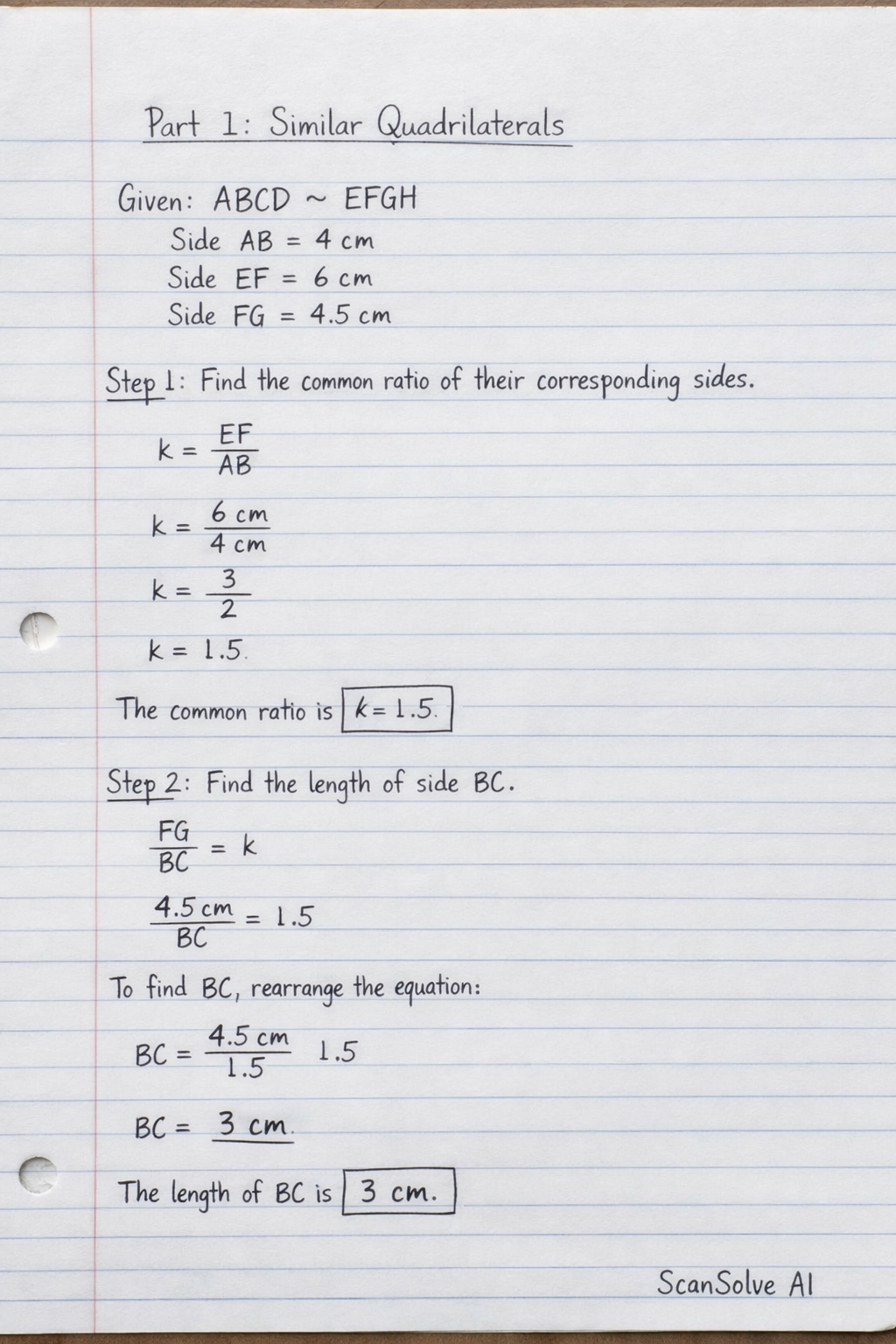
Handwritten Step-by-Step Solution
Get this as a handwritten image on WhatsApp — like a tutor wrote it for you.
Try on WhatsApp