
We read your photo as:
Prove the given geometry problems. Problem 1: In ABC, AE=EB and EF||BC. In ACD, FG||CD. Prove AG=GD. Problem 2: In DEF, DS=SE, EU=UF, and ST||EF. Prove STUE is a parallelogram.
ScanSolve AI Answer
Answer
Step-by-step solution
8 stepsHere are the solutions to your geometry problems.
:
Given:
- In , and .
- In , . Prove: .
Analyze .
We are given that , which means is the midpoint of side .
We are also given that .
By the converse of the Midpoint Theorem (also known as Thales's Theorem or Basic Proportionality Theorem), if a line parallel to one side of a triangle passes through the midpoint of another side, then it bisects the third side.
Therefore, must be the midpoint of side . This implies .Analyze .
From Step 1, we established that is the midpoint of side .
We are given that .
Applying the converse of the Midpoint Theorem to :
Since and is the midpoint of , then must be the midpoint of side .
Therefore, .This completes the proof.
:
Given:
In , , , and .
Prove: is a parallelogram.Analyze using the given information about .
We are given that , which means is the midpoint of side .
We are also given that .
By the converse of the Midpoint Theorem, if a line parallel to one side of a triangle passes through the midpoint of another side, then it bisects the third side.
Therefore, must be the midpoint of side .Apply the Midpoint Theorem to .
Since is the midpoint of and is the midpoint of , by the Midpoint Theorem, the segment connecting the midpoints of two sides of a triangle is parallel to the third side and is half the length of the third side.
So, .Use the given information about .
We are given that , which means is the midpoint of side .
Therefore, .Compare and .
From Step 2, .
From Step 3, .
Thus, .Establish parallelism.
We are given that .
Since lies on , it follows that .Conclude that is a parallelogram.
We have shown that in quadrilateral , one pair of opposite sides ( and ) are both parallel () and equal in length ().
A quadrilateral with one pair of opposite sides that are both parallel and equal in length is a parallelogram.
Therefore, is a parallelogram.This completes the proof.
Try one yourself
A new problem that tests the same skill.
Still stuck on this one?
Ask a follow-up, and the answer starts from this question.
More Mathematics Questions
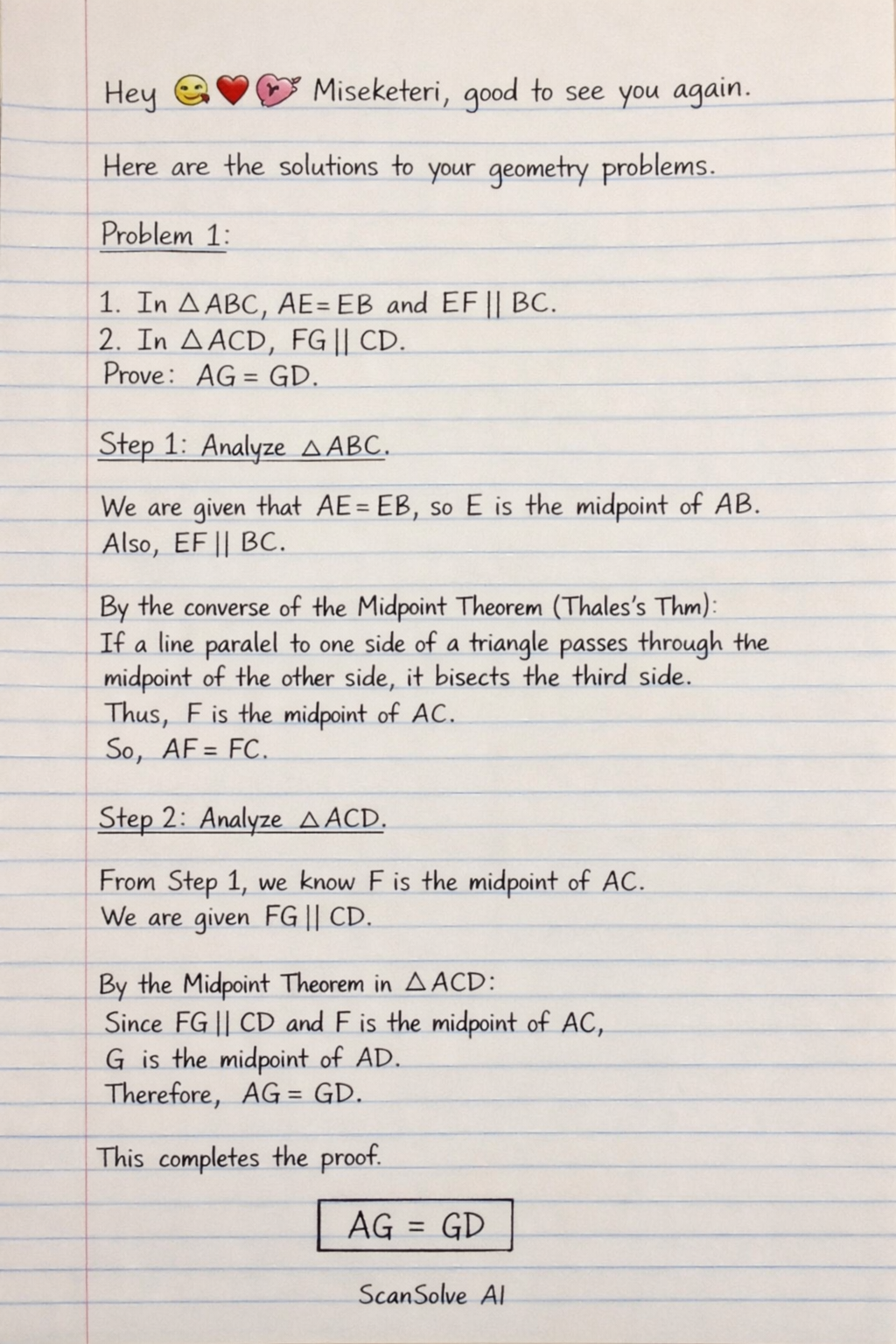
Handwritten Step-by-Step Solution
Get this as a handwritten image on WhatsApp — like a tutor wrote it for you.
Try on WhatsApp