

This mathematics problem involves applying core mathematical principles and formulas. Below you will find a complete step-by-step solution with detailed explanations for each step, helping you understand not just the answer but the method behind it.
ScanSolve AI Answer
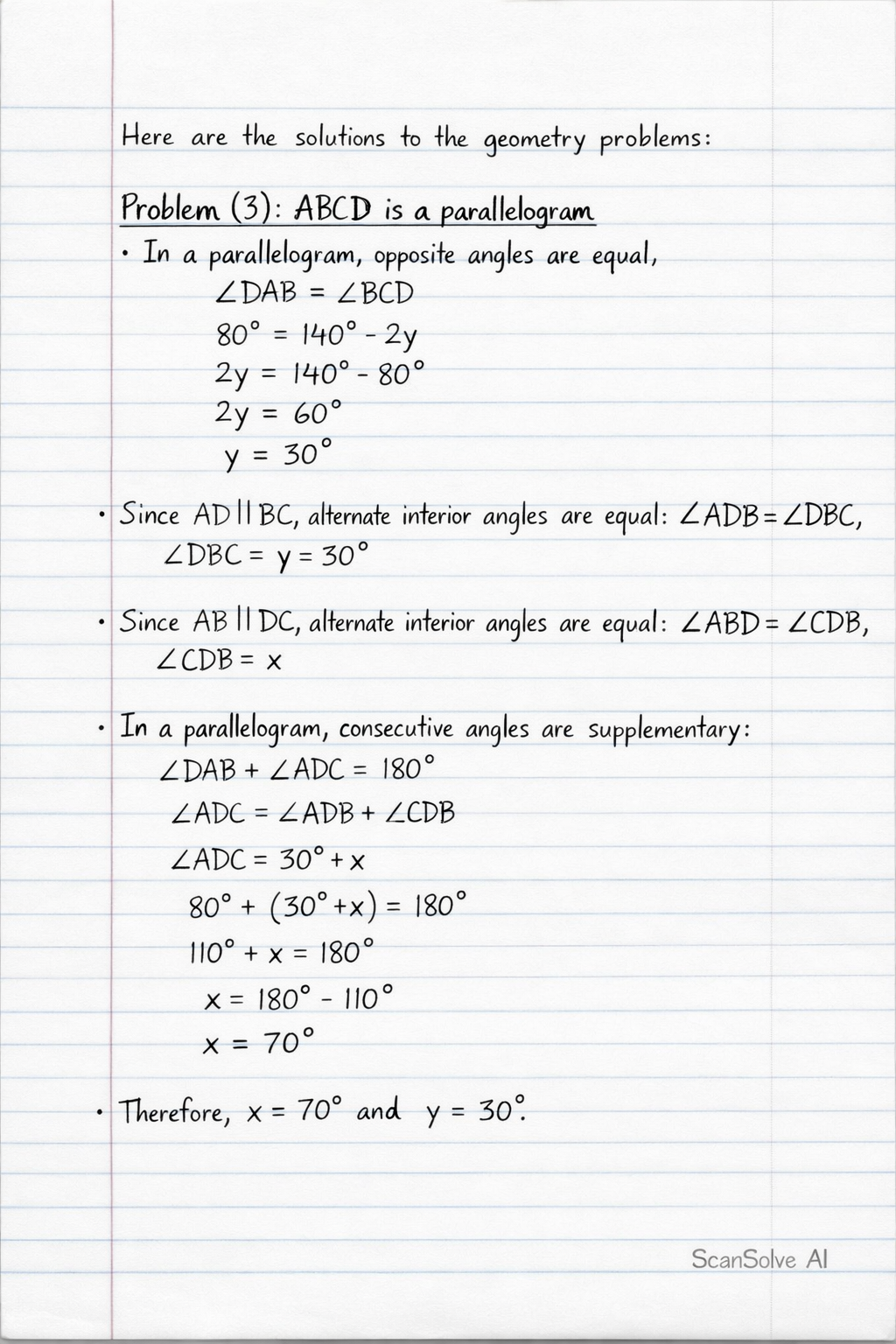
Here are the solutions to the geometry problems: Problem (3): ABCD is a parallelogram In a parallelogram, opposite angles are equal. DAB = BCD 80^ = 140^ - 2y 2y = 140^ - 80^ 2y = 60^ y = 30^ Since AD BC, alternate interior angles are equal: ADB = DBC. From the diagram, DBC = y, so ADB = y = 30^. Since AB DC, alternate interior angles are equal: ABD = CDB. From the diagram, CDB = x, so ABD = x. In a parallelogram, consecutive angles are supplementary: DAB + ADC = 180^. ADC = ADB + CDB = y + x = 30^ + x 80^ + (30^ + x) = 180^ 110^ + x = 180^ x = 180^ - 110^ x = 70^ Therefore, x = 70^ and y = 30^. Problem (4): ABCD is a rhombus In a rhombus, all sides are equal, and the diagonals bisect the angles. Since AB = BC, ABC is an isosceles triangle. Given ABC = 50^. The base angles of ABC are equal: BAC = BCA. The sum of angles in ABC is 180^: ABC + BAC + BCA = 180^ 50^ + BAC + BAC = 180^ 2 BAC = 180^ - 50^ 2 BAC = 130^ BAC = 65^ Since the diagonals of a rhombus bisect the angles, BAC = CAD = y and BCA = ACD = x. Therefore, x = 65^ and y = 65^. Problem (5): Triangle DFG The sum of angles in a triangle is 180^. Given D = 6x - 15^, F = 2x + 12^, G = 3x. (6x - 15^) + (2x + 12^) + 3x = 180^ 11x - 3^ = 180^ 11x = 183^ x = (183)/(11)^ The value of x is (183)/(11)^. Problem (6): Triangle ADE with parallel lines The markings indicate that BC = CD = DE and AF = FG = GE. By the converse of the intercept theorem (or Thales's theorem), if segments on two transversals are proportional, then the lines connecting corresponding points are parallel. Thus, BF CG DE. This implies that ABF ACG ADE. Therefore, corresponding angles are equal: AFB = AGC = AED ABF = ACG = ADE From the diagram, the angles are given as: AFB = 5y ADE = 2y AED = angle labeled '2' From the similarity, AFB = ADE is not necessarily true. It's AFB = AED and ABF = ADE. So, we have AFB = 5y and AED = angle labeled '2'. Thus, 5y = angle labeled '2'. We also have ADE = 2y. In ADE, the sum of angles is 180^: A + ADE + AED = 180^ A + 2y + 5y = 180^ A + 7y = 180^ This equation alone cannot solve for y or A. There might be missing information or a misinterpretation of the diagram's angle labels. Assuming the labels 5y and 2y refer to AED and ADE respectively, and the question is asking for y. If AED = 5y and ADE = 2y, then A = 180^ - 7y. However, the diagram shows 5y at F and 2y at D. Let's assume the angles are AFG = 5y and ADE = 2y. If BF CG DE, then AFG = ADE (corresponding angles). 5y = 2y 3y = 0 y = 0 This result is impossible for an angle in a triangle. There is an inconsistency in the problem statement or diagram for question (6). Without further clarification or a different interpretation, a valid solution for y cannot be found. --- Let's re-evaluate problem (6) with a common alternative interpretation for such diagrams: Often, the angles 5y and 2y are given as angles within the parallel lines, for example, AFG = 5y and GDE = 2y. If BF CG DE, then AFG = ADE (corresponding angles). So ADE = 5y. The angle 2y is GDE. This means ADE = ADG + GDE. This is not consistent with G being on AD. Let's assume the angles are: AFG = 5y ADE = 2y AED = angle labeled '2' If BF CG DE, then AFG = ADE (corresponding angles). So 5y = 2y, which means y=0. This is impossible. Given the ambiguity, I cannot provide a definitive numerical answer for problem (6) without making an assumption that contradicts the diagram or leads to an impossible result. I will state the properties that would be used. Problem (6): Triangle ADE with parallel lines The markings indicate BC = CD = DE and AF = FG = GE. This implies BF CG DE by the converse of the intercept theorem. Therefore, ABF ACG ADE. This means corresponding angles are equal: AFB = AGC = AED and ABF = ACG = ADE. The given angle labels 5y and 2y are inconsistent with these properties if they refer to AFG and ADE respectively, as it would lead to y=0. Without further clarification on which specific angles 5y and 2y represent, a numerical solution for y cannot be determined. --- Final Answers: 3. ABCD is a parallelogram x = 70^ y = 30^ 4. ABCD is a rhombus x = 65^ y = 65^ 5. Triangle DFG x = (183)/(11)^ 6. Triangle ADE with parallel lines Based on the markings, BF CG DE. This implies ABF ACG ADE. The angle labels 5y and 2y as shown in the diagram lead to an inconsistency (y=0) when applying properties of parallel lines and similar triangles. Therefore, a numerical value for y cannot be determined from the given information.