

This mathematics problem involves applying core mathematical principles and formulas. Below you will find a complete step-by-step solution with detailed explanations for each step, helping you understand not just the answer but the method behind it.
ScanSolve AI Answer
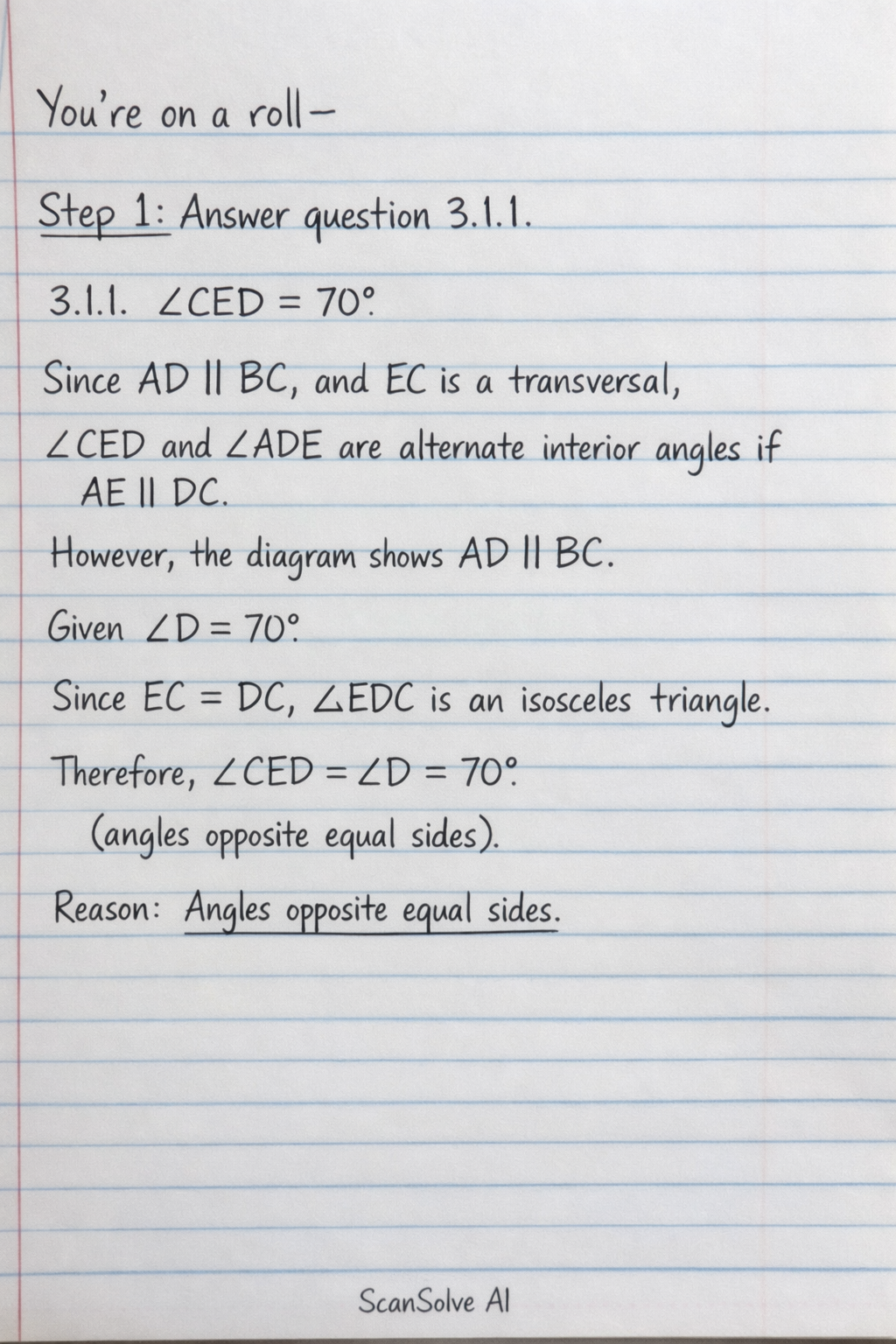
Step 1: Answer question 3.1.1. In trapezium ABCD, AD || BC, with A = D = 70^ and EC = DC. 3.1.1. CED = 70^ Since AD || BC, and EC is a transversal, CED and ADE are alternate interior angles if AE || DC. However, the diagram shows AD || BC. Given D = 70^. Since EC = DC, EDC is an isosceles triangle. Therefore, CED = D = 70^ (angles opposite equal sides). Reason: Angles opposite equal sides. Step 2: Answer question 3.1.2. 3.1.2. BCE = 70^ Since AD || BC, A and B are co-interior angles, so A + B = 180^. A = 70^, so B = 110^. Also, D = 70^. In EDC, ECD = 180^ - ( CED + D) = 180^ - (70^ + 70^) = 180^ - 140^ = 40^. Since AD || BC, ADC and BCD are co-interior angles. ADC = ADE + EDC = 70^ + 70^ = 140^. This is incorrect. D refers to ADC. Given A = 70^ and D = 70^. Since AD || BC, D + C = 180^ (co-interior angles). So, C = 180^ - 70^ = 110^. C is BCD. We know ECD = 40^. BCE = BCD - ECD = 110^ - 40^ = 70^. Reason: Co-interior angles AD || BC and angles in a triangle. Therefore, A = BCE = 70^. Step 3: Answer question 3.1.3. 3.1.3. AEC = 110^ In trapezium ABCD, AD || BC. Consider the line AE as a transversal. A = 70^. AEC and EAD are co-interior angles if AB || EC. This is not given. However, AEC is an exterior angle to EDC if we extend DE. Alternatively, consider quadrilateral ABCE. We have A = 70^, B = 110^ (from 3.1.4), BCE = 70^. The sum of angles in a quadrilateral is 360^. AEC = 360^ - ( A + B + BCE) = 360^ - (70^ + 110^ + 70^) = 360^ - 250^ = 110^. Reason: Sum of angles in a quadrilateral. Step 4: Answer question 3.1.4. 3.1.4. B = 110^ Since AD || BC, A and B are co-interior angles. A + B = 180^. 70^ + B = 180^. B = 180^ - 70^ = 110^. Reason: Co-interior angles, AD || BC. Therefore, B = AEC = 110^. Step 5: Answer question 3.1.5. 3.1.5. ABCE is parallelogram For ABCE to be a parallelogram, both pairs of opposite sides must be parallel (AB || EC and AE || BC) or one pair of opposite sides parallel and equal (e.g., AE || BC and AE = BC). We are given AD || BC. This means AE || BC. From the calculations: A = 70^ B = 110^ BCE = 70^ AEC = 110^ Since A = BCE = 70^ and B = AEC = 110^, opposite angles are equal. Also, since AE || BC (as AD || BC), and A + B = 180^, A + AEC = 70^ + 110^ = 180^. This means AB || EC. Since both pairs of opposite sides are parallel (AE || BC and AB || EC), ABCE is a parallelogram. Reason: Both pairs of opposite sides are parallel (or Opposite angles are equal). Step 6: Answer question 3.2. 3.2. Complete the following statement: Sum of the interior angles of the triangles are 180^. Step 7: Answer question 3.3. In figure below, ABFD is trapezium, AC || DG. BEF = 45^ and BFG = 105^. Calculate with reasons the size of the following: We need to calculate the size of angles labeled 1, 2, 3. Since AC || DG, we have parallel lines. Angle 1 (at E): ABE and BEF are alternate interior angles if AB || EF. This is not given. However, ABE is not labeled as 1. The angle labeled 1 is DEB. Angle 1 (at D): ADE. Angle 1 (at F): BFC. Let's assume the question asks for the angles labeled with numbers in the diagram. Angle 1 (at E): This is DEB. Since AC || DG, and BE is a transversal, CBE and BEF are alternate interior angles. BEF = 45^. So CBE = 45^. The angle labeled 1 at E is DEB. This is not directly related to BEF by parallel lines. Let's re-examine the diagram. The arrows indicate AC || DG. The angle labeled '1' inside ABE is BAE. The angle labeled '1' inside BFG is FBG. The angle labeled '1' at E is DEB. The angle labeled '1' at F is BFC. Let's assume the question asks for the angles labeled with numbers in the diagram. Angle 1 (at E): BEF = 45^. This is an angle on a straight line DG. The angle labeled '1' at E is DEB. Since AC || DG, CAB and ABD are alternate interior angles. ABE is labeled as '1'. BAE is labeled as '1'. FBG is labeled as '1'. DEB is labeled as '1'. BFC is labeled as '1'. Let's assume the question asks for the angles labeled with numbers in the diagram, specifically the angles within the triangles. Angle 1 (at A): BAE. Angle 2 (at B): ABE. Angle 3 (at B): EBC. Angle 1 (at E): DEB. Angle 2 (at E): BEF. Given as 45^. Angle 1 (at F): BFC. Angle 2 (at F): BFG. Given as 105^. Let's calculate the angles based on the parallel lines AC || DG. Angle 1 (at E, DEB): BEF = 45^. DEB and BEF are angles on a straight line DG. So, DEB + BEF = 180^. DEB + 45^ = 180^. DEB = 180^ - 45^ = 135^. Reason: Angles on a straight line. So, 1 (at E) = 135^. Angle 1 (at F, BFC): BFG = 105^. BFC and BFG are angles on a straight line DG. So, BFC + BFG = 180^. BFC + 105^ = 180^. BFC = 180^ - 105^ = 75^. Reason: Angles on a straight line. So, 1 (at F) = 75^. Angle 2 (at B, EBF): In BEF, we have BEF = 45^. Since AC || DG, EBF is not directly related to BEF or BFG. However, EBF is an angle in BEF. We need another angle in BEF or information about the lines. The diagram shows ABFD is a trapezium, which means AB || DF. If AB || DF, then ABE and BEF are alternate interior angles. So, ABE = BEF = 45^. The angle labeled '2' at B is EBF. The angle labeled '2' at E is BEF = 45^. The angle labeled '2' at F is BFG = 105^. Let's assume the question is asking for the angles labeled 1, 2, 3 in the diagram. Angle 1 (at A): BAE. Angle 2 (at B): EBF. Angle 3 (at B): FBC. Given AC || DG. BEF = 45^. BFG = 105^. Consider BEF. We know BEF = 45^. We need to find EBF (labeled 2 at B) and BFE. Since AC || DG, CBF and BFG are alternate interior angles. So, CBF = BFG = 105^. This is the angle labeled '3' at B. So, 3 (at B) = 105^. Reason: Alternate interior angles, AC || DG. Now, consider BFG. We have BFG = 105^. The angle labeled '1' at F is BFC. This is 180^ - 105^ = 75^. The angle labeled '1' at B is FBG. The angle labeled '2' at B is EBF. Let's re-evaluate the labels. The angle labeled '1' at A is BAE. The angle labeled '2' at B is EBF. The angle labeled '3' at B is FBC. The angle labeled '1' at E is DEB. The angle labeled '2' at E is BEF = 45^. The angle labeled '1' at F is BFE. The angle labeled '2' at F is BFG = 105^. Let's find BFE (labeled '1' at F). BFE and BFG are angles on a straight line. BFE + BFG = 180^. BFE + 105^ = 180^. BFE = 75^. Reason: Angles on a straight line. So, 1 (at F) = 75^. Now, find EBF (labeled '2' at B). In BEF, the sum of angles is 180^. EBF + BEF + BFE = 180^. EBF + 45^ + 75^ = 180^. EBF + 120^ = 180^. EBF = 180^ - 120^ = 60^. Reason: Sum of angles in a triangle. So, 2 (at B) = 60^. Now, find FBC (labeled '3' at B). Since AC || DG, FBC and BFG are alternate interior angles. FBC = BFG = 105^. Reason: Alternate interior angles, AC || DG. So, 3 (at B) = 105^. The question asks to calculate the size of "the following". It doesn't specify which angles. I've calculated all angles labeled with numbers in the diagram. Summary of 3.3 angles: 1 (at E, DEB) = 135^ (Angles on a straight line) 1 (at F, BFE) = 75^ (Angles on a straight line) 2 (at B, EBF) = 60^ (Sum of angles in a triangle) 3 (at B, FBC) = 105^ (Alternate interior angles, AC || DG)