
We read your photo as:
In the figure below A = x, ACE = 50°, BEC = 130°, and ECG = 2x – 110°. 1.1 Determine, giving reasons, the value of x. 1.2 Is AB parallel to FG? Give reasons for your answer.
ScanSolve AI Answer
Step-by-step solution
4 steps1.1.1
Determine the measure of .
Angles on a straight line sum to . Since A, E, B form a straight line, and are supplementary.
Given :
Reason: Angles on a straight line.
Use the sum of angles in to find .
The sum of angles in a triangle is .
Given and . From Step 1, .
Reason: Sum of angles in a triangle.
The final answer is .
1.1.2
Calculate the measure of using the value of found in 1.1.1.
Given . Substitute :
Compare angles to determine if AB is parallel to FG.
From 1.1.1, we found .
We just calculated .
Since and are alternate interior angles formed by the transversal line CD intersecting lines AB and FG, and they are equal:Therefore, AB is parallel to FG.
Alternatively, using co-interior angles:
We have and .
These are co-interior angles formed by the transversal line CD intersecting lines AB and FG.Since the co-interior angles are supplementary, AB is parallel to FG.
The final answer is .
Still stuck on this one?
Ask a follow-up, and the answer starts from this question.
More Mathematics Questions
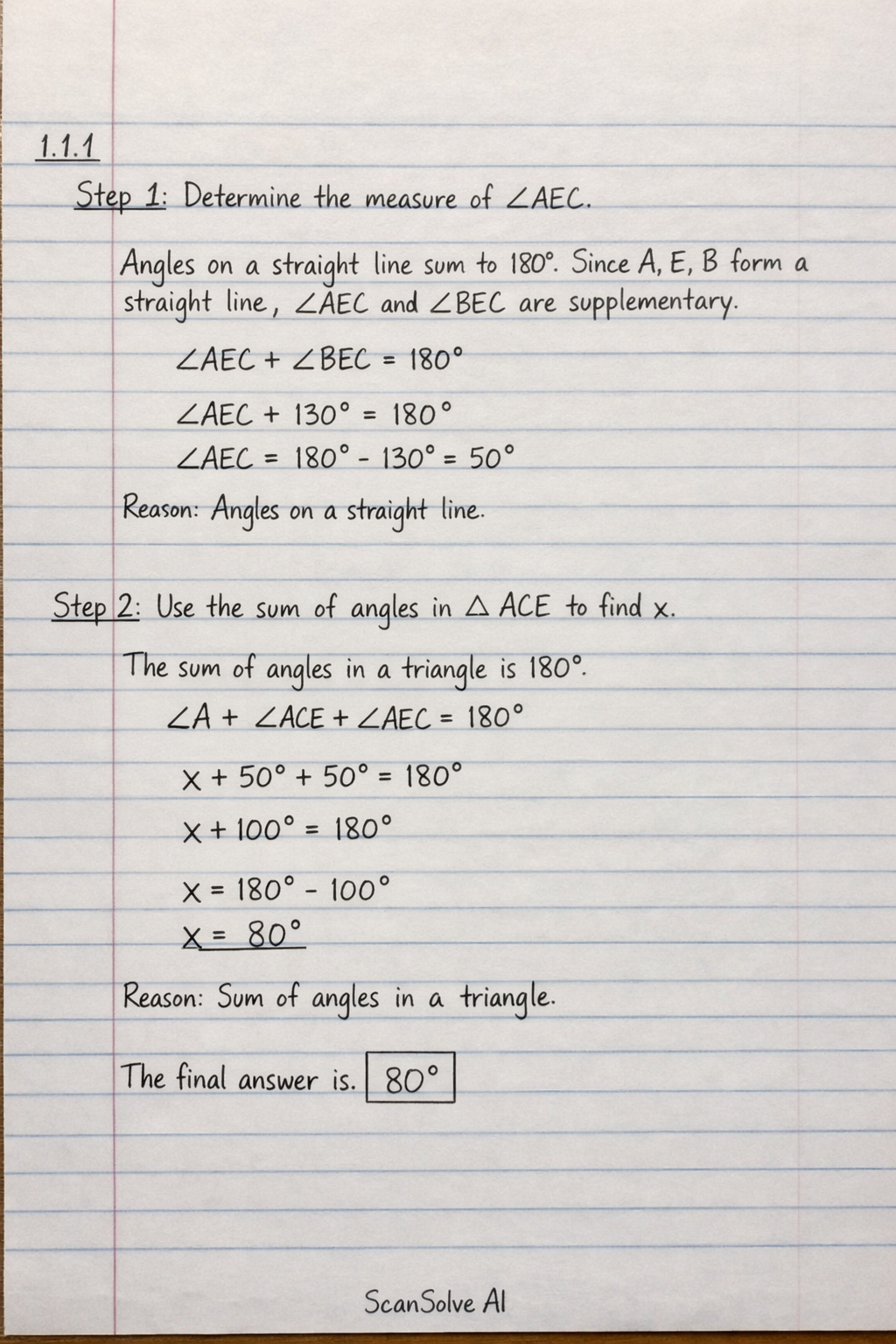
Handwritten Step-by-Step Solution
Get this as a handwritten image on WhatsApp — like a tutor wrote it for you.
Try on WhatsApp