
We read your photo as:
Fill in the blanks regarding quadrilaterals and answer questions about a rectangle's angles and sides.
ScanSolve AI Answer
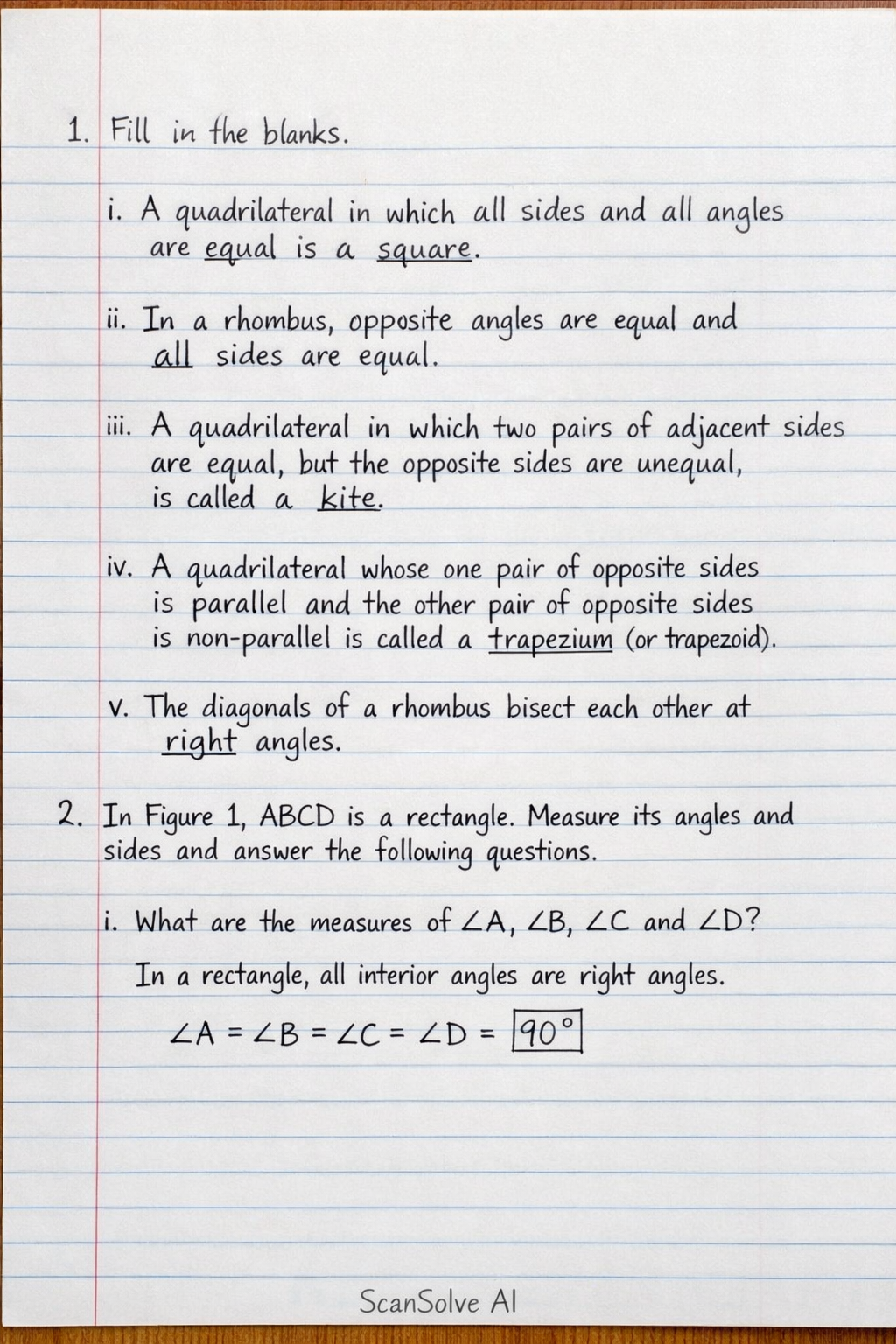
1. Fill in the blanks.
- i. A quadrilateral in which all sides and all angles are equal is a square.
- ii. In a rhombus, opposite angles are equal and all sides are equal.
- iii. A quadrilateral in which two pairs of adjacent sides are equal, but the opposite sides are unequal, is called a kite.
- iv. A quadrilateral whose one pair of opposite sides is parallel and the other pair of opposite sides is non-parallel is called a trapezium (or trapezoid).
- v. The diagonals of a rhombus bisect each other at right angles.
2. In Figure 1, ABCD is a rectangle. Measure its angles and sides and answer the following questions.
-
i. What are the measures of and ? In a rectangle, all interior angles are right angles.
-
ii. Two sets of line segments are given. Match equal line segments. In a rectangle:
-
Opposite sides are equal.
-
Diagonals are equal and bisect each other.
-
Therefore, the segments from the center to each vertex are equal.
-
a. matches 2. (opposite sides)
-
b. matches 4. (opposite sides)
-
c. matches 1. (diagonals)
-
d. matches 3. (halves of a diagonal)
-
3. Name each of the following parallelograms.
-
i. All sides are equal and the diagonals are unequal. This describes a rhombus.
-
ii. The adjacent sides are unequal and the diagonals are equal. This describes a rectangle.
-
iii. The adjacent sides are equal and the diagonals are equal. This describes a square.
4. In Figure 2, kite ABCD has diagonals AC and BD intersecting at O.
-
i. Name three pairs of equal line segments. In a kite:
- Two pairs of adjacent sides are equal.
- One diagonal is bisected by the other. The three pairs of equal line segments are:
-
ii. What is the measure of ? In a kite, the diagonals are perpendicular to each other.
-
iii. Is ? Yes, one diagonal of a kite (the one connecting the vertices between the unequal sides) is bisected by the other diagonal. In Figure 2, is bisected by . The answer is .
Still stuck on this one?
Ask a follow-up, and the answer starts from this question.
More Mathematics Questions
Handwritten Step-by-Step Solution
Get this as a handwritten image on WhatsApp — like a tutor wrote it for you.
Try on WhatsApp