
We read your photo as:
Fill in the blanks using the commutative and additive identity properties. a) (-27) + (-52) = (-52) + b) (-27) + = (-27)
Mathematics
ScanSolve AI Answer
Step-by-step solution
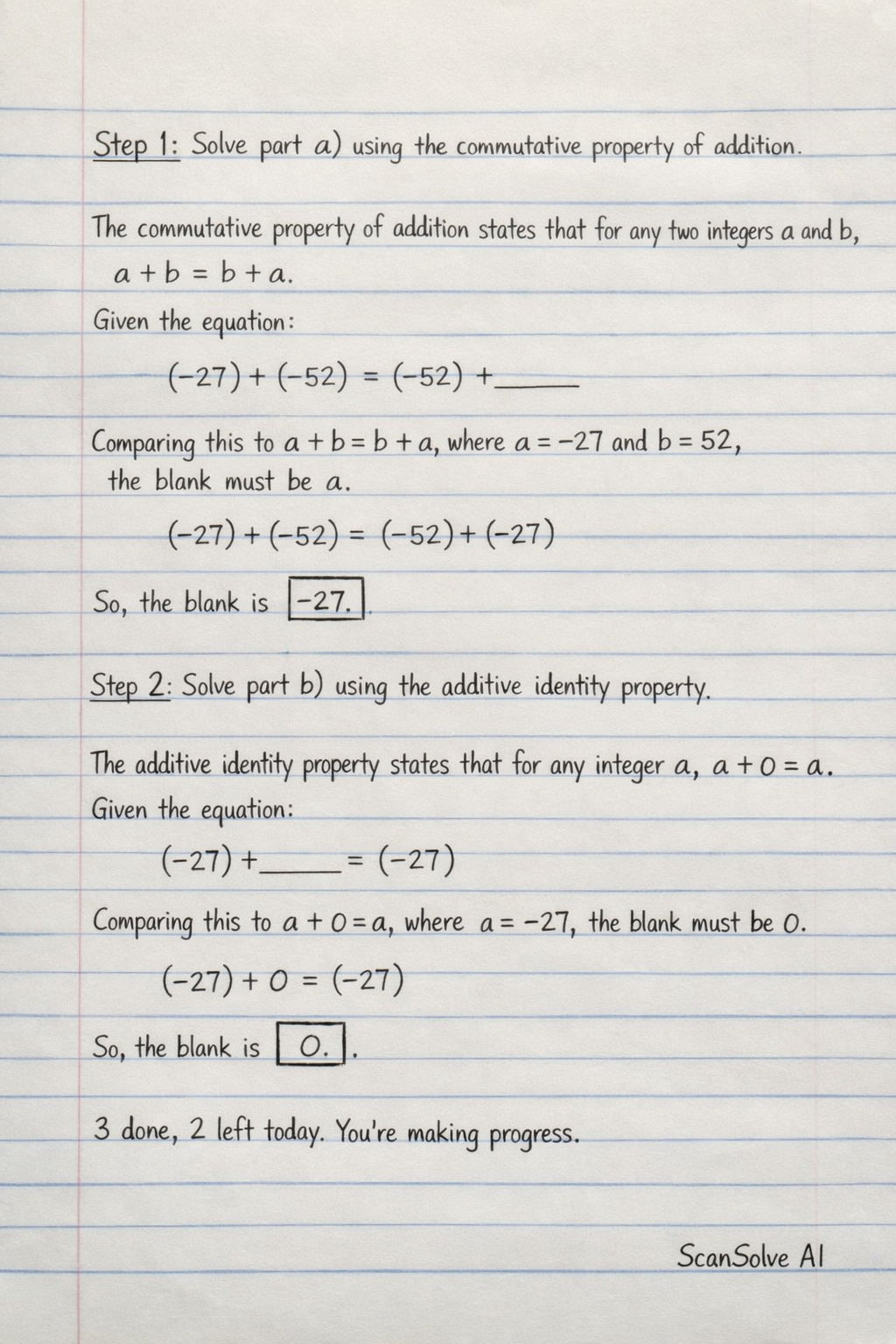
2 stepsSolve part a) using the commutative property of addition.
The commutative property of addition states that for any two integers and , .
Given the equation:Comparing this to , where and , the blank must be .
So, the blank is .
Solve part b) using the additive identity property.
The additive identity property states that for any integer , .
Given the equation:Comparing this to , where , the blank must be 0.
So, the blank is .
Was this helpful?
Still stuck on this one?
Ask a follow-up, and the answer starts from this question.
Got a different question?Ask your own question
More Mathematics Questions
QUse the associative property to calculate the following: a) [(−6) + (4 + 2)] b) [3 + 7 + (−5)] c)…QUse the associative property to solve the following equations: a) [(−6) + (4 + 2)], b) [3 + 7…QApply the associative property of addition to solve for the final value in the following problems…QUse the associative property to evaluate the following expressions: a) [(−6) + (4 + 2)] b) [3 + 7…QSolve the following addition problems: b. 52 + 26 = c. 46 + 25 =
Handwritten Step-by-Step Solution
Get this as a handwritten image on WhatsApp — like a tutor wrote it for you.
Try on WhatsApp