We read your photo as:

A small boy plc manufactures and sells a product called mummy. The following reports were extracted from its records: Sales (2500 units @ N40 each): N 1,000,000. Expenses: Direct materials: N 250,000, Direct labour: N 125,000, Variable overhead: N 62,500, Fixed admin expenses: N 180,000, Fixed miscellaneous expenses: N 70,000. Total expenses: N 687,500. Net profit: N 312,500. Required: 1. How many units must be sold before the company can break even? 2. What will be the Net profit if sales increase by 30% assuming no increase in selling price? 3. If selling price is reduced by 5% how many units must be sold in order to maintain a net profit equal to the current profit?

Economics

ScanSolve AI Answer

This answer stops before the end.

It was cut off when it was first written. Ask ScanSolve this question again for the full working.

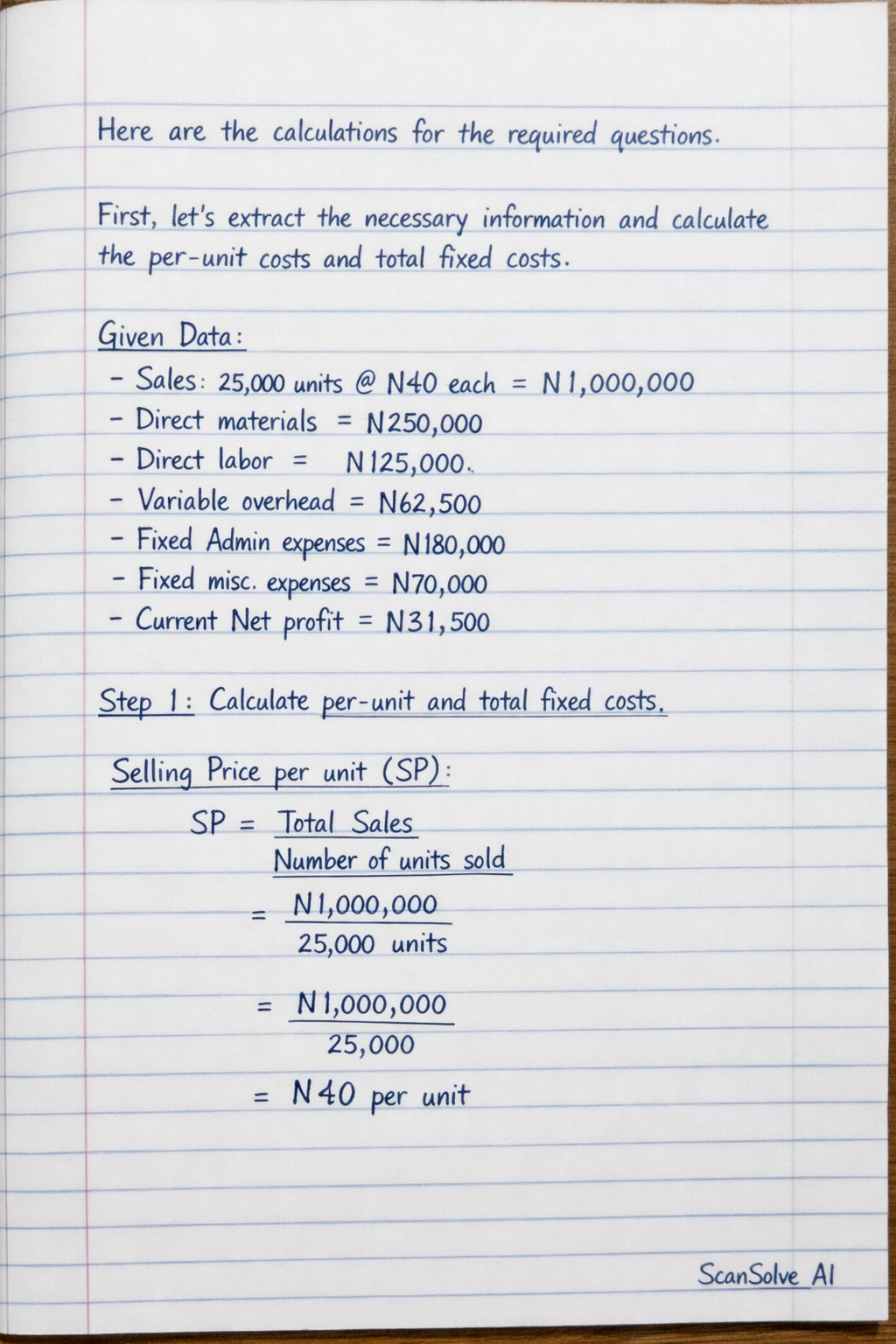
Here are the calculations for the required questions.

First, let's extract the necessary information and calculate the per-unit costs and total fixed costs.

Given Data:

  • Sales: 25,000 units @ N40\text{N}40 each = N1,000,000\text{N}1,000,000
  • Direct materials = N250,000\text{N}250,000
  • Direct labor = N125,000\text{N}125,000
  • Variable overhead = N62,500\text{N}62,500
  • Fixed Admin expenses = N180,000\text{N}180,000
  • Fixed miscellaneous expenses = N70,000\text{N}70,000
  • Current Net profit = N312,500\text{N}312,500

Step 1: Calculate per-unit and total fixed costs.

  • Selling Price per unit (SP):

    SP=Total SalesNumber of units sold=N1,000,00025,000 units=N40/unit\text{SP} = \frac{\text{Total Sales}}{\text{Number of units sold}} = \frac{\text{N}1,000,000}{25,000 \text{ units}} = \text{N}40/\text{unit}
  • Variable Costs per unit (VC per unit):

    • Direct materials per unit = N250,00025,000 units=N10/unit\frac{\text{N}250,000}{25,000 \text{ units}} = \text{N}10/\text{unit}
    • Direct labor per unit = N125,00025,000 units=N5/unit\frac{\text{N}125,000}{25,000 \text{ units}} = \text{N}5/\text{unit}
    • Variable overhead per unit = N62,50025,000 units=N2.50/unit\frac{\text{N}62,500}{25,000 \text{ units}} = \text{N}2.50/\text{unit}
    VC per unit=N10+N5+N2.50=N17.50/unit\text{VC per unit} = \text{N}10 + \text{N}5 + \text{N}2.50 = \text{N}17.50/\text{unit}
  • Total Fixed Costs (FC):

    FC=Fixed Admin expenses+Fixed miscellaneous expenses\text{FC} = \text{Fixed Admin expenses} + \text{Fixed miscellaneous expenses} FC=N180,000+N70,000=N250,000\text{FC} = \text{N}180,000 + \text{N}70,000 = \text{N}250,000
  • Contribution Margin per unit (CM per unit):

    CM per unit=SP−VC per unit=N40−N17.50=N22.50/unit\text{CM per unit} = \text{SP} - \text{VC per unit} = \text{N}40 - \text{N}17.50 = \text{N}22.50/\text{unit}

1. How many units must be sold before the company can break even?

Step 1: Identify the formula for break-even point in units.

Break-even point in units=Total Fixed CostsContribution Margin per unit\text{Break-even point in units} = \frac{\text{Total Fixed Costs}}{\text{Contribution Margin per unit}}

Step 2: Substitute the calculated values into the formula.

Break-even point in units=N250,000N22.50/unit\text{Break-even point in units} = \frac{\text{N}250,000}{\text{N}22.50/\text{unit}}

Step 3: Calculate the break-even point.

Break-even point in units=11,111.11 units\text{Break-even point in units} = 11,111.11 \text{ units}

Since units must be whole numbers, we round up to the next whole unit to ensure breaking even.

Break-even point in units=11,112 units\text{Break-even point in units} = 11,112 \text{ units}

The company must sell 11,112 units\boxed{11,112 \text{ units}} to break even.


2. What will be the Net profit if sales increase by 30% assuming no increase in selling price?

Step 1: Calculate the new number of units sold.

New units sold=25,000 units×(1+0.30)=25,000 units×1.30=32,500 units\text{New units sold} = 25,000 \text{ units} \times (1 + 0.30) = 25,000 \text{ units} \times 1.30 = 32,500 \text{ units}

Step 2: Calculate the new total sales revenue.

New total sales revenue=32,500 units×N40/unit=N1,300,000\text{New total sales revenue} = 32,500 \text{ units} \times \text{N}40/\text{unit} = \text{N}1,300,000

Step 3: Calculate the new total variable costs.

New total variable costs=32,500 units×N17.50/unit=N568,750\text{New total variable costs} = 32,500 \text{ units} \times \text{N}17.50/\text{unit} = \text{N}568,750

Step 4: Calculate the new total contribution margin.

New total contribution margin=N1,300,000−N568,750=N731,250\text{New total contribution margin} = \text{N}1,300,000 - \text{N}568,750 = \text{N}731,250

Step 5: Calculate the new Net Profit.

New Net Profit=New total contribution margin−Total Fixed Costs\text{New Net Profit} = \text{New total contribution margin} - \text{Total Fixed Costs} New Net Profit=N731,250−N250,000=N481,250\text{New Net Profit} = \text{N}731,250 - \text{N}250,000 = \text{N}481,250

The Net profit if sales increase by 30% will be N481,250\boxed{\text{N}481,250}.


3. If selling price is reduced by 5%, how many units must be sold in order to maintain a net profit equal to the current profit?

Step 1: Identify the target profit.
Target Net Profit = Current Net Profit = N312,500\text{N}312,500

Step 2: Calculate the new selling price per unit.

Was this helpful?

Still stuck on this one?

Ask a follow-up, and the answer starts from this question.

Got a different question?Ask your own question
Handwritten step-by-step solution preview

Handwritten Step-by-Step Solution

Get this as a handwritten image on WhatsApp — like a tutor wrote it for you.

Try on WhatsApp