

This mathematics problem involves applying core mathematical principles and formulas. Below you will find a complete step-by-step solution with detailed explanations for each step, helping you understand not just the answer but the method behind it.
ScanSolve AI Answer
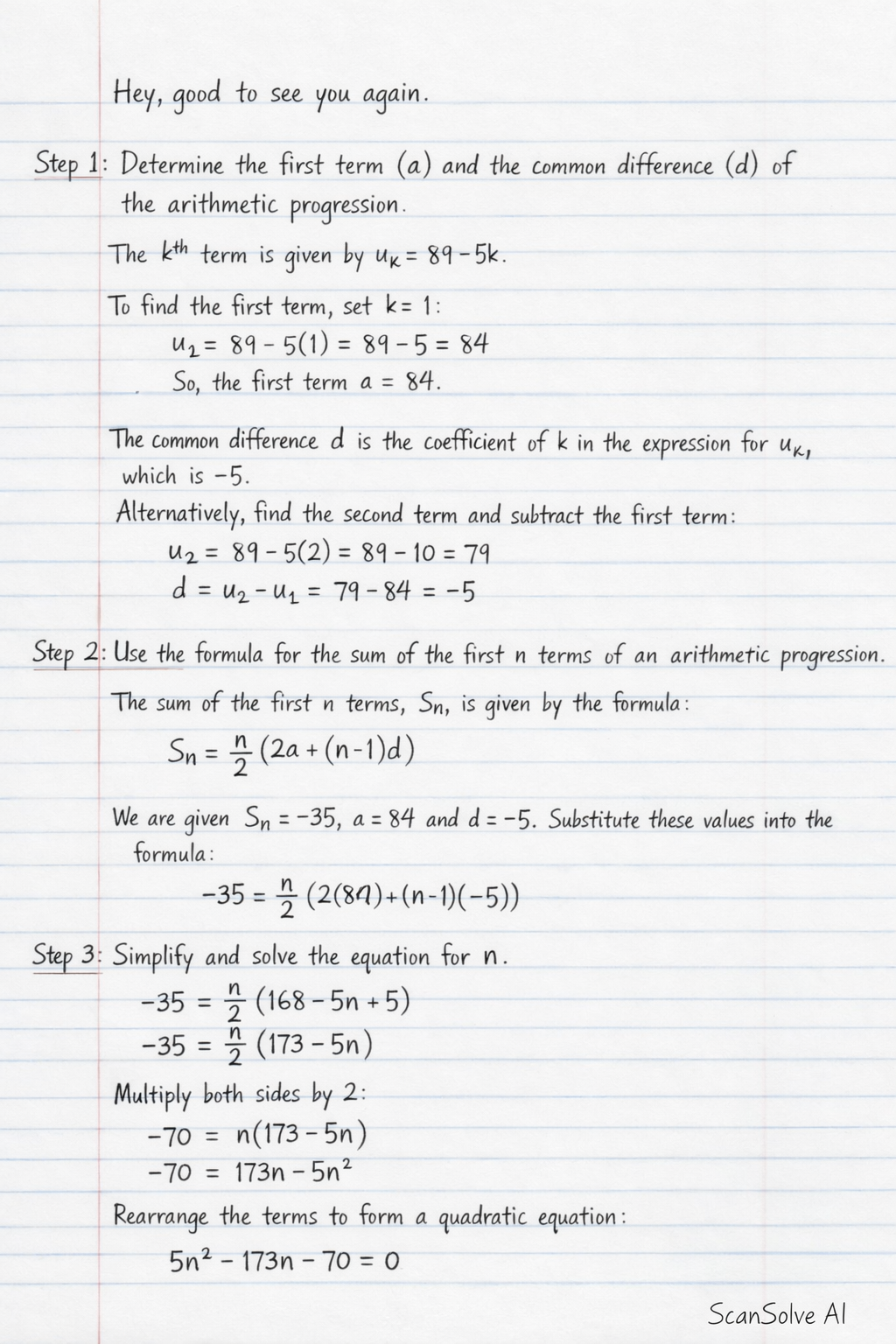
Hey, good to see you again. Step 1: Determine the first term (a) and the common difference (d) of the arithmetic progression. The kth term is given by u_k = 89 - 5k. To find the first term, set k=1: u_1 = 89 - 5(1) = 89 - 5 = 84 So, the first term a = 84. The common difference d is the coefficient of k in the expression for u_k, which is -5. Alternatively, find the second term and subtract the first term: u_2 = 89 - 5(2) = 89 - 10 = 79 d = u_2 - u_1 = 79 - 84 = -5 Step 2: Use the formula for the sum of the first n terms of an arithmetic progression. The sum of the first n terms, S_n, is given by the formula: S_n = (n)/(2)(2a + (n-1)d) We are given S_n = -35, a = 84, and d = -5. Substitute these values into the formula: -35 = (n)/(2)(2(84) + (n-1)(-5)) Step 3: Simplify and solve the equation for n. -35 = (n)/(2)(168 - 5n + 5) -35 = (n)/(2)(173 - 5n) Multiply both sides by 2: -70 = n(173 - 5n) -70 = 173n - 5n^2 Rearrange the terms to form a quadratic equation: 5n^2 - 173n - 70 = 0 Step 4: Solve the quadratic equation using the quadratic formula n = -B ± sqrt(B^2 - 4AC)2A. Here, A=5, B=-173, and C=-70. n = -(-173) ± sqrt((-173)^2 - 4(5)(-70))2(5) n = 173 ± sqrt(29929 + 1400)10 n = 173 ± sqrt(31329)10 Calculate the square root: sqrt(31329) = 177 Substitute this back into the equation for n: n = (173 ± 177)/(10) This gives two possible values for n: n_1 = (173 + 177)/(10) = (350)/(10) = 35 n_2 = (173 - 177)/(10) = (-4)/(10) = -0.4 Since n must be a positive integer representing the number of terms, we discard n = -0.4. The value of n is 35. Send me the next one 📸