
We read your photo as:
Solve the following: i) State the five (5) Laws of Indices ii) Simplify 2a + 5a x 3a - a
ScanSolve AI Answer
Step-by-step solution
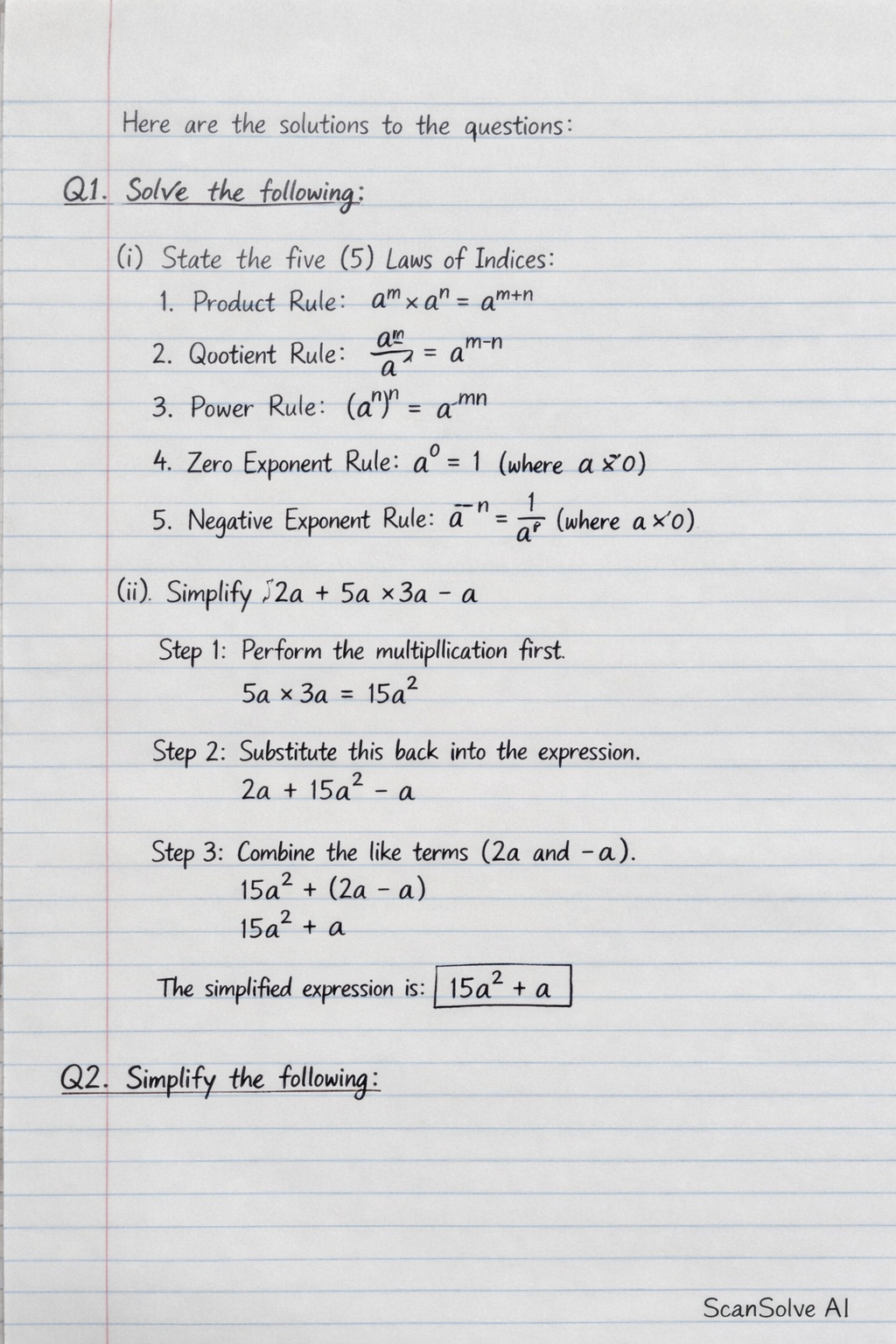
15 stepsHere are the solutions to the questions:
Q1. Solve the following:
-
i) State the five (5) Laws of Indices
- Product Rule:
- Quotient Rule:
- Power Rule:
- Zero Exponent Rule: (where )
- Negative Exponent Rule: (where )
-
ii) Simplify
Perform the multiplication first.
$$ 5a \times 3a = 15a^2 $$Substitute this back into the expression.
$$ 2a + 15a^2 - a $$Combine the like terms ( and ).
$$ 15a^2 + (2a - a) = 15a^2 + a $$ The simplified expression is $\boxed{15a^2 + a}$.Q2. Simplify the following:
- i) and evaluate when
Simplify the expression using the laws of indices.
For $a$: $\frac{a^3}{a^1} = a^{3-1} = a^2$ For $b$: $\frac{b^2}{b^1} = b^{2-1} = b^1 = b$ For $c$: $\frac{c^4}{c^{-2}} = c^{4 - (-2)} = c^{4+2} = c^6$ The simplified expression is $a^2 b c^6$.Substitute the given values into the simplified expression.
$$ (3)^2 \times \left(\frac{1}{8}\right) \times (2)^6 $$Calculate the powers.
$$ 3^2 = 9 $$ $$ 2^6 = 64 $$Perform the multiplication.
$$ 9 \times \frac{1}{8} \times 64 $$ $$ 9 \times \frac{64}{8} $$ $$ 9 \times 8 $$ $$ 72 $$ The evaluated value is $\boxed{72}$.Q3. A deposit of N50 is made on the first day of each month in a saving account that pays 6% compounded monthly. What is the balance at the end of 2 years?
This is an annuity due problem.
- Monthly Payment (PMT) = N50
- Annual Interest Rate (r) = 6% = 0.06
- Number of compounding periods per year (n) = 12 (monthly)
- Time (t) = 2 years
- Total number of payments (N) =
- Monthly Interest Rate (i) =
The formula for the future value of an annuity due is:
Calculate .
Substitute the values into the formula.
Round to two decimal places for currency.
The balance at the end of 2 years is .
Q4. A painter is paid N4.20 per hour for a basic 36 hour week, and overtime is paid at one and a third times this rate. Determine how many hours the painter has to work in a week to earn N212.80.
Calculate the earnings for the basic 36 hours.
Basic hourly rate = N4.20
Basic earnings =Calculate the remaining amount the painter needs to earn.
Total desired earnings = N212.80
Remaining earnings = N212.80 - N151.20 = N61.60Calculate the overtime hourly rate.
Overtime rate factor =
Overtime hourly rate =Calculate the number of overtime hours required to earn the remaining amount.
Overtime hours =
Calculate the total hours the painter has to work.
Total hours = Basic hours + Overtime hours =
The painter has to work a total of .
Still stuck on this one?
Ask a follow-up, and the answer starts from this question.
More Mathematics Questions
Handwritten Step-by-Step Solution
Get this as a handwritten image on WhatsApp — like a tutor wrote it for you.
Try on WhatsApp