
We read your photo as:
Solve the following inequalities and illustrate the solution on a number line: 3x−5 > 10; 2(x+1) <= 3x-4
ScanSolve AI Answer
Step-by-step solution
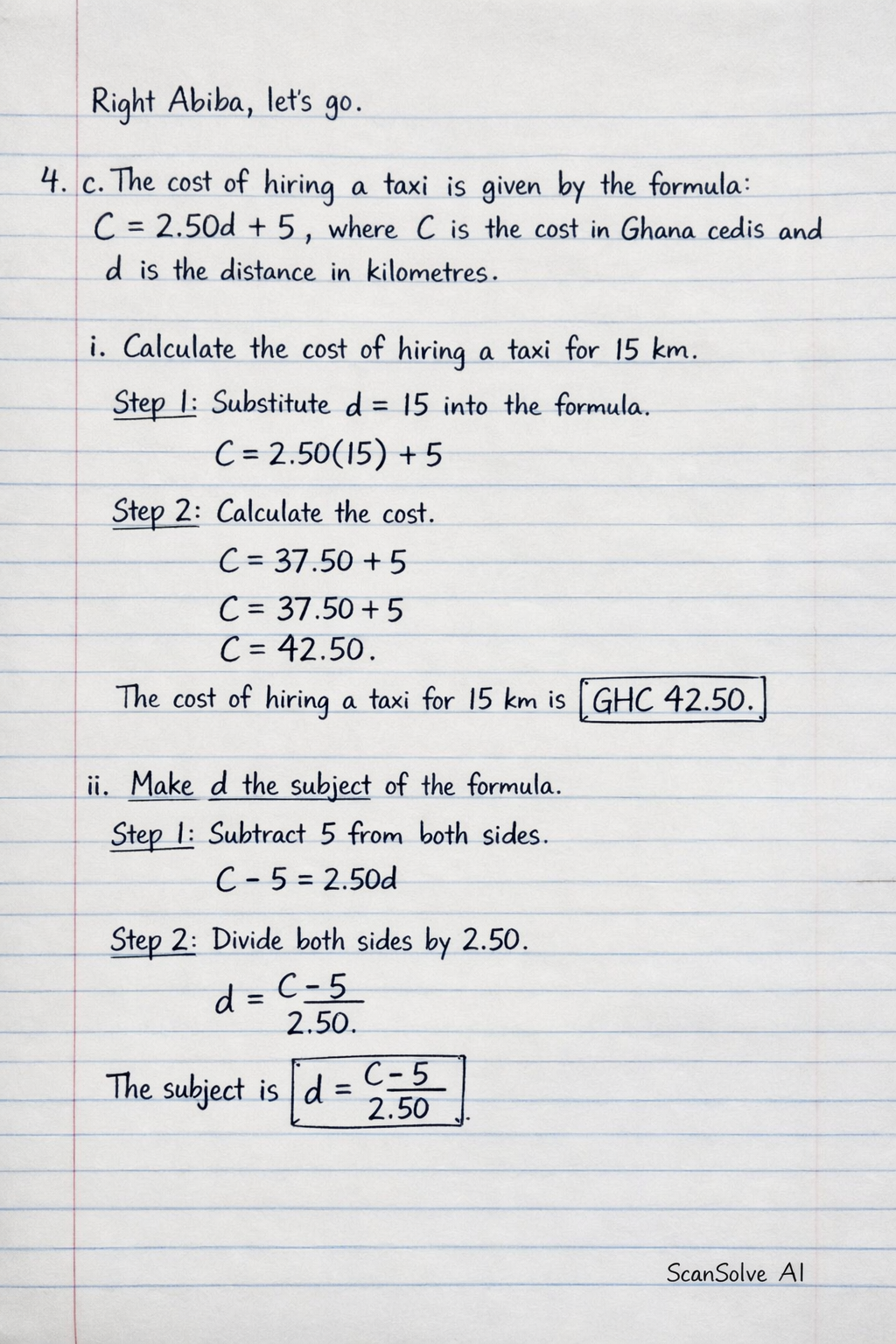
21 steps4. c. The cost of hiring a taxi is given by the formula: , where is the cost in Ghana cedis and is the distance in kilometres.
- i. Calculate the cost of hiring a taxi for 15 km. (2 marks)
Substitute into the formula.
$$ C = 2.50(15) + 5 $$Calculate the cost.
$$ C = 37.50 + 5 $$ $$ C = 42.50 $$ The cost of hiring a taxi for 15 km is $\boxed{\text{GHC } 42.50}$.- ii. Make the subject of the formula. (2 marks)
Subtract 5 from both sides of the equation.
$$ C - 5 = 2.50d $$Divide both sides by 2.50.
$$ d = \frac{C - 5}{2.50} $$ The subject is $\boxed{d = \frac{C - 5}{2.50}}$.- iii. Find the distance travelled if the cost was GHC 35. (2 marks)
Substitute into the formula.
$$ 35 = 2.50d + 5 $$Subtract 5 from both sides.
$$ 35 - 5 = 2.50d $$ $$ 30 = 2.50d $$Divide by 2.50.
$$ d = \frac{30}{2.50} $$ $$ d = 12 $$ The distance travelled is $\boxed{12 \text{ km}}$.5. a. Solve the following inequalities and illustrate the solution on a number line: (4 marks)
- i.
Add 5 to both sides.
$$ 3x > 10 + 5 $$ $$ 3x > 15 $$Divide by 3.
$$ x > \frac{15}{3} $$ $$ x > 5 $$ The solution is $\boxed{x > 5}$. **Illustration on a number line:** Draw a number line. Place an open circle at 5 and draw an arrow extending to the right.- ii.
Distribute the 2 on the left side.
$$ 2x + 2 \le 3x - 4 $$Subtract $2x$ from both sides.
$$ 2 \le 3x - 2x - 4 $$ $$ 2 \le x - 4 $$Add 4 to both sides.
$$ 2 + 4 \le x $$ $$ 6 \le x $$ This can also be written as $x \ge 6$. The solution is $\boxed{x \ge 6}$. **Illustration on a number line:** Draw a number line. Place a closed circle (or shaded dot) at 6 and draw an arrow extending to the right.5. b. A mobile phone company charges a base fee of GHC 10 per month plus GHC 0.50 per minute of calls.
-
i. Write an inequality to represent the monthly cost being less than GHC 50. (2 marks) Let be the number of minutes of calls. The total cost is . The inequality is .
-
ii. Solve the inequality to find the maximum number of minutes a customer can talk. (3 marks)
-
Subtract 10 from both sides.
$$ 0.50m < 50 - 10 $$ $$ 0.50m < 40 $$Divide by 0.50.
$$ m < \frac{40}{0.50} $$ $$ m < 80 $$ Since the number of minutes must be an integer, the maximum number of minutes a customer can talk is 79. The maximum number of minutes is $\boxed{79 \text{ minutes}}$.- iii. Interpret your answer in the context of the problem. (2 marks) To keep the monthly cost strictly below GHC 50, a customer must use less than 80 minutes of call time. Therefore, the maximum whole number of minutes they can talk is 79 minutes.
5. c. The sum of three consecutive integers is greater than 24 but less than or equal to 33.
-
i. Write an inequality to represent this situation. (2 marks) Let the first integer be . The three consecutive integers are , , and . Their sum is . The inequality is .
-
ii. Solve the inequality to find the possible values of the integers. (3 marks)
Solve the left part of the inequality
.
Solve the right part of the inequality
.
Combine the two inequalities.
$$ 7 < n \le 10 $$ Since $n$ must be an integer, the possible values for $n$ are $8, 9, 10$. The possible values for the first integer are $\boxed{8, 9, 10}$.- iii. List all possible sets of three consecutive integers that satisfy the condition. (2 marks)
- If , the integers are . (Sum = 27)
- If , the integers are . (Sum = 30)
- If , the integers are . (Sum = 33) The possible sets of integers are .
6. a. Find the gradient of the straight line joining the following pairs of points: (4 marks)
The formula for the gradient between two points and is .
- i. P(2, 3) and Q(5, 9)
- iii. List all possible sets of three consecutive integers that satisfy the condition. (2 marks)
Identify the coordinates.
.
Substitute the values into the gradient formula.
$$ m = \frac{9 - 3}{5 - 2} $$ $$ m = \frac{6}{3} $$ $$ m = 2 $$ The gradient is $\boxed{2}$.- ii. A(-1, 4) and B(3, -4)
Identify the coordinates.
.
Substitute the values into the gradient formula.
$$
m = \frac{-4 - 4}{3 - (-1)}
$$
$$
m = \frac{-8}{3 + 1}
$$
$$
m = \frac{-8}{4}
$$
$$
m = -2
$$
The gradient is $\boxed{-2}$.
Still stuck on this one?
Ask a follow-up, and the answer starts from this question.
More Mathematics Questions
Handwritten Step-by-Step Solution
Get this as a handwritten image on WhatsApp — like a tutor wrote it for you.
Try on WhatsApp