We read your photo as:

Solve the following limit problems: Problem 1: lim x→0 (sqrt(x2+9)-3)/x2. Problem 2: lim x→1 (e^(x-1)-x)/(x-1)2.

Mathematics

ScanSolve AI Answer

Answer

16\frac{1}{6}

12\frac{1}{2}

4

Step-by-step solution

13 steps

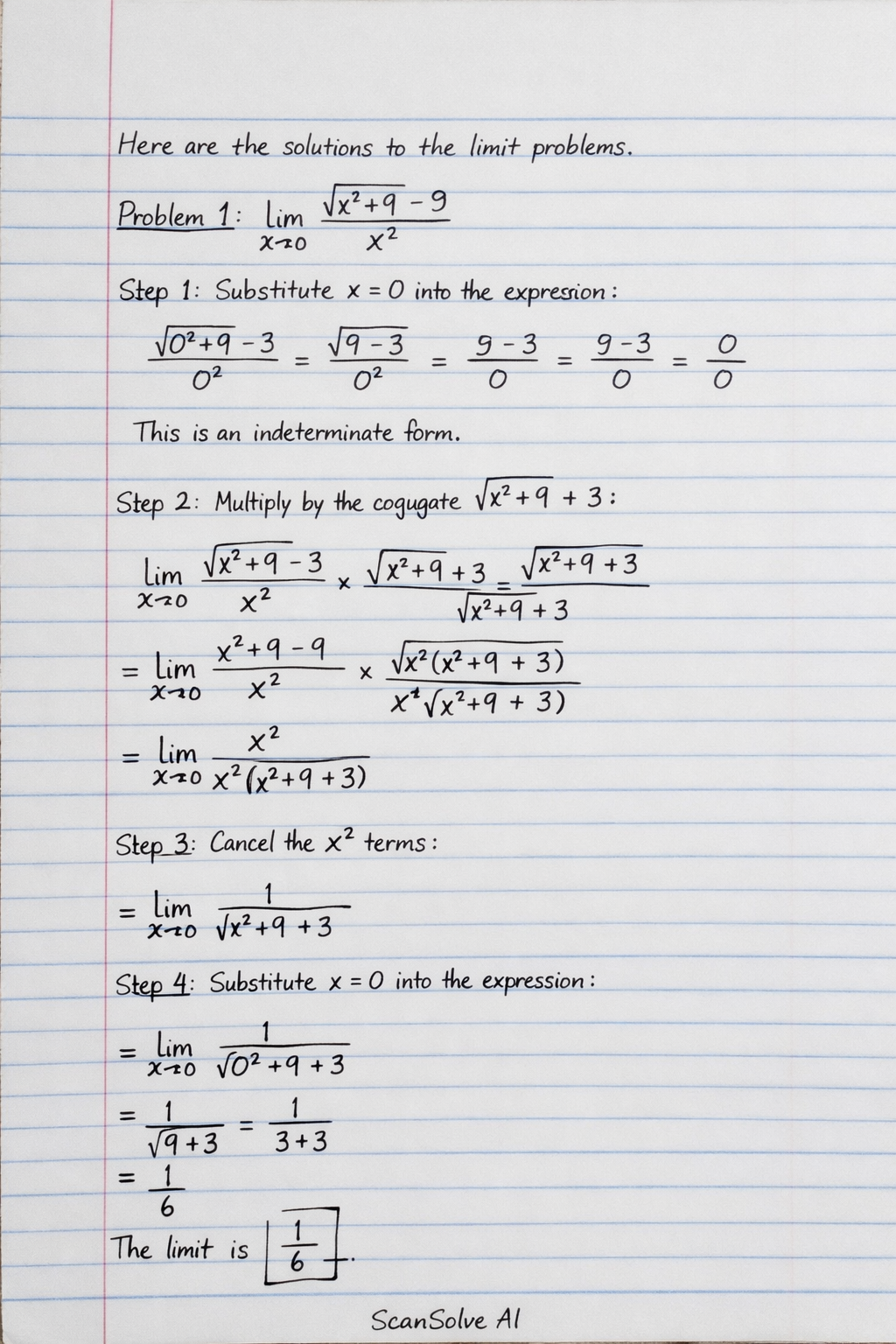
Here are the solutions to the limit problems.

:

lim⁡x→0x2+9−3x2\lim_{x \to 0} \frac{\sqrt{x^2+9}-3}{x^2}
  1. Substitute x=0x=0 into the expression.

    02+9−302=9−30=3−30=00\frac{\sqrt{0^2+9}-3}{0^2} = \frac{\sqrt{9}-3}{0} = \frac{3-3}{0} = \frac{0}{0}

    This is an indeterminate form.

  2. Multiply the numerator and denominator by the conjugate of the numerator, which is x2+9+3\sqrt{x^2+9}+3.

    lim⁡x→0x2+9−3x2×x2+9+3x2+9+3\lim_{x \to 0} \frac{\sqrt{x^2+9}-3}{x^2} \times \frac{\sqrt{x^2+9}+3}{\sqrt{x^2+9}+3} =lim⁡x→0(x2+9)2−32x2(x2+9+3)= \lim_{x \to 0} \frac{(\sqrt{x^2+9})^2 - 3^2}{x^2(\sqrt{x^2+9}+3)} =lim⁡x→0x2+9−9x2(x2+9+3)= \lim_{x \to 0} \frac{x^2+9-9}{x^2(\sqrt{x^2+9}+3)} =lim⁡x→0x2x2(x2+9+3)= \lim_{x \to 0} \frac{x^2}{x^2(\sqrt{x^2+9}+3)}
  3. Cancel out the x2x^2 term from the numerator and denominator.

    =lim⁡x→01x2+9+3= \lim_{x \to 0} \frac{1}{\sqrt{x^2+9}+3}
  4. Substitute x=0x=0 into the simplified expression.

    =102+9+3=19+3=13+3=16= \frac{1}{\sqrt{0^2+9}+3} = \frac{1}{\sqrt{9}+3} = \frac{1}{3+3} = \frac{1}{6}

    The limit is 16\boxed{\frac{1}{6}}.

    :

    lim⁡x→1ex−1−x(x−1)2\lim_{x \to 1} \frac{e^{x-1}-x}{(x-1)^2}
  5. Substitute x=1x=1 into the expression.

    e1−1−1(1−1)2=e0−102=1−10=00\frac{e^{1-1}-1}{(1-1)^2} = \frac{e^0-1}{0^2} = \frac{1-1}{0} = \frac{0}{0}

    This is an indeterminate form, so we apply L'Hôpital's Rule.

  6. Apply L'Hôpital's Rule by taking the derivative of the numerator and the denominator.

    Let f(x)=ex−1−xf(x) = e^{x-1}-x and g(x)=(x−1)2g(x) = (x-1)^2.
    f′(x)=ddx(ex−1−x)=ex−1−1f'(x) = \frac{d}{dx}(e^{x-1}-x) = e^{x-1}-1
    g′(x)=ddx((x−1)2)=2(x−1)g'(x) = \frac{d}{dx}((x-1)^2) = 2(x-1)

    lim⁡x→1ex−1−12(x−1)\lim_{x \to 1} \frac{e^{x-1}-1}{2(x-1)}
  7. Substitute x=1x=1 again.

    e1−1−12(1−1)=e0−10=1−10=00\frac{e^{1-1}-1}{2(1-1)} = \frac{e^0-1}{0} = \frac{1-1}{0} = \frac{0}{0}

    This is still an indeterminate form, so we apply L'Hôpital's Rule again.

  8. Apply L'Hôpital's Rule a second time.

    Let f2(x)=ex−1−1f_2(x) = e^{x-1}-1 and g2(x)=2(x−1)g_2(x) = 2(x-1).
    f2′(x)=ddx(ex−1−1)=ex−1f_2'(x) = \frac{d}{dx}(e^{x-1}-1) = e^{x-1}
    g2′(x)=ddx(2(x−1))=2g_2'(x) = \frac{d}{dx}(2(x-1)) = 2

    lim⁡x→1ex−12\lim_{x \to 1} \frac{e^{x-1}}{2}
  9. Substitute x=1x=1 into the expression.

    =e1−12=e02=12= \frac{e^{1-1}}{2} = \frac{e^0}{2} = \frac{1}{2}

    The limit is 12\boxed{\frac{1}{2}}.

    :

    lim⁡x→4x−4x−2\lim_{x \to 4} \frac{x-4}{\sqrt{x}-2}
  10. Substitute x=4x=4 into the expression.

    4−44−2=02−2=00\frac{4-4}{\sqrt{4}-2} = \frac{0}{2-2} = \frac{0}{0}

    This is an indeterminate form.

  11. Factor the numerator using the difference of squares formula, a2−b2=(a−b)(a+b)a^2-b^2 = (a-b)(a+b).

    We can write x−4x-4 as (x)2−22(\sqrt{x})^2 - 2^2.

    x−4=(x−2)(x+2)x-4 = (\sqrt{x}-2)(\sqrt{x}+2)

    Substitute this back into the limit expression:

    lim⁡x→4(x−2)(x+2)x−2\lim_{x \to 4} \frac{(\sqrt{x}-2)(\sqrt{x}+2)}{\sqrt{x}-2}
  12. Cancel out the common term (x−2)(\sqrt{x}-2) from the numerator and denominator.

    =lim⁡x→4(x+2)= \lim_{x \to 4} (\sqrt{x}+2)
  13. Substitute x=4x=4 into the simplified expression.

    =4+2=2+2=4= \sqrt{4}+2 = 2+2 = 4

    The limit is 4\boxed{4}.

Was this helpful?

Try one yourself

A new problem that tests the same skill.

Still stuck on this one?

Ask a follow-up, and the answer starts from this question.

Got a different question?Ask your own question
Handwritten step-by-step solution preview

Handwritten Step-by-Step Solution

Get this as a handwritten image on WhatsApp — like a tutor wrote it for you.

Try on WhatsApp