
We read your photo as:
Solve the following mental maths problems: 1. \(sqrt(169) - sqrt(36)\) 2. \(2 x 3 x 5\) 3. \(10\% of 8000\) 4. \((15 - sqrt(25))2\) 5. \(3 x (18 + 27)\) 6. \(-19 x 0\) 7. \((60 + 132) / 12\) 8. \(6 x
ScanSolve AI Answer
Step-by-step solution
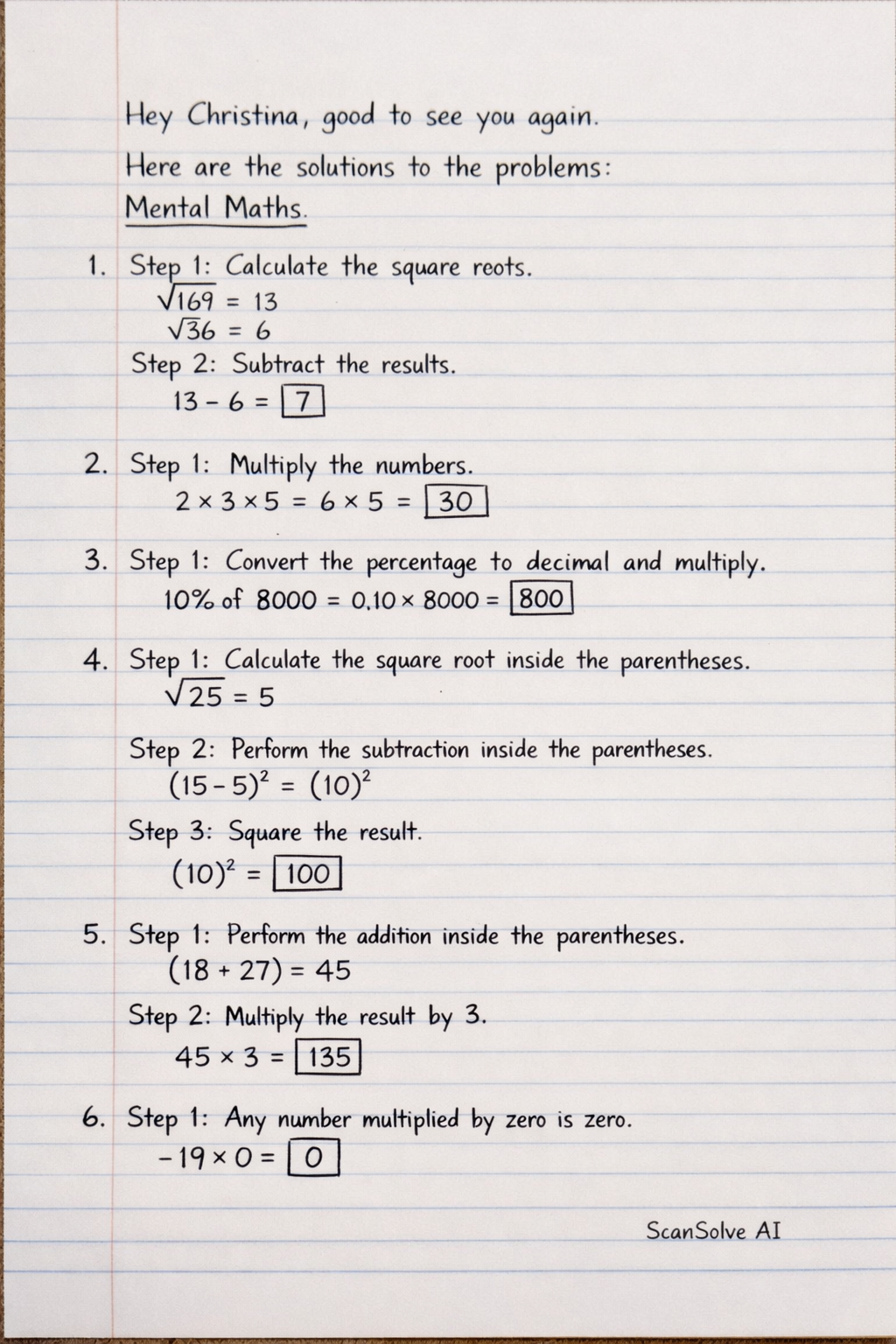
9 stepsHere are the solutions to the problems:
Mental Maths
-
Step 1: Calculate the square roots.
Step 2: Subtract the results.
-
Step 1: Multiply the numbers.
-
Step 1: Convert the percentage to a decimal and multiply.
-
Step 1: Calculate the square root inside the parentheses.
Step 2: Perform the subtraction inside the parentheses.
Step 3: Square the result.
-
Step 1: Perform the addition inside the parentheses.
Step 2: Multiply the result by 3.
-
Step 1: Any number multiplied by zero is zero.
-
Step 1: Perform the addition inside the parentheses.
Step 2: Divide the result by 12.
-
Step 1: Perform the multiplication first (order of operations).
Step 2: Add 1 to the result.
-
Step 1: Perform the multiplication first (order of operations).
Step 2: Perform the subtractions from left to right.
-
Step 1: Perform the addition inside the parentheses.
Step 2: Divide the result by 5.
Classwork
- Use commutative property to prove the following: The commutative property of addition states that for any two numbers and , .
Part a· 3 steps
Evaluate the Left Hand Side (LHS).
$$ 3 + (-7) = 3 - 7 = -4 $$Evaluate the Right Hand Side (RHS).
$$ (-7) + 3 = -4 $$Compare LHS and RHS.
Since $-4 = -4$, the statement is proven.
Part b· 3 steps
Evaluate the LHS.
$$ (-9) + (-6) + 12 = -9 - 6 + 12 = -15 + 12 = -3 $$Evaluate the RHS.
$$ 12 + (-6) + (-9) = 12 - 6 - 9 = 6 - 9 = -3 $$Compare LHS and RHS.
Since $-3 = -3$, the statement is proven.
Part c· 3 steps
The commutative property applies to addition. Let's rewrite the terms as additions:
LHS: $21 + (-5) + (-8)$
RHS: $21 + 8 + 5$
Evaluate the LHS.
$$ 21 - (+5) + (-8) = 21 - 5 - 8 = 16 - 8 = 8 $$Evaluate the RHS.
$$ 21 - (-8) + (+5) = 21 + 8 + 5 = 29 + 5 = 34 $$Compare LHS and RHS.
Since $8 \neq 34$, the given statement is **incorrect** as written.
However, if the intention was to show the commutative property for addition, it would be:
$21 + (-5) + (-8) = 21 + (-8) + (-5)$
Let's verify this correct application of the commutative property:
LHS: $21 + (-5) + (-8) = 21 - 5 - 8 = 8$
RHS: $21 + (-8) + (-5) = 21 - 8 - 5
Still stuck on this one?
Ask a follow-up, and the answer starts from this question.
More Mathematics Questions
Handwritten Step-by-Step Solution
Get this as a handwritten image on WhatsApp — like a tutor wrote it for you.
Try on WhatsApp