
![Solve the following problems: 1. Calculate 0.018 of 200,000 frs. 2. Which is smaller, 1/4 or 7/8? Find their difference. 3. If X=5 and Y=3 1/2, calculate X-Y. 4. [Incomplete problem description]](/_next/image?url=https%3A%2F%2Fohijasnjvprzodcmxltt.supabase.co%2Fstorage%2Fv1%2Fobject%2Fpublic%2Fwhatsapp-images%2F1776781453913-5828a44782b0358d.png&w=3840&q=75)
This mathematics problem involves applying core mathematical principles and formulas. Below you will find a complete step-by-step solution with detailed explanations for each step, helping you understand not just the answer but the method behind it.
ScanSolve AI Answer
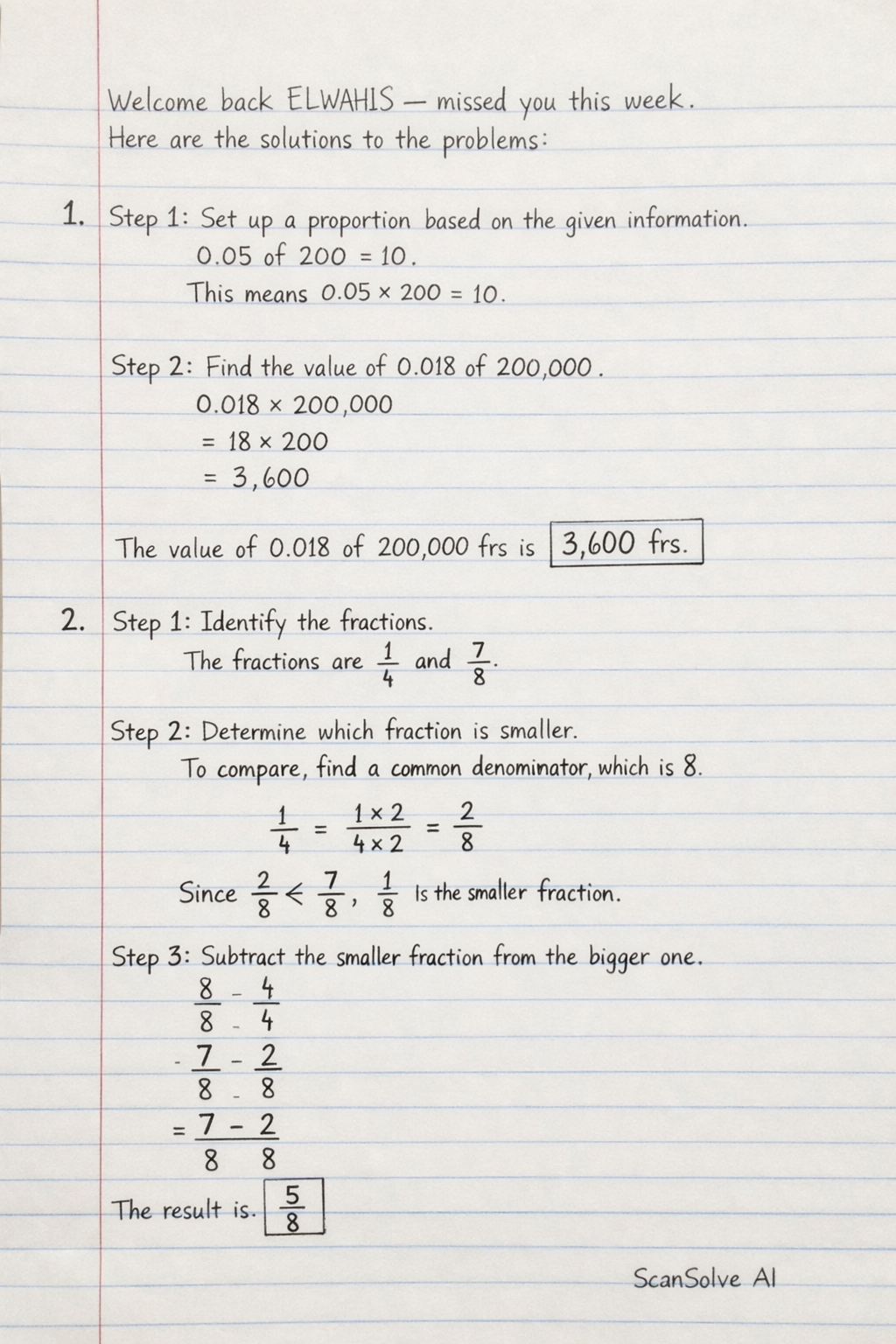
Welcome back ELWAHIS — missed you this week. Here are the solutions to the problems: 1. Step 1: Set up a proportion based on the given information. 0.05 of 200 = 10 This means 0.05 × 200 = 10. Step 2: Find the value of 0.018 of 200,000. 0.018 × 200,000 = 18 × 200 = 3,600 The value of 0.018 of 200,000 frs is 3,600 frs. 2. Step 1: Identify the fractions. The fractions are (1)/(4) and (7)/(8). Step 2: Determine which fraction is smaller. To compare, find a common denominator, which is 8. (1)/(4) = (1 × 2)/(4 × 2) = (2)/(8) Since (2)/(8) < (7)/(8), (1)/(4) is the smaller fraction. Step 3: Subtract the smaller fraction from the bigger one. (7)/(8) - (1)/(4) = (7)/(8) - (2)/(8) = (7 - 2)/(8) = (5)/(8) The result is (5)/(8). 3. Step 1: Write down the given values for X and Y. X = 5 Y = 3(1)/(2) Step 2: Convert Y to an improper fraction. Y = 3(1)/(2) = ((3 × 2) + 1)/(2) = (6 + 1)/(2) = (7)/(2) Step 3: Simplify X - Y. X - Y = 5 - (7)/(2) Step 4: Find a common denominator to subtract. 5 = (5 × 2)/(2) = (10)/(2) X - Y = (10)/(2) - (7)/(2) = (10 - 7)/(2) = (3)/(2) The simplified value of X - Y is (3)/(2). 4. Step 1: List the given decimal fractions. 0.045, 0.371, 0.375 Step 2: Arrange them in ascending order of magnitude. Compare the numbers digit by digit from left to right. 0.045 is the smallest because it has a 0 in the tenths place. Between 0.371 and 0.375, compare the thousandths place. 1 < 5. So, 0.371 is smaller than 0.375. The ascending order is 0.045, 0.371, 0.375. 5. Step 1: Identify the average weight and the number of pigs. Average weight of 7 pigs = 35 kg. Number of pigs = 7. Step 2: Calculate the total weight. Total weight = Average weight × Number of pigs = 35 kg × 7 = 245 kg The total weight is 245 kg. 6. Step 1: Determine the rate of time loss. A wall clock loses 2 minutes every three hours. Step 2: Calculate how many 3-hour intervals are in 15 hours. Number of intervals = 15 hours3 hours/interval = 5 intervals Step 3: Calculate the total time lost. Total time lost = Loss per interval × Number of intervals = 2 minutes/interval × 5 intervals = 10 minutes The clock loses 10 minutes in 15 hours. 7. Step 1: Identify the decimals. The decimals are 0.124 and 2.5. Step 2: Determine which decimal is smaller. 0.124 is smaller than 2.5. Step 3: Subtract the smaller decimal from the bigger one. 2.5 - 0.124 To subtract, align the decimal points and add trailing zeros to 2.5: 2.500 -0.124 ----- 2.376 The result is 2.376. 8. Step 1: Identify the cost of seven books. Seven books cost 2100 frs. Step 2: Calculate the cost of one book. Cost per book = 2100 frs7 books = 300 frs/book Step 3: Calculate the number of books that can be bought with 900 frs. Number of books = Total moneyCost per book = 900 frs300 frs/book = 3 books The number of books that can be bought is 3. 9. Step 1: Recall the conversion factor between grams and kilograms. 1 kg = 1000 g Step 2: Convert 5400 g to kilograms. 5400 g = (5400)/(1000) kg = 5.4 kg 5400 g is equal to 5.4 kg. 10. Step 1: List the elements of sets A and B. A = \3, 6, 9, 12\ B = \6, 8, 10, 12\ Step 2: Find the intersection of A and B, denoted as A B. The intersection consists of elements that are common to both sets. Common elements are 6 and 12. A B = \6, 12\ The intersection is \6, 12\. 11. Step 1: Identify the numbers to be added in base 7. 344_7 + 235_7 Step 2: Add the numbers column by column from right to left, remembering that in base 7, digits range from 0 to 6. If a sum is 7 or more, divide by 7 to get the carry and the digit. Units column: 4 + 5 = 9. 9 ÷ 7 = 1 remainder 2. Write down 2, carry over 1. Sevens column: 4 + 3 + 1 (carry) = 8. 8 ÷ 7 = 1 remainder 1. Write down 1, carry over 1. Forty-nines column: 3 + 2 + 1 (carry) = 6. 6 ÷ 7 = 0 remainder 6. Write down 6. The sum is 612_7. 12. Step 1: Identify the initial amount and the ratio. Initial amount = 600 frs. Ratio for increase = 5:4. This means the new amount is (5)/(4) of the original amount. Step 2: Calculate the increased amount. Increased amount = Original amount × (5)/(4) = 600 frs × (5)/(4) = (600 × 5)/(4) = 150 × 5 = 750 frs The increased amount is 750 frs. 13. Step 1: Write the given equation. (2)/(3) = (n)/(18) Step 2: Solve for n by cross-multiplication. 2 × 18 = 3 × n 36 = 3n Step 3: Divide by 3 to find n. n = (36)/(3) n = 12 The value of n is 12. 14. Step 1: Identify the given series. 2, 5, 8, Step 2: Determine the pattern. Find the difference between consecutive terms: 5 - 2 = 3 8 - 5 = 3 The pattern is an arithmetic progression with a common difference of 3. Step 3: Find the next number in the series. Add 3 to the last given term: 8 + 3 = 11 The next number in the series is 11. 15. Step 1: List the numbers. 3, 8, 24, 1 Step 2: Calculate the sum of these numbers. Sum = 3 + 8 + 24 + 1 = 36. The question states "The sum of 3, 8, 24 and 1 is 36." This confirms our sum. Step 3: Count the number of values. There are 4 numbers. Step 4: Calculate the average. Average = Sum of numbersNumber of values = (36)/(4) = 9 The average of these numbers is 9. Send me the next one 📸