
We read your photo as:
Solve the following problems: 1. If 540 oranges are divided equally among 10 pupils, how many oranges does each pupil get? 2. How many times is 14 contained in 3500? 3. Change the following mixed numb
ScanSolve AI Answer
Step-by-step solution
20 stepsHere are the solutions to your homework questions:
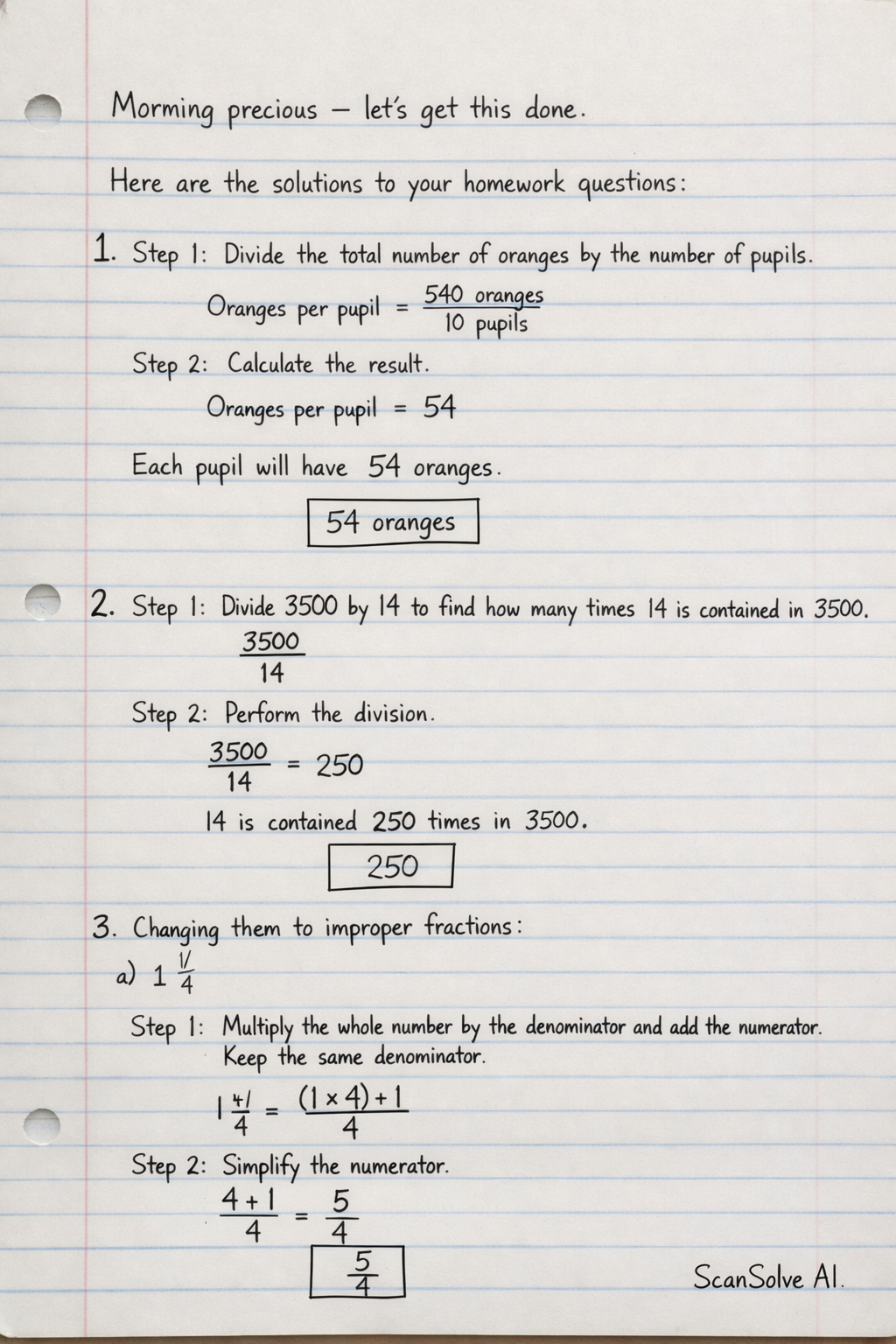
1.
Step 1: Divide the total number of oranges by the number of pupils.
Step 2: Calculate the result.
Each pupil will have 54 oranges.
2.
Step 1: Divide 3500 by 14 to find how many times 14 is contained in 3500.
Step 2: Perform the division.
14 is contained 250 times in 3500.
3. Changing them to improper fractions:
Part a· 2 steps
Multiply the whole number by the denominator and add the numerator.
Keep the same denominator.
Simplify the numerator.
Part b· 3 steps
Multiply the whole number by the denominator and add the numerator.
Keep the same denominator.
Simplify the numerator.
Simplify the fraction by dividing both numerator and denominator by their greatest common divisor, which is 3.
Part c· 2 steps
Multiply the whole number by the denominator and add the numerator.
Keep the same denominator.
Simplify the numerator.
Part d· 2 steps
Multiply the whole number by the denominator and add the numerator.
Keep the same denominator.
Simplify the numerator.
Part e· 11 steps
Multiply the whole number by the denominator and add the numerator.
Keep the same denominator.
Simplify the numerator.
4.
This is an inverse proportion problem: more time means fewer pupils are needed.Set up the inverse proportion relationship
.
Calculate the total "pupil-hours" of work.
Solve for .
Since you can't have half a pupil, and you need enough pupils to eat the food, you would need 14 pupils. (If the question implies minimum whole pupils, it's 14. If it implies exact rate, it's 13.5. Assuming practical application, round up).
5.
This is an inverse proportion problem: fewer days mean more men are needed.Set up the inverse proportion relationship
.
Calculate the total "man-days" of work.
Solve for .
20 men can build the shed in 3 days.
6.
This is a direct proportion problem: if the distance doubles, the time taken will also double at the same rate.Identify the given information.
Notice that is twice .
Since the rate is the same, will also be twice .
It will take 30 hours to travel 100 kilometres.
Still stuck on this one?
Ask a follow-up, and the answer starts from this question.
More Mathematics Questions
Handwritten Step-by-Step Solution
Get this as a handwritten image on WhatsApp — like a tutor wrote it for you.
Try on WhatsApp