
We read your photo as:
Solve the following systems of simultaneous equations.
ScanSolve AI Answer
This answer stops before the end.
It was cut off when it was first written. Ask ScanSolve this question again for the full working.
Here are the solutions to the problems:
1. Solve the system of the simultaneous equations
-
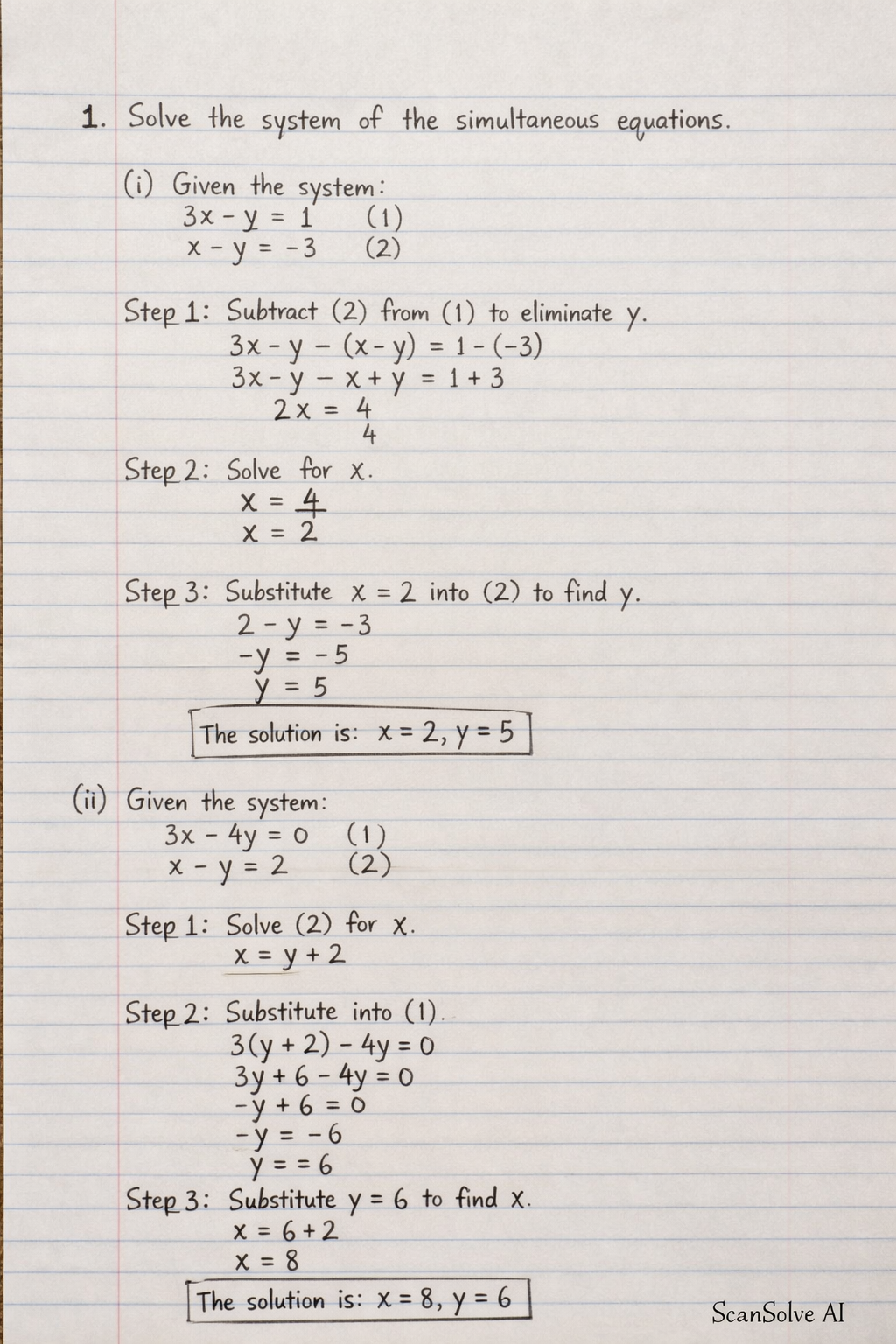
i. Given the system:
Step 1: Subtract equation (2) from equation (1) to eliminate .
Step 2: Solve for .
Step 3: Substitute into equation (2) to find .
The solution is .
-
ii. Given the system:
Step 1: From equation (2), express in terms of .
Step 2: Substitute this expression for into equation (1).
Step 3: Substitute back into the expression for .
The solution is .
-
iii. Given the system:
Step 1: Substitute the expression for from equation (1) into equation (2).
Step 2: Combine the terms.
Step 3: Add 12 to both sides.
Step 4: Multiply by to solve for .
Step 5: Substitute back into equation (1) to find .
The solution is .
2. Solve the inequalities
-
i.
Step 1: Distribute .
Step 2: Find a common denominator for the terms (LCM of 3 and 2 is 6).
Step 3: Subtract from both sides.
Step 4: Multiply both sides by -6 and reverse the inequality sign.
The solution is .
-
ii.
Step 1: Subtract 1 from both sides.
Step 2: Find a common denominator.
Step 3: Find critical points by setting the numerator and denominator to zero. Numerator: Denominator:
Step 4: Test intervals , , and .
- For (e.g., ): . This interval is part of the solution.
- For (e.g., ): . This interval is not part of the solution.
- For (e.g., ): . This interval is part of the solution. Note that is excluded because it makes the denominator zero. is included because the inequality is . The solution is .
-
iii.
Step 1: Subtract from both sides.
Step 2: Multiply both sides by .
The solution is .
-
iv.
Step 1: Multiply both sides by 2 to clear the fraction.
Step 2: Subtract from both sides.
Step 3: Add 4 to both sides.
Step 4: Divide by 3.
The solution is .
-
v.
Step 1: Subtract from both sides.
Step 2: Add 2 to both sides.
Step 3: Divide by 2.
The solution is .
-
vi.
Step 1: Add 7 to both sides.
The solution is .
3. Solve for x
-
i.
Step 1: Add to both sides.
Step 2: Cross-multiply.
Step 3: Subtract from both sides.
Step 4: Add 8 to both sides.
Check for restrictions: and . Our solution is valid. The solution is .
-
ii.
Step 1: Find a common denominator for all terms (LCM of 9 and 3 is 9).
Step 2: Multiply the entire equation by 9.
Step 3: Combine like terms.
Step 4: Add 5 to both sides.
Step 5: Divide by 21.
The solution is .
-
iii.
Step 1: Find a common denominator for the terms (LCM of 7 and 5 is 35).
Still stuck on this one?
Ask a follow-up, and the answer starts from this question.
More Mathematics Questions
Handwritten Step-by-Step Solution
Get this as a handwritten image on WhatsApp — like a tutor wrote it for you.
Try on WhatsApp