
We read your photo as:
Solve for d in the given triangle, where the angles are 90°, 45°, and d°.
ScanSolve AI Answer
Answer
Step-by-step solution
4 stepsIdentify the type of triangle and its properties.
The diagram shows a right-angled triangle, indicated by the square symbol, meaning one angle is . The two short sides (legs) of the triangle are marked with single dashes, which means they are equal in length. This indicates that the triangle is an isosceles right-angled triangle.
Determine the base angles of the isosceles triangle.
In an isosceles triangle, the angles opposite the equal sides are also equal. Since the two legs are equal, the two acute angles must be equal. Let the unknown angle be . Therefore, the other acute angle is also .
Apply the angle sum property of a triangle.
The sum of the interior angles in any triangle is .
So, we can write the equation:Solve for .
Subtract from both sides:
Divide by 2:
Your calculation is correct. The value of is .
Try one yourself
A new problem that tests the same skill.
Still stuck on this one?
Ask a follow-up, and the answer starts from this question.
More Mathematics Questions
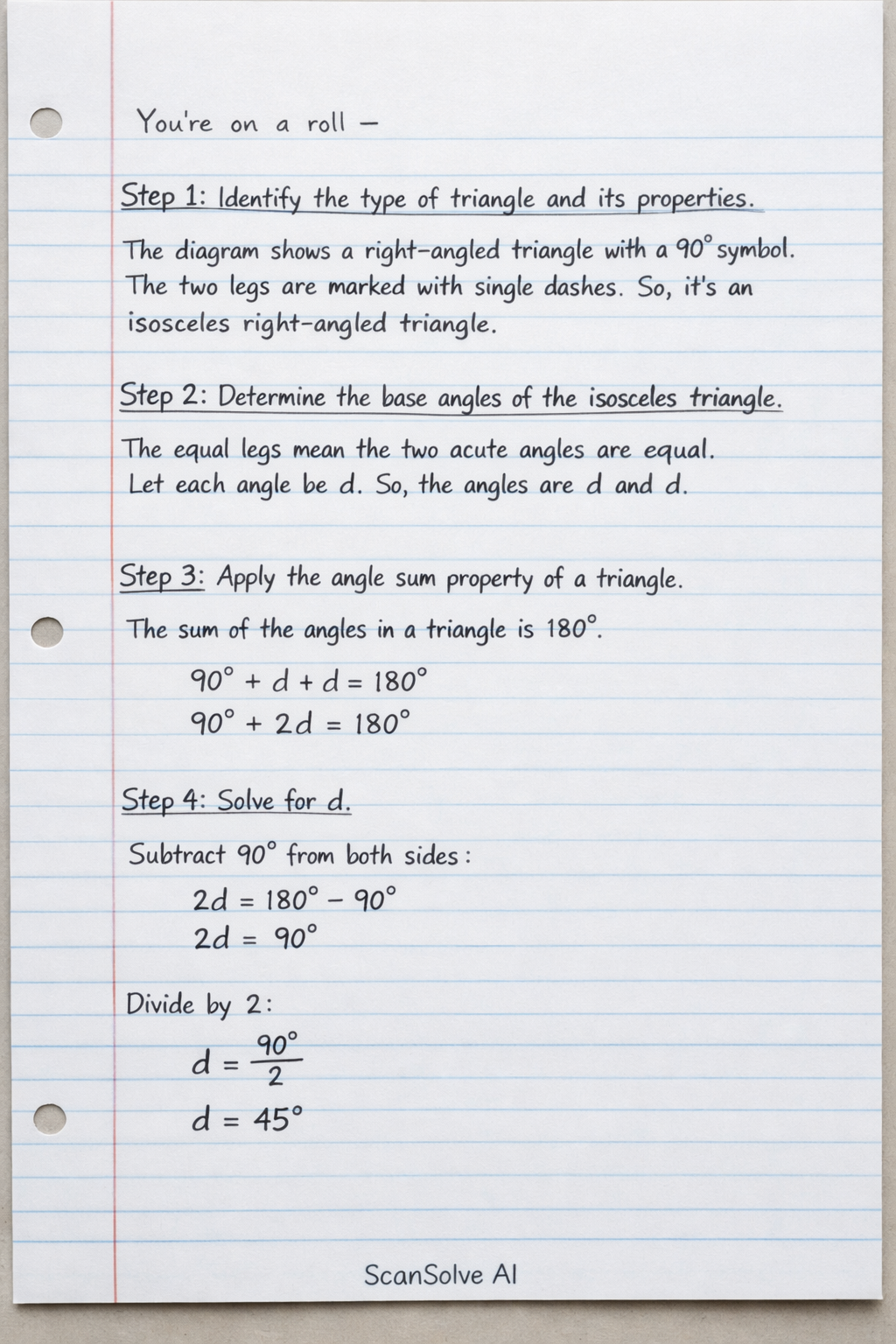
Handwritten Step-by-Step Solution
Get this as a handwritten image on WhatsApp — like a tutor wrote it for you.
Try on WhatsApp