
We read your photo as:
Solve for n: 1 - (1/3)ⁿ = 242/243. Simplify the expression: (y+1)(4k2-ky) / (y2+y-4ky-4k)e.
ScanSolve AI Answer
Answer
Step-by-step solution
11 stepsIsolate the term with .
The given equation is:
Subtract from 1:
Express the right side as a power of .
We need to find what power of 3 equals 243.
So, can be written as , which is equivalent to .Equate the exponents.
Since the bases are equal, the exponents must be equal:
The value of is .
Factor the numerator.
The numerator is .
Factor out from the second term :Factor the denominator.
The denominator is .
Group the terms in the parenthesis:Factor out :
Substitute the factored expressions back into the fraction.
Simplify the expression.
Notice that is the negative of , i.e., .
Substitute this into the expression:Assuming and , we can cancel out the common terms and :
The simplified expression is .
Define the two-digit number using its digits.
Let the two-digit number be , where is the tens digit and is the units digit.
must be an integer from 1 to 9.
must be an integer from 0 to 9.Use the first condition to form an equation.
"The product of the digits is 20."
Possible integer pairs that satisfy this condition are:
- If , then . The number is 45.
- If , then . The number is 54.
Use the second condition to form another equation.
"When the digits are reversed, the number so formed is greater than the original number by 9."
The reversed number is .Simplify the equation:
Divide by 9:
Check which of the possible numbers from Step 2 satisfies equation .
Case 1: For the number 45, and .
Substitute into :
This is true, so 45 is a valid number.Case 2: For the number 54, and .
Substitute into :
This is false, so 54 is not the number.The number is .
Try one yourself
A new problem that tests the same skill.
Still stuck on this one?
Ask a follow-up, and the answer starts from this question.
More Mathematics Questions
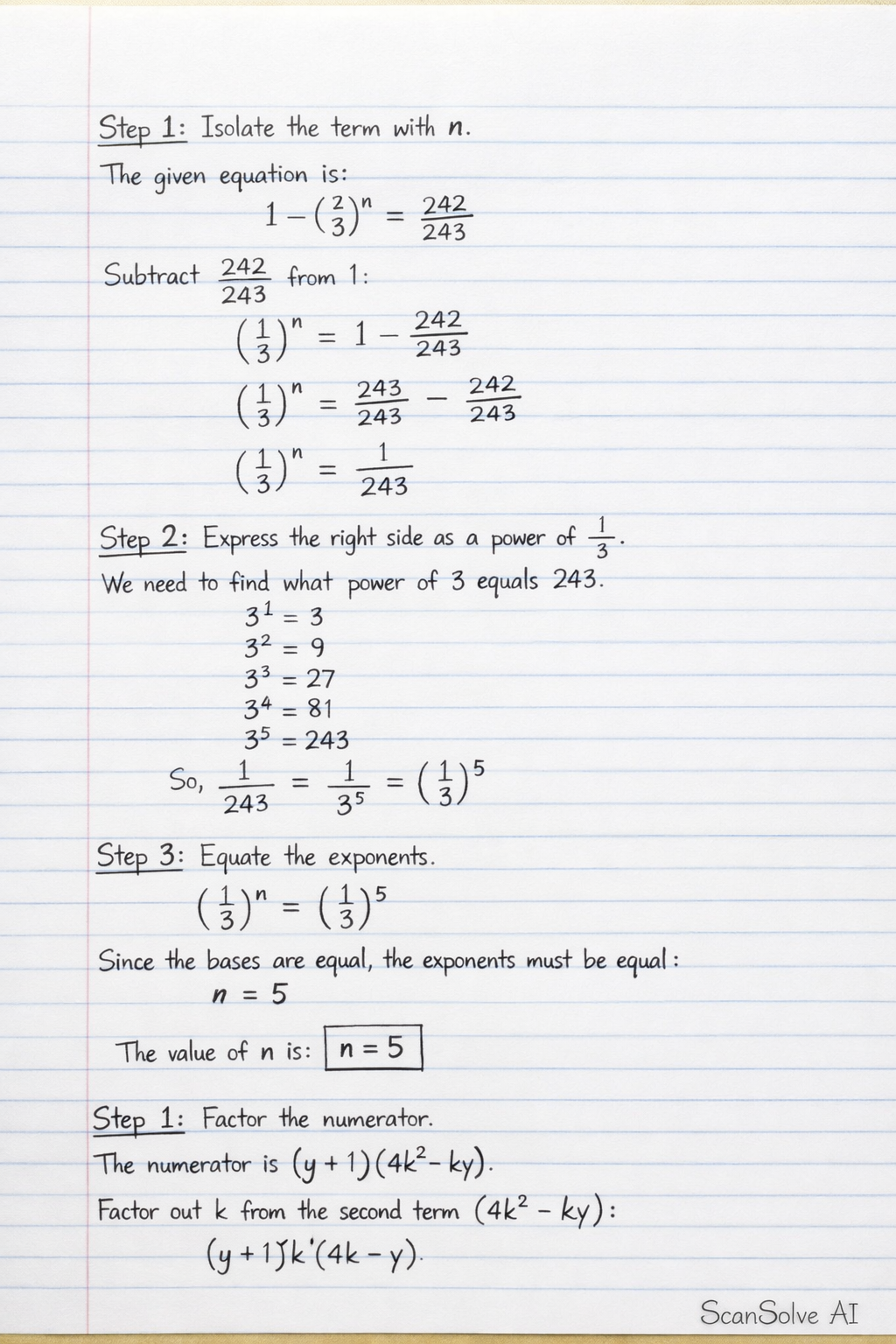
Handwritten Step-by-Step Solution
Get this as a handwritten image on WhatsApp — like a tutor wrote it for you.
Try on WhatsApp